[Asia Economy Reporters Moon Hyewon and Song Seungyun] Office worker A visited VIPS for lunch on a weekday with a colleague after a long time and was shocked by the significantly increased price list compared to before. During the social distancing period due to COVID-19, they refrained from dining out, but after nearly two years, the weekday lunch price of the salad bar, which was only in the high 10,000 won to low 20,000 won range, had jumped to the high 20,000 won range. A planned to reserve a room for a family event next month while visiting, but postponed the reservation and left due to the increasing burden of prices as the number of people increased.
As distribution companies have raised prices more than twice within half a year citing the rise in overall costs such as raw materials, labor, and logistics, consumers' burden from inflation is growing. Some resistance has emerged, including boycotts against certain franchise companies. Experts point out that during times of rising prices like now, companies should not focus solely on immediate profits but show a cooperative attitude toward consumers.
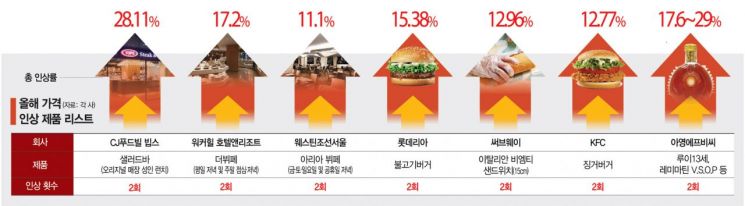
According to the industry on the 21st, CJ Foodville’s VIPS raised the salad bar price by an average of 6% for adults starting that day. For example, the adult lunch price at the ‘VIPS Original’ store increased by 3,000 won from 28,900 won to 31,900 won, and dinner and weekend prices rose by 2,000 won from 35,700 won to 37,900 won. VIPS had already raised salad bar prices by an average of 9.2% in April. The adult lunch price, which was 24,900 won earlier this year, rose to 28,900 won in April and then to 31,900 won three months later, a total increase of 7,000 won. The total increase rate reached 28.1%. CJ Foodville explained that this unavoidable decision was due to the sharp rise in domestic and international raw material prices, logistics, and processing costs. The food service industry, where food cost increases are significant, has seen a sharp rise in the number of price hikes.
Hotel buffet prices are also rising. Walkerhill Hotel & Resort’s ‘The Buffet’ raised buffet prices twice. At the beginning of the year, weekday dinner and weekend lunch and dinner prices increased from 122,000 won to 131,000 won, and on the 1st of last month, prices rose again to 143,000 won. The annual increase rate is about 17.2%. Westin Chosun Seoul’s ‘Aria’ also raised prices in January and again in July. Weekend and holiday dinner prices rose 7.4% from 135,000 won to 145,000 won in January, and 3.4% to 150,000 won in July. Lotteria raised prices of major menu items by 4.1% in December last year and again by an average of 5.5% on 81 items including burgers on the 16th of last month. The signature Bulgogi Burger rose from 3,900 won to 4,100 won (5.1%) in December and then to 4,500 won last month. The total increase over half a year reached 15.3%. Subway also raised prices twice this year. The Italian B.M.T. sandwich (15cm) rose from 5,400 won to 5,700 won (5.56%) in January and was further raised to 6,100 won from the 12th of this month. The total increase rate is 12.9%.
KFC raised some menu prices by 200 to 400 won from the 12th of this month, the first increase in half a year since January. The signature Zinger Burger rose from 4,700 won to 4,900 won (4.26%) in January and then to 5,300 won on the 12th, a total increase of 12.7% over the year. Coffee Bean Korea raised prices of 49 coffee and beverage items by 100 won in February and added another 100 to 300 won increase in May. The price of a small Americano rose from 4,800 won in February to 4,900 won and then to 5,000 won in May.
Among imported alcoholic beverages, cognac products have seen two price hikes this year. Alcohol importer AYFBC raised prices by up to 29% from the 1st of this month for Louis XIII, Remy Martin V.S.O.P, Remy Martin X.O, and Remy Martin 1738. Except for Remy Martin 1738, the other items had already been raised once in January. Prices have risen again in less than six months.
Prices of most food items including confectionery, bread, beverages, and alcohol have been rising since early this year, but with raw material and logistics costs continuing to increase, the factors driving price hikes remain piled up. Typically, price increases start with the industry leader, so the food and beverage industry is now watching closely regarding further hikes. If the atmosphere for re-increases forms, places that already raised prices earlier this year may raise product prices one after another in the second half.
In this regard, consumer groups and distribution experts point out that companies are inflating the burden of cost increases and shifting it mostly onto consumers. A representative from the Korea Consumer Organization Council said, "When raw material prices rise, companies pass the burden to consumers through price hikes, but when prices fall, they absorb the difference as corporate profit. This raises suspicion." They added, "As the government shows determination by announcing measures to stabilize living costs, companies should also strive for price stability by cooperating with consumers rather than raising prices."
Professor Kim Ikseong of Dongduk Women’s University, honorary president of the Korea Distribution Society, said, "Due to external wars, prices of raw materials and energy have all risen, so companies inevitably raised prices, and rising interest rates that fuel inflation have increased financial costs, making it difficult from a cost perspective." However, he advised, "At times like these when everyone is struggling, companies should show a cooperative attitude by enduring up to a point where profits and costs roughly balance."
© The Asia Business Daily(www.asiae.co.kr). All rights reserved.

















