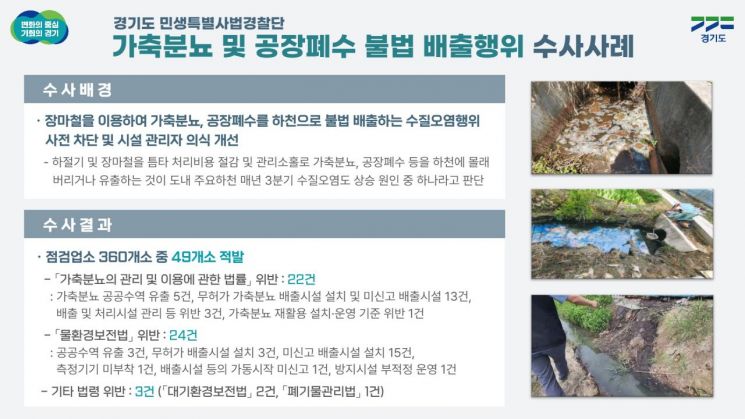
[Asia Economy (Suwon) = Reporter Lee Young-gyu] Gyeonggi Province has cracked down on numerous businesses that committed illegal acts such as dumping several tons of livestock manure into rivers or spreading liquid fertilizer in unregistered areas during the heavy rainy season.
The Gyeonggi Province Special Judicial Police for Public Welfare announced on the 21st that from the 7th to the 27th of last month, they inspected 360 major livestock manure and industrial wastewater discharge sites across 31 cities and counties in the province and found 49 businesses violating the Livestock Manure Act and the Water Environment Conservation Act.
Among the major cases, Farm A located in Anseong City was caught secretly installing a branch pipe in the livestock manure storage tank and discharging about 2.5 tons of livestock manure with a TOC (Total Organic Carbon) concentration 9.1 times (1,820 mg/L) higher than the discharge water quality standard (TOC 200 mg/L) into public waters. Farm B in Anseong City was found to have illegally spread about 2 tons of liquid fertilizer using transport vehicles from Company C in unregistered areas.
Laundry Factory D in Pocheon City was caught leaking about 50 liters of heavy oil into public waters through a nearby stormwater drain due to negligence in managing the valve of the heavy oil storage facility (professional negligence).
Under the current Livestock Manure Act, violations such as discharge into public waters and mismanagement of discharge and treatment facilities are punishable by imprisonment of up to 2 years or a fine of up to 20 million KRW. The Water Environment Conservation Act stipulates that professional negligence or gross negligence resulting in the discharge of heavy oil, a water pollutant, into public waters is punishable by imprisonment of up to 1 year or a fine of up to 10 million KRW.
Kim Min-kyung, head of the Gyeonggi Province Special Judicial Police for Public Welfare, stated, "Most livestock farms are small-scale, and there is a misconception that 'livestock manure is natural compost and therefore good,' which has led to improper management. We will encourage strengthening of internal environmental management and intensify crackdowns annually during vulnerable periods such as the rainy season to prevent water pollution."
© The Asia Business Daily(www.asiae.co.kr). All rights reserved.

















