[Debt Relief Controversy③]
Relief Rate 60~90%...Exceeding Existing Debt Adjustment Systems
Moral Hazard for Borrowers, Loss of Social Trust for the Public
"Possible with Existing Debt Adjustment Programs...May Even Need to Assist in Resolution"
The government has decided to establish a 'New Start Fund' worth 30 trillion won as it plans to end the extension of loan maturities and repayment deferrals for small business owners affected by COVID-19 at the end of September. However, the financial authorities have faced fierce criticism amid controversy over debt forgiveness. Critics argue that principal reductions are political decisions aimed at gaining popularity, and as expectations for debt forgiveness grow, concerns have been raised that this could encourage moral hazard and worsen debt insolvency.
How radical is the decision to forgive 60-90% of loans for delinquent borrowers? The financial sector evaluates the government's set forgiveness rate as 'excessively bold.' This is because such levels are difficult to obtain under existing debt adjustment programs. The maximum principal reduction rate under the Credit Recovery Committee's debt adjustment procedure, 'Personal Workout,' is up to 30%. In practice, reductions of 20-70% are only granted when the debt is deemed unrecoverable. For basic livelihood security recipients, reductions can reach up to 90%, but the average overall forgiveness rate is in the 40% range. The forgiveness rate for student loan delinquents is also up to 30%. To receive more than 90% forgiveness, the only options are to become a credit delinquent and obtain discharge through bankruptcy or to undergo individual rehabilitation procedures in court.
Financial Services Commission Chairman Kim Ju-hyun explained the rationale, saying, "If we let small business owners and self-employed individuals go bankrupt, our economy will bear even greater costs. Please understand this with a warm heart." However, criticism that the government gave a free pass without signaling the need to repay continues unabated. Financial authorities and experts agree on the necessity of support given the special circumstances of COVID-19 but advise that the support process must be carefully refined to prevent moral hazard.
◆ Moral Hazard Controversy Ignited by the Government
Even officials from financial public enterprises that guarantee corporate and individual loans or handle non-performing loans point out that political 'showmanship' has caused moral hazard among borrowers and social trust loss among the public.
"Those who have been in this field can often see cases where people who have once been rescued fall back into critical situations again. While small business owners deserve help, they can be assisted through existing court, Credit Recovery Committee, and Korea Asset Management Corporation debt adjustment programs. Rather, those who are going to go bankrupt should be helped to be properly liquidated. I am skeptical about pouring tens of trillions of won to forgive debts," said a senior official from a financial public enterprise (A).
A financial sector official who has dealt with non-performing loans (NPLs) also said, "Artificially rescuing marginal borrowers can actually worsen insolvency," adding, "In practice, we often see cases where businesses in difficulty are rescued but then fall back into critical situations." Another official said, "Some borrowers become 'addicted' to various policy fund loans instead of strengthening competitiveness."
Another official commented, "While the intention to support self-employed individuals in difficulty may be good, given the president's plummeting approval ratings, this seems like a populist debt forgiveness. When announcing this measure, they should have said 'we will activate the debt adjustment program' and then forgive 60-90% during actual screening. Revealing the 60-90% figure upfront appears to be a political move to gain votes (public support) from self-employed people," criticizing the approach.
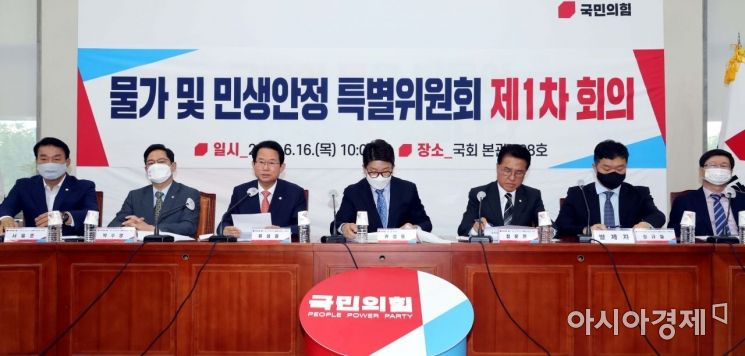 Ryu Seong-geol, Chairman of the People Power Party's Price and Livelihood Safety Special Committee, is delivering an opening remark at the "1st Meeting of the Price and Livelihood Safety Special Committee" held at the National Assembly on the 16th. Photo by Yoon Dong-joo doso7@
Research also shows that policy financial support can worsen the situation of marginal borrowers by lowering their credit ratings. According to a report titled 'Diagnosis of the Risk of Self-Employed Debt and Policy Directions' published last year by the Korea Development Institute (KDI), which compared and analyzed individual business owners who received policy finance and a control group with similar conditions (based on 2016-2017 data), the credit score of individual business owners who closed their businesses one year after receiving policy finance dropped by 64 points (sample size 2,800). This was 2.6 times larger than the 24-point drop observed in the entire sample (30,000).
However, many argue that this is an unavoidable measure considering the special circumstances of COVID-19. Joo Won, head of the Economic Research Department at Hyundai Research Institute, said, "Since the shock from COVID-19 is still ongoing, political and social logic currently outweigh market economic logic."
◆ "Selective and Fine-Tuned Measures Essential to Prevent Moral Hazard Precedents"
Experts advise that the government must conduct thorough screening during this support process to prevent future cases of moral hazard among small business owners and the self-employed. Given the signs of COVID-19 resurgence and worsening economic conditions, support for small business owners and the self-employed is unlikely to be a one-time effort, making it important to set the right direction from the start.
Professor Han Jae-jun of Inha University's Department of Global Finance said, "Support for small business owners and the self-employed is inevitable at this point," adding, "To avoid moral hazard, it is worth considering conditional forgiveness based on the business performance or employment status of marginal borrowers."
Professor Lee Jeong-hee of Chung-Ang University's Department of Economics also said that support for small business owners and the self-employed will inevitably continue, emphasizing, "To ensure that moral hazard does not become a precedent in future support, the government must meticulously screen and finely adjust recipients despite administrative difficulties. For example, it is necessary to distinguish whether the debt arose from circumstances beyond the individual's control, like COVID-19, or from investment losses."
© The Asia Business Daily(www.asiae.co.kr). All rights reserved.
![User Who Sold Erroneously Deposited Bitcoins to Repay Debt and Fund Entertainment... What Did the Supreme Court Decide in 2021? [Legal Issue Check]](https://cwcontent.asiae.co.kr/asiaresize/183/2026020910431234020_1770601391.png)