Ministry of Industry Unveils 'Radioactive Waste R&D Roadmap'... Accelerating K-Radioactive Waste Facility Development
900 Billion Won Invested in Core Technology Development... 500 Billion Won for Infrastructure Construction
Localization of Key Materials by 2050s... Plans to Establish Underground Research Facilities
Deputy Minister Park Il-jun: "We Will Safely Manage Radioactive Waste... Calling on the Scientific Community to Step Up"
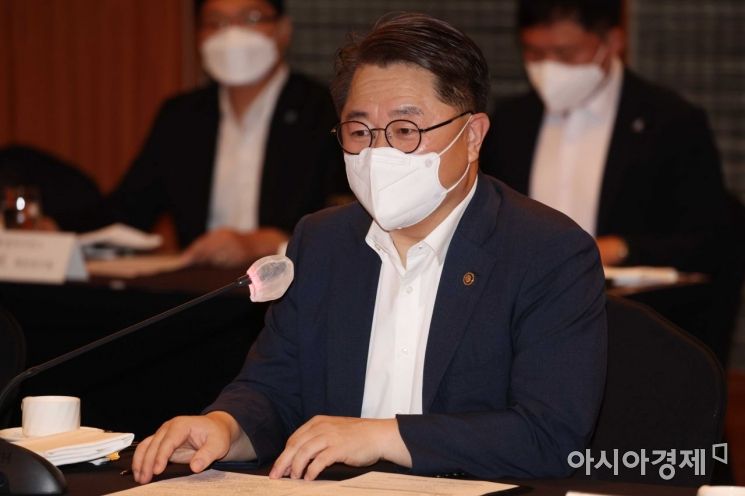 Park Il-jun, Vice Minister of the Ministry of Trade, Industry and Energy, is speaking at the 'Industry Meeting for Revitalizing Investment in the Hydrogen Economy' held on the 20th at Lotte Hotel in Jung-gu, Seoul. / Photo by Moon Ho-nam munonam@
[Asia Economy Sejong=Reporter Lee Jun-hyung] The government will invest 1.4 trillion KRW to create a Korean-style ‘high-level radioactive waste disposal facility.’ Considering the characteristics of domestic underground rock formations, the plan is to develop a uniquely Korean radioactive waste disposal system by the 2040s. Key materials for disposal facilities, such as disposal containers, will be domestically produced by the 2050s.
The Ministry of Trade, Industry and Energy unveiled the ‘High-Level Radioactive Waste Research and Development (R&D) Roadmap’ containing these details on the 20th. This roadmap announcement is a follow-up measure to the government’s ‘2nd Basic Plan for High-Level Radioactive Waste Management’ announced at the end of last year. A government official stated, “The R&D roadmap is the first technological blueprint to safely manage radioactive waste,” adding, “We plan to secure the necessary technologies without delay according to the schedule presented in the roadmap.”
 High-Level Radioactive Waste Research and Development (R&D) Investment Outlook.
 [Photo by Ministry of Trade, Industry and Energy]
1.4 Trillion KRW Invested by 2060... Domestic Production of Transport and Storage Technologies
According to the roadmap, the government will invest about 1.4 trillion KRW in the development of disposal facility technologies from next year until 2060. Specifically, 900.2 billion KRW will be allocated to R&D for transport, storage, and disposal technologies. Additionally, 493.6 billion KRW will be invested in infrastructure construction such as underground research facilities. The Ministry of Trade, Industry and Energy expects that public and private enterprises will invest approximately 50 billion KRW separately in transport and storage containers and site investigation technologies.
Through this large-scale investment, the government aims to develop a Korean-style radioactive waste disposal system by the 2040s. This is based on the judgment that disposal technologies unique to Korea are necessary due to the characteristics of domestic radioactive waste and underground rock formations. Core disposal technologies such as radionuclide behavior evaluation within disposal containers and conceptual design of disposal systems are scheduled to be developed by 2029. Subsequently, demonstrations of barrier stability including containers and disposal tunnels will be conducted at underground research facilities.
The government will also promote domestic production of disposal technologies. Key materials such as radioactive waste disposal containers, buffer materials, and sealing materials are planned to be domestically produced by the 2050s. The Ministry estimates that approximately 17,000 disposal containers and 5 million square meters of buffer and sealing materials will be required domestically. Furthermore, through phased development of disposal technologies, the government plans to secure all 46 element technologies and 140 detailed technologies necessary for the construction of disposal facilities by the 2050s.
Transport and storage technologies for radioactive waste will also be domestically produced. Specifically, the government plans to secure all 30 element technologies and 108 detailed technologies related to transport and storage by the late 2030s, when licensing for intermediate storage facilities is expected. Among these, core technologies with high utilization and industrial ripple effects, such as transport and storage system design and spent nuclear fuel integrity evaluation, will be prioritized for domestic production. Considering the current high domestic technology level in low-burnup spent nuclear fuel management, deficiencies will be supplemented by 2026 and applied to dry storage within nuclear power plants. However, if necessary, the government will also consider utilizing overseas technologies from countries such as the United States and France for vulnerable areas.
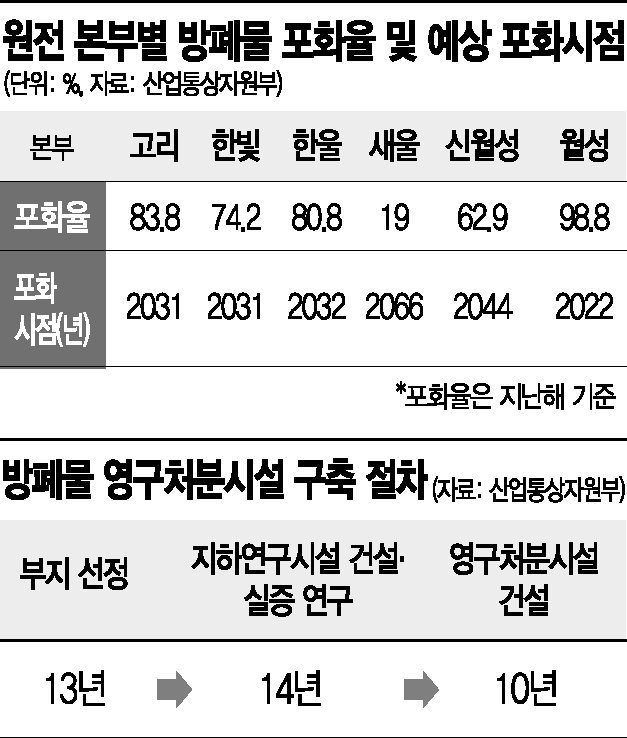
Site Selection Technologies Secured by 2029... Underground Research Facilities Also Established
Technologies for site selection of disposal facilities will be gradually secured by 2029. To exclude unsuitable areas for disposal facilities, the government plans to develop site selection methodologies as well as site investigation and suitability evaluation procedures by next year. Site evaluations such as surface and drilling surveys and geophysical exploration will utilize technologies already secured. Deep investigation technologies, including preliminary site characteristic modeling and geological environment change modeling, are scheduled to be completed by 2029.
To demonstrate the safety of the Korean-style disposal facility, underground research facilities will also be established. The government will initiate procedures to secure underground research facilities separately from site selection within 3 to 4 years. These facilities will be used for developing core radioactive waste technologies and constructing disposal facilities. A Ministry of Trade, Industry and Energy official explained, “Underground research facilities are necessary separately from disposal facilities to investigate site-specific characteristics unique to Korea and to demonstrate deep disposal technologies,” adding, “While overseas facilities could be used, there are no facilities that match Korea’s rock types, geology, groundwater, and other environmental characteristics.”
Meanwhile, the Ministry held a forum on the roadmap at The-K Hotel in Seoul, chaired by Deputy Minister Park Il-jun, to gather opinions. The Ministry plans to finalize the roadmap in the second half of this year after additional consultations such as follow-up forums and advice from overseas expert organizations. Furthermore, the Ministry intends to actively cooperate with leading countries in disposal facility technologies such as Finland and France, as well as international organizations like the International Atomic Energy Agency (IAEA), to supplement the roadmap.
At the forum, Deputy Minister Park Il-jun said, “We plan to secure safety management technologies based on scientific rationality to safely manage radioactive waste,” and added, “We ask the scientific community to responsibly secure technologies based on the roadmap so that both the public and local communities can feel assured and trust the process.”
© The Asia Business Daily(www.asiae.co.kr). All rights reserved.



















