16th Health Insurance Policy Deliberation Committee in 2022
Fee Improvement to Support Continuous Treatment for Mental Illness Patients
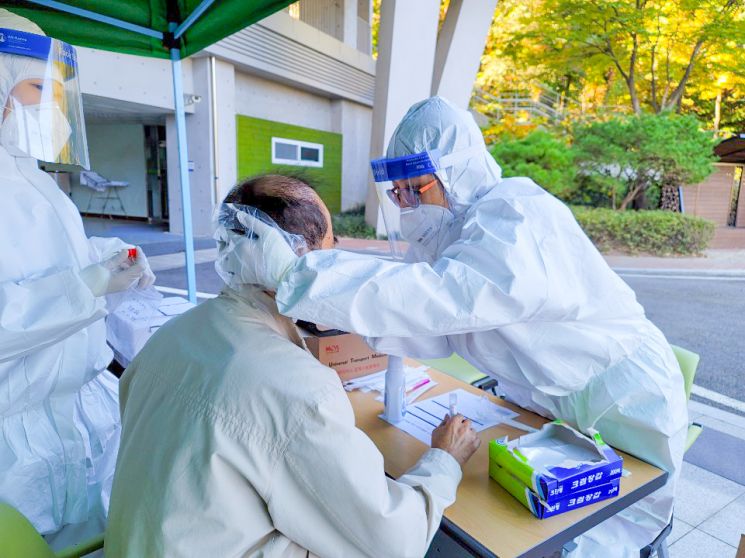
[Asia Economy Reporter Kim Young-won] As the 6th wave of the COVID-19 resurgence intensifies, the government is reviewing the COVID-19 medical fees for the second quarter and discussing the fee direction to prepare for the resurgence.
On the 20th, the Ministry of Health and Welfare held a meeting of the Health Insurance Policy Deliberation Committee (Geonjeongsim), the highest decision-making body for health insurance, to discuss ▲ improvements in COVID-19 health insurance fees and application plans for fees in preparation for re-spread ▲ and improvements to the pilot project fees supporting continuous treatment for patients with mental illnesses.
According to the Ministry of Health and Welfare, the health insurance fees supported for COVID-19 response so far amount to approximately 7.1 trillion KRW. In the second quarter of this year, as face-to-face COVID-19 treatment expanded, a new face-to-face treatment fee was established to provide additional compensation to medical institutions and pharmacies for treating and dispensing medication to confirmed patients.
Since April 25, when COVID-19 was downgraded to a Class 2 legally designated infectious disease, the health insurance compensation system for isolation hospitalization has also changed. Since last month, additional fees are recognized when only some patients (1-2 people) are isolated in multi-patient rooms housing 3-6 patients.
Also, from last month, an integrated isolation management fee for COVID-19 was applied exclusively to long-term care hospitals. The integrated isolation management fee for long-term care hospitals is 50,000 KRW per confirmed patient per day. Until May 5, the integrated isolation management fee was applied to tertiary general hospitals, general hospitals, hospitals, psychiatric hospitals, and long-term care hospitals, but from May 6, institutions other than long-term care hospitals were excluded.
Geonjeongsim plans to operate fees based on the experience of the past two years for smooth response during the resurgence and conduct in-depth discussions on individual fees through subcommittees of Geonjeongsim.
Improving Pilot Project to Enable Continuous Treatment for Patients with Mental Illness
At this Geonjeongsim meeting, improvement plans for the pilot project supporting continuous treatment for acute mental illness patients at high risk of self-harm or harm to others were also discussed.
This project has been implemented since January 2020 and aims to prevent the worsening and chronicity of mental illness and increase recovery rates through ▲ support for intensive acute phase treatment ▲ case management ▲ continuous management via day wards.
However, as participation in the project is less than half of the target and the current participation rate of mental health institutions in the acute phase pilot project is low, and limitations were pointed out such as not reflecting actual acute phase hospitalization routes, the government decided to improve the benefit criteria for appropriate acute phase fees. The pilot project applies only to emergency hospitalization (3 days) among the 'types of hospitalization' under the Mental Health Welfare Act and does not apply to acute phase patients hospitalized by voluntary/admitted consent, hospitalization by guardians, or administrative hospitalization.
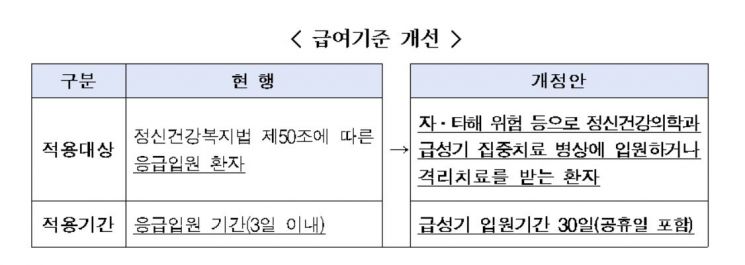
The government will first expand the scope of the acute phase pilot project to include all patients admitted or receiving isolation treatment in acute phase intensive care beds in psychiatric departments due to risks such as self-harm or harm to others. These beds must meet criteria such as having at least 10 beds in a closed ward, 2 protection rooms, 1 psychiatric specialist per 20 beds, and 1 nurse per 6 beds.
Additionally, the fee application period has been stabilized to a maximum of 30 days to allow sufficient intensive treatment during the acute phase.
A Ministry of Health and Welfare official stated, "With the improvement of this pilot project, if acute phase treatment is activated, it is expected to reorganize psychiatric inpatient services in Korea to focus on acute phase treatment, reduce unnecessary hospitalizations, and establish grounds for timely transition to community treatment."
© The Asia Business Daily(www.asiae.co.kr). All rights reserved.


















