In June, Both Reported Cases and Reported Patients Exceeded Last Year and 5-Year Average
[Asia Economy Reporter Kim Young-won] Reports of suspected food poisoning cases last month exceeded the average of the past five years. Early heatwaves and the easing of social distancing measures were cited as causes.
On the 19th, the Ministry of Food and Drug Safety (MFDS) analyzed the causes of the increase in food poisoning cases and announced mitigation measures at a briefing held at the Seoul Regional Food and Drug Administration.
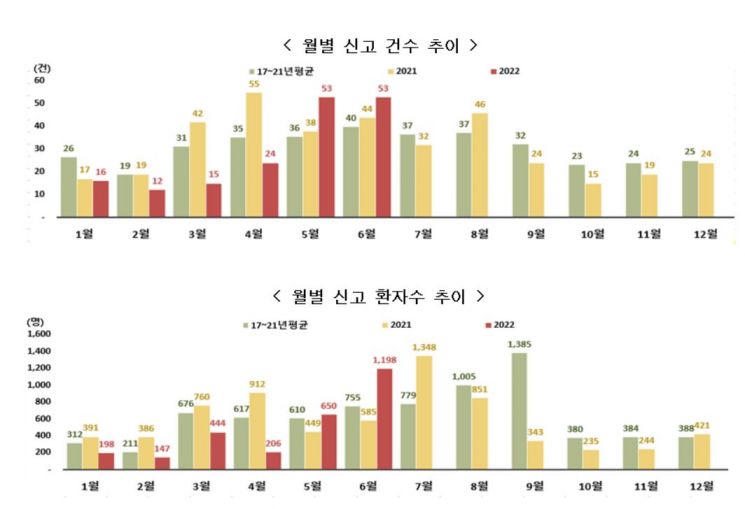
According to the MFDS, there were 53 reported cases of food poisoning last month, higher than last year's 44 cases and the five-year average of 40 cases. The number of reported patients also rose to 1,198, surpassing last year's 585 and the five-year average of 755. However, the number of reported food poisoning cases may decrease later as some reports include cases that are not food poisoning, such as person-to-person infections.
The causes of the increased food poisoning reports include not only hot weather but also the easing of social distancing and the prolonged prevalence of norovirus. Lee Jae-yong, Director of the Food Consumer Safety Bureau at the MFDS, explained, "Early heatwaves, increased social activities due to eased distancing, and the resumption of regional festivals all acted as combined factors."
Last month, 291 people showed suspected food poisoning symptoms at a senior citizens' festival in Gijang-gun, Busan, and 187 people at a restaurant in Seongju-gun, Gyeongbuk. Director Lee said, "While delivery through applications (apps) is common, large-scale cooked meals consumed by construction workers are also included in delivery food, which can lead to large-scale food poisoning incidents."
The continued occurrence of norovirus infections, which mainly happen in winter, until this month was also pointed out as a factor for the increase in suspected reports. Kim Jin-sook, Health Research Officer of the Food Poisoning Prevention Division at the MFDS, said, "Norovirus is an RNA virus with various types that tend to circulate in waves by type," adding, "Experts believe that the recent change in types may make infections more likely."
In response, the MFDS announced that it has prepared food poisoning mitigation measures tailored to locations where food poisoning frequently occurs. First, customized food poisoning prevention education will be conducted at schools, social welfare facilities, and other places, along with focused publicity through mass media.
Among restaurants, which accounted for 58% of food poisoning cases in the past five years, safety management will be strengthened for more vulnerable establishments. This month, seasonal foods such as cold noodles and soybean noodles will be collected and tested, and inspections will be conducted at multi-use food establishments such as beaches, rest areas, and large supermarkets.
Director Lee stated, "To enable rapid analysis of food poisoning causes, we will improve testing methods and focus on egg safety management related to Salmonella, a major causative bacterium," adding, "In a situation with a high risk of COVID-19 resurgence, preventing food poisoning will not only protect public health but also help reduce the burden on local government medical systems."
© The Asia Business Daily(www.asiae.co.kr). All rights reserved.

















