21.9% of Psychological Autopsy Cases Since 2020 Are Presumed Related to COVID-19

[Asia Economy Reporter Kim Young-won] Mr. A, a man in his 20s, suffered from domestic violence by his parents since childhood and engaged in delinquency, but found peace of mind after meeting his girlfriend. A aimed to start a business and opened a cafe in July 2019 with the money he earned from three years of delivery part-time jobs. The cafe, located in a famous tourist spot, began to establish itself through word of mouth, but its sales plummeted when social distancing measures were implemented due to the spread of COVID-19 in 2020. With no income, Mr. A had to continue paying rent and electricity bills for the store as before and faced financial difficulties, including taking out high-interest loans. He attempted an extreme choice but was discovered by his girlfriend, who made an appointment for a psychiatric visit. However, he was found dead the day before the hospital visit, leaving a note saying he wanted to rest.
Such stress from changes in job and economic situations due to COVID-19 was found to have influenced suicide. On the 19th, the Ministry of Health and Welfare announced the results of an analysis conducted with the Korea Life Respect Hope Foundation, which performed psychological autopsies on 952 bereaved families of 801 suicide victims over seven years from 2015.
A psychological autopsy is a process that investigates the causes of suicide by reviewing the psychological and behavioral patterns and changes of the deceased before death based on testimonies and records from people around them. It has been conducted in Korea since 2015 and is also practiced in the United States, Japan, Finland, and other countries.
29 Suicide Deaths Attributed to COVID-19 Impact
According to the analysis, among 132 suicide deaths occurring in Korea since January 2020, when COVID-19 emerged domestically, 29 cases (21.9%) were estimated to be related to socioeconomic changes caused by COVID-19.
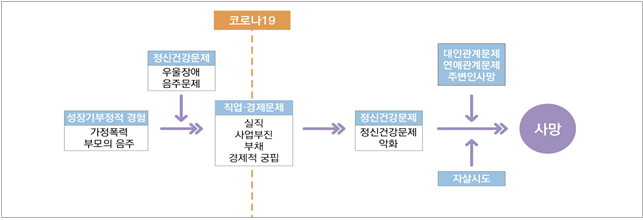
All 29 individuals were vulnerable to suicide due to pre-existing issues such as job, economic, family, marital, or interpersonal problems before COVID-19, but changes in economic conditions like unemployment and business closures or restrictions on social activities due to COVID-19 led to their suicide deaths.
Analysis of their life stress events showed that 19 (65.5%) experienced job-related stress before death, and 23 (79.3%) experienced economic stress. Additionally, 51.7% experienced family relationship stress, 42.9% marital stress, and 27.6% interpersonal stress. Among the 23 who experienced economic stress, 10 complained of debt, and 8 expressed anxiety about their current or future economic status.
There were nine cases of business stagnation or failure, mostly in tourism, culture, and education sectors severely impacted by COVID-19. Two suicide victims suffered from increased work burdens due to COVID-19.
Furthermore, most COVID-19-related suicide victims (28 people) were found to have had psychiatric disorders. Fifteen were presumed to have worsened mental health problems due to stress caused by changes triggered by COVID-19.
Most Psychological Autopsy Subjects Reported Mental Health Issues... Bereaved Families Also Show Increased Depression
Among the 801 suicide victims subjected to psychological autopsy, 40.8% (327 people) were low-income earners with a monthly income below 1 million KRW or no income at all. Those with no income accounted for 18.7%, and those earning less than 1 million KRW made up 22.1%.
At the time of death, 310 (38.7%) were employees, 199 (24.8%) unemployed, and 132 (16.5%) self-employed.
Suicide victims were found to have experienced an average of 3.1 complex stress events per person. Family relationship stress involving parents and children was the highest at 60.4%, followed by economic problems at 59.8%, and occupational issues such as colleague relationships or unemployment at 59.2%.
Notably, the proportion of middle-aged and older adults experiencing economic stress was high. About 12% of middle-aged and older suicide victims were found to have visited financial institutions. Won So-yoon, head of the Suicide Prevention Policy Division at the Ministry of Health and Welfare, said, "When analyzing stress events, about 70% of middle-aged and 66.3% of older adults reported economic stress, which is higher than in youth or elderly groups. We suspect this is related to visits to financial institutions."
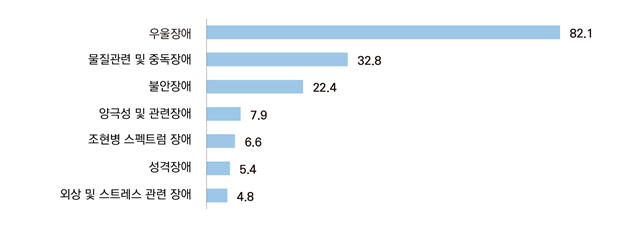
Suicide victims commonly experienced or worsened mental health problems such as depression triggered by stress events leading to suicide. Among 801 victims, 88.6% were diagnosed with or presumed to have had psychiatric disorders. Depression was the most common at 82.1%, followed by substance and addiction disorders at 32.8%, and anxiety disorders at 22.4%. Approximately half of the psychological autopsy suicide victims, 394 people, visited mental health institutions such as psychiatric clinics within three months before death seeking help.
Most bereaved families of suicide victims experienced depressive symptoms. Among 952 bereaved family members who participated in psychological autopsy interviews, 793 (83.3%) experienced depressive symptoms, with 60.9% of them in moderate or severe depression. About 60% (566 people) of the bereaved also reported having suicidal thoughts at the time of the interview.
Professor Jeon Hong-jin of the Department of Psychiatry at Samsung Seoul Hospital stated, "Bereaved families have different thoughts about the suicide death, which can cause family conflicts. Psychological autopsy helps organize the situation at that time and understand that the suicide resulted from multiple deep-rooted causes, leading to family reconciliation and reconsideration of suicide. Psychological autopsy has the dual effect of suicide prevention and providing support to bereaved families," he emphasized.
© The Asia Business Daily(www.asiae.co.kr). All rights reserved.



















