Legal Community "Prioritizes Speed Over Direction"
'Consistent Low Profile and Downplaying of Exoneration'
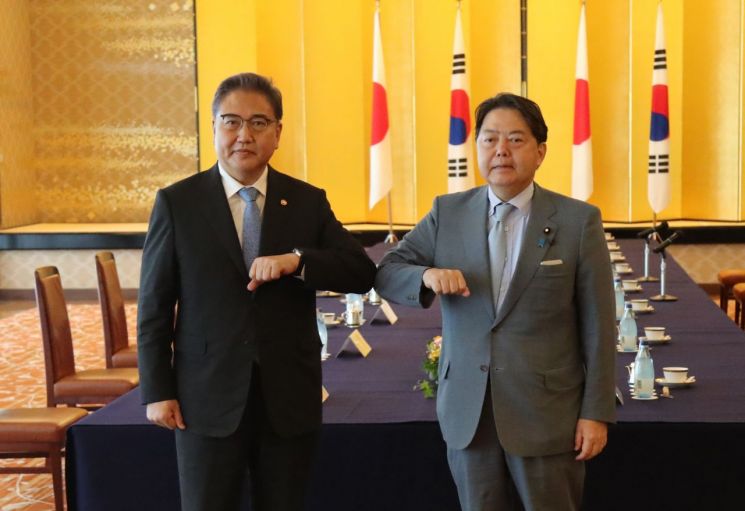
[Asia Economy Reporter Kim Hyung-min] Legal circles have voiced criticism over Foreign Minister Park Jin's meeting with Japanese Foreign Minister Yoshimasa Hayashi, in which they promised a swift resolution to the issue of compensation rulings related to forced labor.
Im Jae-sung, a lawyer from Haemaru Law Firm who has represented victims of forced labor, evaluated the outcome on the 19th, telling this publication that "(the recent Korea-Japan foreign ministers' meeting) was a result focused more on speed than direction." He described it as a hollow meeting with no substantial results regarding the crucial apology from Japanese companies or methods of compensation. Another lawyer from Seocho-dong pointed out, "It is concerning as it appears the government intends to actively intervene in a compensation issue that should be resolved according to legal principles."
There is also an assessment that our government has consistently maintained an excessively submissive stance, effectively pledging to grant Japanese companies a clean slate. Japan is uneasy about the forced sale (liquidation) of domestic assets belonging to companies such as Nippon Steel and Mitsubishi Heavy Industries. Although our Supreme Court issued final rulings in October and November 2018 ordering these companies to compensate victims of forced labor, they have refused to fulfill their compensation obligations, prompting the initiation of forced procedures to sell the assets of these companies located in South Korea. The liquidation process is likely to be realized as early as this fall.
However, Minister Park promised, "We will strive to find a desirable resolution before the liquidation of Japanese companies' domestic assets takes place," seemingly alleviating Japan's concerns. They also exchanged views on "normalizing" issues triggered by Japan's export restrictions due to disagreements over compensation responsibilities and South Korea's termination of the General Security of Military Information Agreement (GSOMIA). The Ministry of Foreign Affairs also explained to Japan the discussions held by the public-private consultative body formed to find solutions for compensation for forced labor victims during the Japanese colonial period. While the Ministry stated that "there is significance in providing this explanation," legal circles responded that it was "inappropriate."
Controversy is also expected within the public-private consultative body. Composed of victim representatives, experts from academia, legal and economic sectors, and former diplomats, the body officially launched on the 4th and has held two meetings, but victim representatives have not participated. The Mitsubishi Forced Labor Litigation Support Group (Citizens' Group for Forced Labor under Japanese Colonial Rule) and the litigation representatives maintain the position that "an apology from Japanese companies must come first" and have stated they cannot participate. Many analyses suggest that the recent Korea-Japan foreign ministers' meeting concluded with outcomes contrary to their claims, making it increasingly likely that they will continue to reject the public-private consultative body going forward.
© The Asia Business Daily(www.asiae.co.kr). All rights reserved.

![Clutching a Stolen Dior Bag, Saying "I Hate Being Poor but Real"... The Grotesque Con of a "Human Knockoff" [Slate]](https://cwcontent.asiae.co.kr/asiaresize/183/2026021902243444107_1771435474.jpg)














