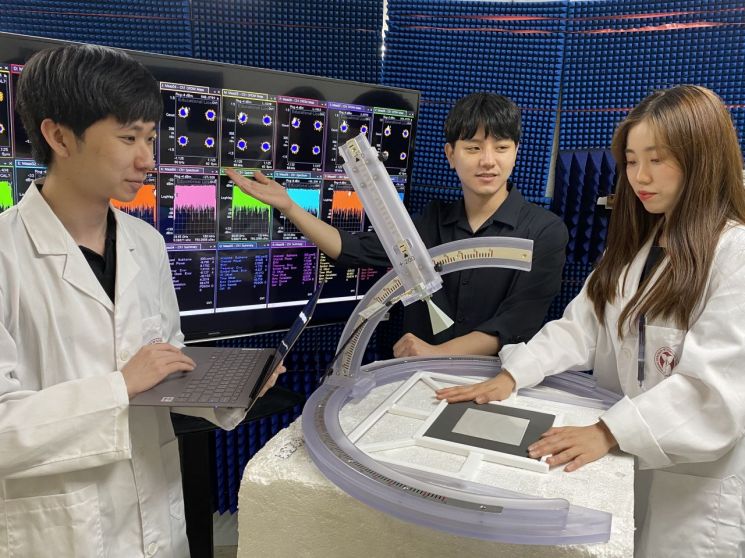
 Professor Hong Won-bin's research team at POSTECH (from left, Andong-geun, Hwang Myung-jin, Lee Cheong-ah) is testing the performance of RIS in the radio wave testing chamber.
[Asia Economy Reporter Lim Hye-seon] LG Uplus announced on the 18th that it will conduct industry-academic joint research with Pohang University of Science and Technology (POSTECH) on the core antenna technology of 6G mobile communication, ‘Reconfigurable Intelligent Surface (RIS)’ technology.
Since last year, LG Uplus has been verifying the technological effectiveness of 6G RIS in collaboration with domestic antenna specialist companies such as Crimo. Next, together with the research team led by Professor Hong Won-bin of POSTECH, who is conducting leading research in the fields of 6G and millimeter (mm) waves, they plan to carry out an industry-academic cooperation project to verify the performance of RIS in the terahertz wave band, a candidate frequency band for 6G.
Through this joint research, both parties intend to simulate the RIS operating environment without power consumption in the terahertz wave band, produce prototypes, and conduct verification to secure the core technology of 6G RIS.
In 6G mobile communication, ultra-wideband frequencies ranging from hundreds of megahertz (MHz) to tens of gigahertz (GHz) are expected to be required for specialized services such as holograms and extended reality (XR). In particular, the terahertz wave band, which has not been used in mobile communication until now, is attracting attention as a candidate frequency.
Terahertz waves have a wide available bandwidth, enabling data transmission speeds of terabits per second (Tbps). However, due to their very short wavelength, losses occur in environments where there are obstacles in the distance the waves travel or when signals enter indoors from outdoor base stations.
To solve these problems, RIS, known as an ‘intelligent mirror,’ is gaining attention. RIS adjusts transmission power according to the characteristics of radio waves, transmitting (penetrating) external signals into buildings or reflecting them at necessary angles to avoid obstacles, thereby improving coverage in radio shadow areas.
Professor Hong Won-bin of POSTECH said, “Since the beginning of the history of electromagnetic waves, the radio transmission and reception environment has been beyond human control. Through the development of power-free 6G RIS with LG Uplus, we will pioneer technology to control the radio transmission and reception environment in the terahertz band, which has infinite potential.”
© The Asia Business Daily(www.asiae.co.kr). All rights reserved.

















