Dollar Futures Index Tracking ETFs
All Show Stock Price Increases Over 7%
Growing Preference Among Individual Investors
[Asia Economy Reporter Myung-hwan Lee] Exchange-traded funds (ETFs) tracking dollar-related indices have been riding an upward trend despite the recent continued downturn in the market. This is thanks to the U.S. Federal Reserve (Fed) tightening monetary policy aggressively to tackle inflation, which has strengthened the dollar. Securities firms have forecasted that the dollar's strength will continue for the time being.
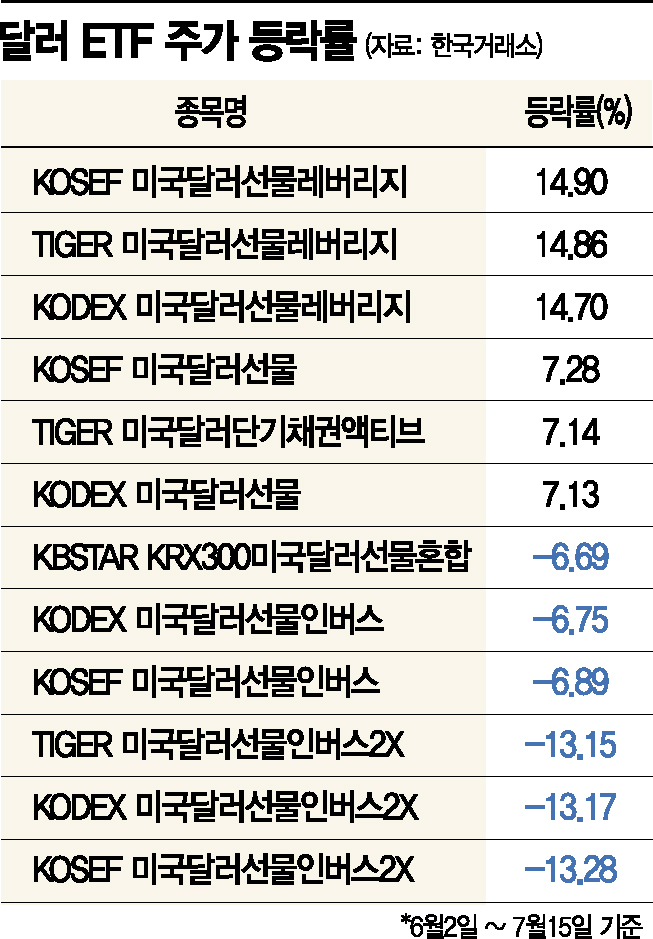
On the 18th, Asia Economy analyzed the trading trends of dollar-related ETFs listed on the domestic stock market from June 2 to July 15. The analysis showed that all ETFs tracking the dollar futures index closely recorded stock price increases exceeding 7%.
Kiwoom Asset Management’s ‘KOSEF U.S. Dollar Futures Leverage’ posted the highest stock price increase during this period at 14.90%. This ETF, a leveraged product that tracks the U.S. dollar futures index at twice the rate, rose from 10,405 KRW on June 2 to 11,955 KRW on July 15. Similarly, other leveraged ETFs tracking the same index at twice the rate also recorded increases in the 14% range. ETFs tracking the dollar futures index at a 1x rate also recorded stock price fluctuations exceeding 7%. Conversely, inverse ETFs and 2x inverse (short leverage) ETFs tracking the index showed similar levels of decline.
The dollar futures index tracked by these ETFs also rose significantly during this period. The dollar futures index increased by 5.97%, from 101,832 on June 2 to 107,911 on July 15. During this period, the dollar futures index peaked at 109,140.
Considering the recent weakness in the domestic stock market, with the KOSPI falling below the 2300 level, the performance of dollar ETFs stands out even more. The average stock price fluctuation rate of all ETFs listed on the domestic market during the same period was -7.71%, whereas the average stock price fluctuation rate of six ETFs tracking the dollar futures index closely was 11%.
The strength of ETFs betting on the dollar is due to the sustained strong dollar. The dollar has continued to strengthen as the Fed has intensified its tightening, going beyond the giant step of raising the benchmark interest rate by 0.75 percentage points to even considering an ultra step of a 1 percentage point hike. This has highlighted the appeal of safe-haven assets. On July 15, the won-dollar exchange rate rose to the 1,326 won level, setting a new yearly high. The exchange rate surpassing 1,320 won intraday was the first time in over 13 years and 2 months since April 30, 2009, when it reached 1,325.0 won (high price basis).
Individual investors’ preference for dollar ETFs also appears to be strengthening. Among the top 20 ETFs in net purchases by individuals from the beginning of this month to July 15, four were ETFs tracking dollar-related indices. During this period, the dollar short leverage ETF ‘KODEX U.S. Dollar Futures Inverse 2X’ ranked fifth in net purchases by individuals, which is presumed to be driven by demand aiming for short-term gains from price volatility.
Securities firms have forecasted that the dollar’s strength will continue for the time being. Jung-hoon Seo, a researcher at Samsung Securities, said, "The dollar will bow only when inflationary pressures decrease and clearer signals emerge that the Fed is slowing the pace of rate hikes. While the market seems to be heading in that direction, it is difficult to predict exactly when it will arrive."
© The Asia Business Daily(www.asiae.co.kr). All rights reserved.

















