"Middle East, Closely Linked to US National Interests"... Emphasis on Active Leadership
No Concrete Results on Oil Production Increase and Regional Security Issues... Controversy Over 'Empty-Handed' Tour
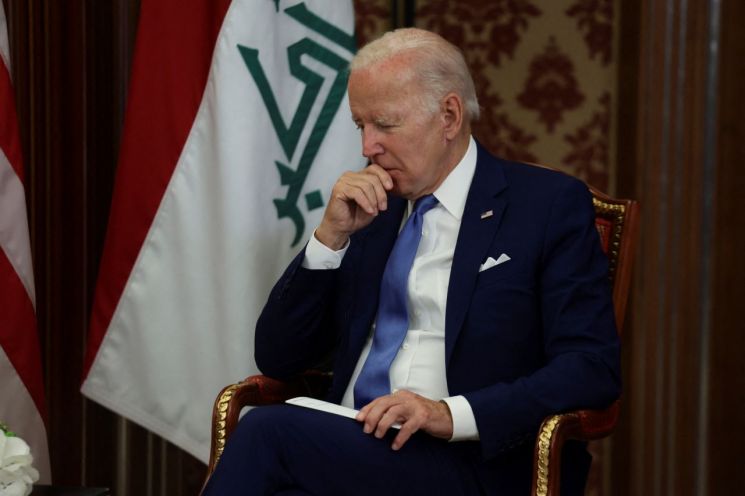
[Asia Economy Reporter Hyunwoo Lee] U.S. President Joe Biden pledged active American involvement to Saudi Arabia and Middle Eastern Arab countries, warning that he would not tolerate the infiltration of influence by China and Russia. He reiterated his plan to halt the exit strategy from the Middle East region that had continued since the previous Donald Trump administration and to strengthen U.S. influence in the Middle East once again.
However, concerns are growing that Biden’s first Middle East trip may end 'empty-handed' as no concrete achievements were made on the key issues of this visit, such as increasing oil production or improving relations between Arab countries and Israel. Especially since President Biden pushed ahead with this Middle East trip despite the human rights issues cited as a factor for the defection of core Democratic supporters, political backlash is expected to intensify.
On the 16th (local time), at the 'Gulf Cooperation Council (GCC) +3 Summit' held in Jeddah, Saudi Arabia, President Biden said, "As the world becomes more competitive and the challenges we face become more complex, it has become clearer that the Middle East is closely intertwined with U.S. national interests. The U.S. will not leave the Middle East region and allow China, Russia, and Iran to fill that space," adding, "The U.S. will remain an actively engaged partner in the Middle East. The U.S. will strengthen its foundation in the region based on active and principled leadership."
President Biden then introduced five key principles of U.S. Middle East policy: ▲ strengthening cooperation with countries that uphold a rules-based international order ▲ protecting freedom of navigation in the Middle East, including the Strait of Hormuz ▲ pursuing tension reduction in the Middle East ▲ seeking political, economic, and social cooperation with Middle Eastern countries ▲ and advocating for human rights protection. This was interpreted as a reaffirmation to Middle Eastern countries that the U.S. will stop its exit strategy and resume active military involvement in the region.
The GCC +3 Summit included leaders from GCC member states (Saudi Arabia, United Arab Emirates, Qatar, Bahrain, Oman, Kuwait) as well as Egypt, Iraq, and Jordan. Notably, Crown Prince Mohammed bin Salman, known as the de facto ruler of Saudi Arabia, attended the meeting on behalf of King Salman bin Abdulaziz Al Saud, who leads the summit.
However, the 'empty-handed' controversy is spreading as no concrete outcomes were achieved regarding oil production increases or strengthening regional security cooperation including Israel at this summit. President Biden stated, "We agreed on the need to ensure sufficient supply to meet international demand," and added, "Energy producers have already increased production, and we are hopeful about what will happen in the coming months." However, no specific figures were provided on how much Saudi Arabia and other Middle Eastern countries pledged to increase production.
Saudi Arabia also indicated that additional increases are difficult. At the meeting, Crown Prince Mohammed said, "Saudi Arabia has already announced plans to increase production to its maximum capacity of 13 million barrels per day, and additional production beyond this is not possible." Saudi Foreign Minister Faisal bin Farhan also drew a line during a press conference after the meeting, stating, "There were no discussions related to crude oil at this summit."
Cooperation on responding to the Iranian nuclear issue, one of the core matters raised by President Biden during this trip, also failed to produce concrete results. In particular, the U.S. government had been promoting the establishment of a joint air defense network to counter Iran’s threat based on normalization of relations between Israel and Arab countries, but the Saudi government revealed that such discussions did not take place at the summit.
Despite strong backlash over human rights issues, President Biden pushed ahead with this trip and is expected to face political repercussions ahead of the November midterm elections. President Biden also expressed his complex feelings about human rights issues during the meeting, saying, "I too have faced countless criticisms over the years, and it is not pleasant," but emphasized, "However, the ability to speak freely and share ideas brings about innovation."
© The Asia Business Daily(www.asiae.co.kr). All rights reserved.

















