Vegetable Prices Like Sangchu More Than Double Compared to Average
Shrinkflation Phenomenon as Food Ingredients Are Reduced
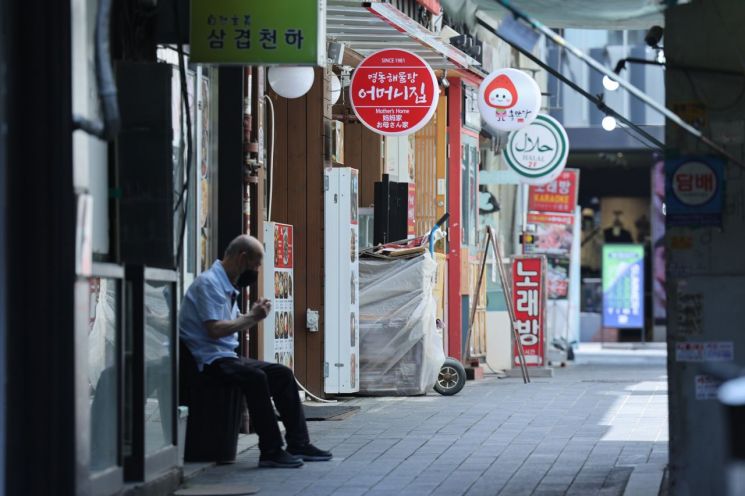 Following the severe drought this spring, recent heavy rains and heatwaves have caused poor crop growth, leading to a sharp rise in vegetable prices. Coupled with soaring inflation, the worries of self-employed business owners are deepening. The photo shows a restaurant street in Myeongdong, Jung-gu, Seoul, on the 3rd.
 [Image source=Yonhap News]
[Asia Economy Intern Reporter Kim Gunchan] "We add other vegetables or choose less expensive ones."
Ahn, who runs a bibimbap restaurant in Euljiro 3-ga, Jung-gu, Seoul, recently said, "The cost of purchasing vegetables has increased by about 100,000 won compared to before," referring to the soaring price of lettuce.
As the prices of vegetables, including lettuce, have surged recently, 'shrinkflation'?reducing the amount of ingredients or substituting them with cheaper items instead of raising food prices?is spreading. Shrinkflation is a compound word of 'shrink' and 'inflation.' On the 8th (local time), the US AP News introduced the term as a phenomenon accelerating worldwide.
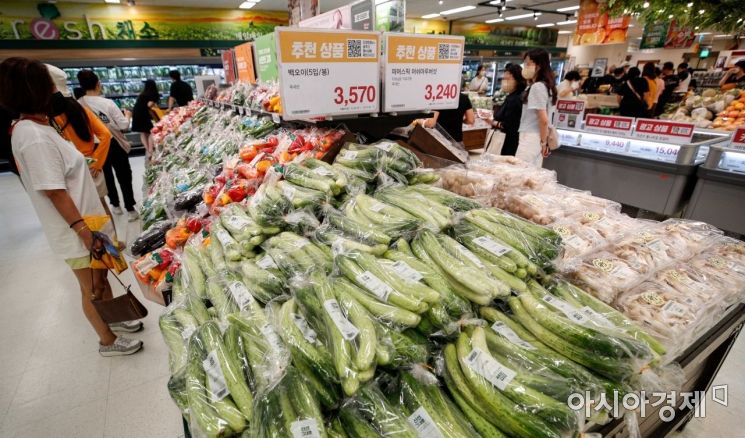 Customers are shopping at a large supermarket in Seoul on the 3rd, as vegetable prices surge due to the recent heavy rain and monsoon season. Photo by Kang Jin-hyung aymsdream@
This phenomenon has already become a reality in Korea. Self-employed business owners struggling with rising vegetable prices choose relatively cheaper ingredients instead of vegetables with sharply increased prices. Park Daesik (62), who runs a meat restaurant in Chungmuro, said, "Lettuce is so expensive that we serve perilla leaves instead," adding, "If the situation continues, we may have to consider raising prices."
According to the Agricultural Products Distribution Information (KAMIS) system operated by the Korea Agro-Fisheries & Food Trade Corporation (aT), as of the 14th, the retail price of red leaf lettuce is 2,294 won per 100g, and green leaf lettuce is 2,358 won. Compared to the average prices of 1,093 won and 1,085 won, respectively, this is an increase of 109.9% and 117.3%. The price of red leaf lettuce, which was in the 900 won range last month, rose by more than 1,300 won in just one month.
Prices of other vegetables are also rising. The retail price of spinach is 23,014 won per kilogram, a 211.5% increase from the average of 7,388 won. The retail prices of young radish leaves, cucumbers, and young napa cabbage have also risen more than 100% compared to the average. Moreover, severe drought this spring, followed by recent monsoon rains and heatwaves, have negatively affected crop growth.
Self-employed business owners who do not reduce or substitute vegetables like lettuce and continue to provide the same amount as before are complaining of difficulties. A, who runs a shabu-shabu restaurant in Jung-gu, said, "Recently, I really feel that the cost of purchasing vegetables has increased a lot." B, who runs a meat restaurant nearby, said, "The cost of buying leafy vegetables like lettuce accounts for a significant portion. If customers ask for more, naturally, we give more as a business, but it is true that we are suffering losses, so it is burdensome."
Meanwhile, the government has begun checking the supply and demand situation for lettuce and perilla leaves. On the 11th, Kim Injoong, Vice Minister of Agriculture, Food and Rural Affairs, visited a lettuce and perilla leaf cultivation and distribution facility in Geumsan-gun, Chungnam Province, to inspect crop conditions. Vice Minister Kim stated that the government will strengthen support for agricultural production and distribution by expanding 'production area distribution centers,' which have a well-established system from production to processing, to farmers and distribution center officials.
© The Asia Business Daily(www.asiae.co.kr). All rights reserved.
![Clutching a Stolen Dior Bag, Saying "I Hate Being Poor but Real"... The Grotesque Con of a "Human Knockoff" [Slate]](https://cwcontent.asiae.co.kr/asiaresize/183/2026021902243444107_1771435474.jpg)













