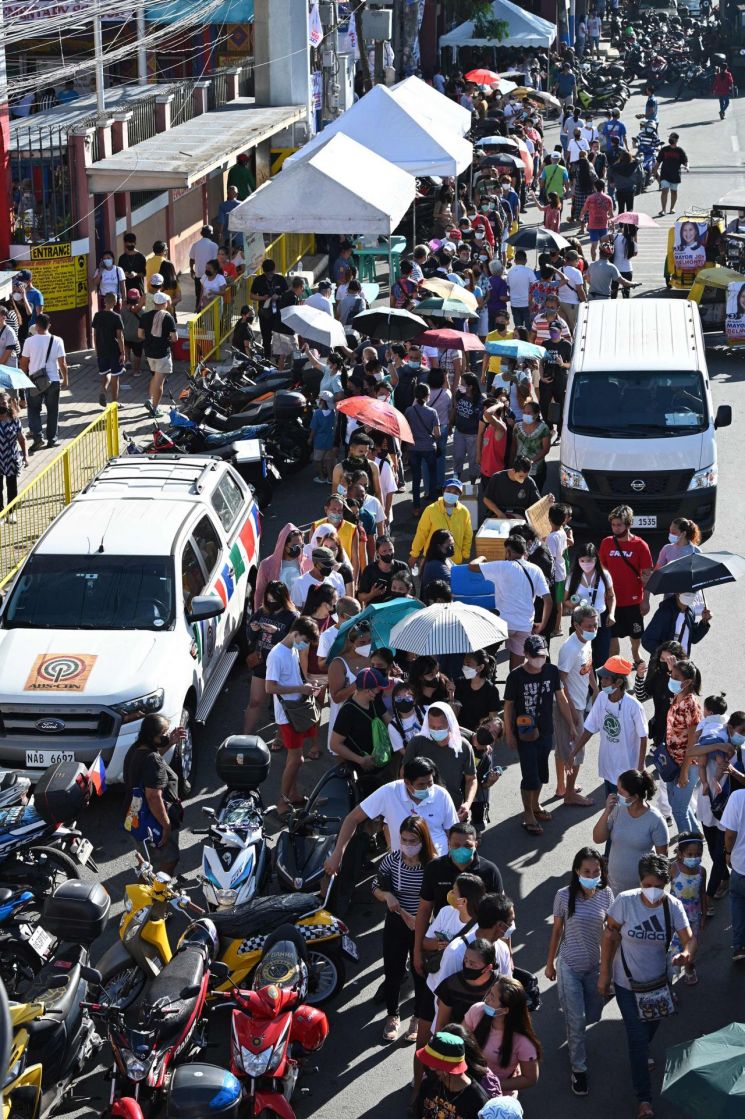
 On May 9, the day of the Philippine presidential election (local time), voters lined up in front of a polling station in Quezon City, on the outskirts of Manila.
 Central banks around the world are battling inflation.
According to major foreign media on the 14th, the Bangko Sentral ng Pilipinas (BSP) raised its benchmark interest rate by 0.75 percentage points from 2.5% to 3.25%. This is the largest rate hike in 22 years. BSP had originally planned to hold a monetary policy meeting on the 18th of next month, but unexpectedly implemented the rate hike on this day.
Felipe Medalla, Governor of BSP, explained the background of the unscheduled rate hike, saying, "By taking emergency measures, we aimed to further anchor inflation expectations and mitigate the rising risks to the inflation outlook."
BSP had stated its intention to gradually raise rates to protect the economic recovery, but it is interpreted that they took emergency action as the peso fell to an all-time low against the dollar this week.
Since the Philippines relies heavily on imports for many goods such as rice and fuel, a decline in the peso's value raises import prices. The consumer price inflation rate in the Philippines reached 6.1% in June, the highest since October 2018.
On the same day, the Monetary Authority of Singapore (MAS), Singapore's central bank, also took decisive monetary tightening measures to curb inflation.
MAS announced that it implemented monetary tightening by raising the midpoint of the policy band for the Singapore dollar (S$) nominal effective exchange rate (NEER).
The width and midpoint of the policy band were maintained at existing levels.
This is the second time this year, following January, that MAS has changed monetary policy outside of its regular meetings held in April and October.
MAS operates monetary policy by adjusting the policy band for the nominal effective exchange rate, which takes into account exchange rate changes of major trading partners, instead of using a benchmark interest rate.
Earlier, on the previous day, the Bank of Canada (BoC) surprised the market by raising its benchmark interest rate by a full 1.0 percentage point from 1.5% to 2.5%.
This "Jumbo Jump" (a 1% point increase) was the first in 24 years since 1998. Economists had initially expected a 0.75 percentage point increase.
© The Asia Business Daily(www.asiae.co.kr). All rights reserved.

![Clutching a Stolen Dior Bag, Saying "I Hate Being Poor but Real"... The Grotesque Con of a "Human Knockoff" [Slate]](https://cwcontent.asiae.co.kr/asiaresize/183/2026021902243444107_1771435474.jpg)















