Health Authorities Reveal Summer Resurgence Response Plan
No 'Social Distancing' but Challenges Remain for New Variant 대응
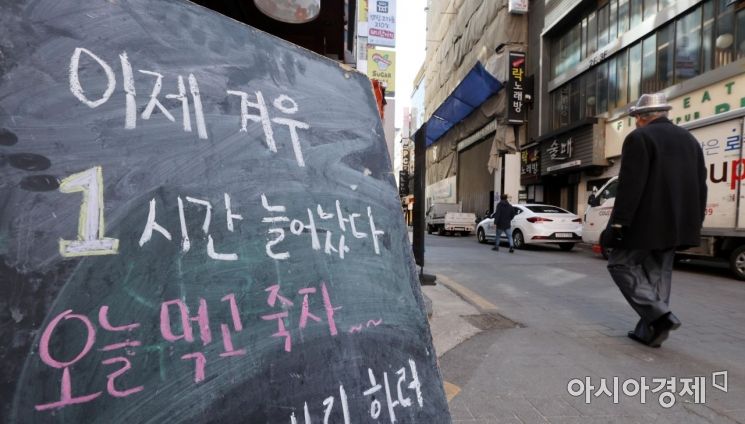 On March 6th, a restaurant in Jongno, Seoul displayed a critical message regarding the extension of business hours. Photo by Kim Hyun-min kimhyun81@
[Asia Economy Reporter Kim Jeong-wan] As the COVID-19 infectious disease shows signs of a resurgence, self-employed individuals who were hit hard by social distancing measures over the past two years are once again on edge. Although relief was felt as quarantine measures restricting social activities have not been implemented, there is still a possibility that such measures could be partially introduced depending on the epidemic situation.
On the 13th, the Central Disease Control Headquarters and the Central Accident Management Headquarters announced their response plan for the summer resurgence of COVID-19. With the 'doubling phenomenon'?where new confirmed cases double every week?continuing for two consecutive weeks and the rebound trend becoming more apparent, the government officially acknowledged that the country is approaching the sixth wave and began medical and quarantine responses.
The government stated that the main focus of this response plan is to minimize broad restrictions on social activities. Accordingly, the target group for the fourth vaccination dose has been expanded from those aged 60 and above to include people in their 50s and individuals aged 18 and older with underlying health conditions. The mandatory 7-day isolation for confirmed COVID-19 cases remains in place, and the PCR test after entry has been strengthened from within 3 days to the first day.
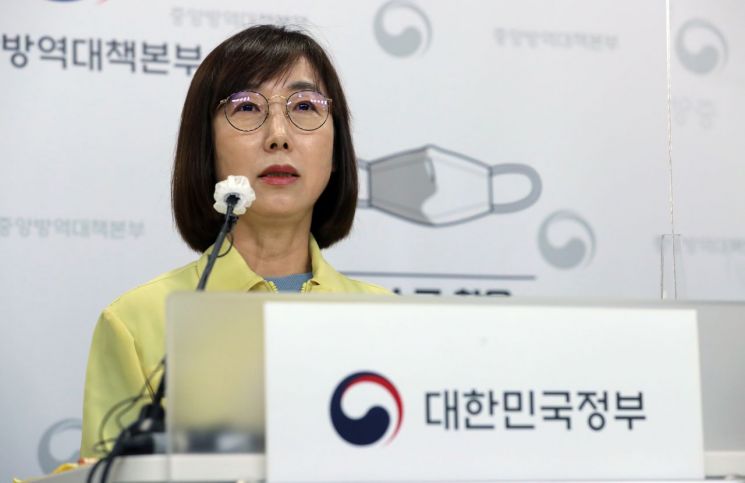 Baek Kyung-ran, Commissioner of the Korea Disease Control and Prevention Agency, is announcing measures to prepare for the resurgence of COVID-19 on the 13th at the briefing room of the Korea Disease Control and Prevention Agency in Osong, Chungbuk.
 [Image source=Yonhap News]
Although there were no social distancing measures limiting gathering sizes or business hours initially, the possibility of reinstating such measures depending on the situation was suggested. On this day, Prime Minister Han Duck-soo stated in his opening remarks at the Central Disaster and Safety Countermeasures Headquarters meeting, "At this stage, mandatory social distancing measures will not be implemented," but added, "However, if there is a significant change in the epidemic situation, we will consider introducing selective and phased social distancing."
While the government has presented 'vaccines' as a countermeasure against the resurgence, the rapid emergence of new variants raises the possibility of sudden changes in the epidemic situation. The BA.5 variant, which has recently become dominant domestically, and the BA.2.75 variant, which is rapidly spreading overseas, both have much stronger transmissibility and enhanced immune evasion compared to previous strains.
The fact that the overall fourth-dose vaccination rate among those in their 60s remains at only 23% is another challenge. The expansion of the fourth-dose target group aims to increase vaccination rates among the high-risk 50s age group to reduce the fatality rate, but the slow vaccination rate among those in their 60s suggests this may be difficult to achieve.
The World Health Organization (WHO) has announced that it will continue to maintain the Public Health Emergency of International Concern (PHEIC) and urged governments worldwide to take measures to suppress COVID-19 infections.
According to Bloomberg News on the 12th (local time), WHO Director-General Tedros Adhanom Ghebreyesus said at a briefing held in Geneva, Switzerland, "The Omicron (BA.1) subvariant (BA.5) is increasing the number of infections and causing additional deaths," and recommended reinstating measures such as mask-wearing to prevent the further spread of COVID-19.
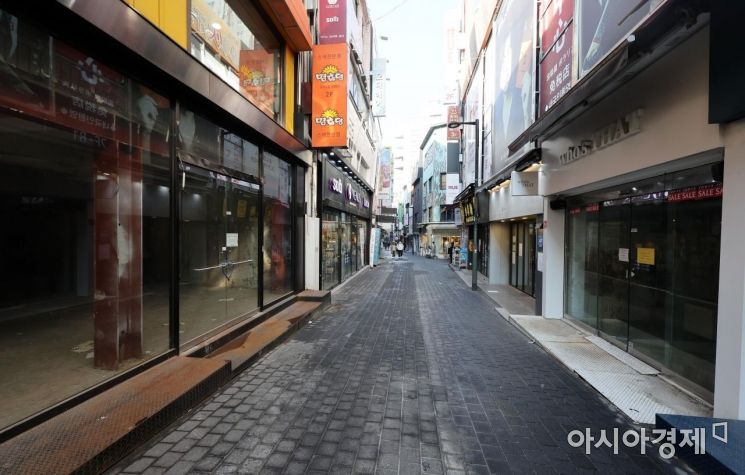 The shops on Myeongdong Street in Seoul are empty due to closures and other reasons. Photo taken on January 2nd. Photo by Hyunmin Kim kimhyun81@
Due to this situation, concerns have arisen among self-employed individuals who have suffered economic losses from social distancing over the past two years, as they cannot afford to let their guard down. Kim (64), who runs a pub in Seodaemun-gu, Seoul, said, "During the COVID period, there were many days when not a single customer came in a day," adding, "I was just starting to recover sales and pay off debts, but thinking about going back to those times makes me very anxious." He continued, "Pubs are heavily affected by time restrictions, so I cannot relax even for a moment."
Kwon (67), who operates a restaurant in Dongdaemun-gu, said, "The past two years were the worst nightmare," and added, "I waited for restrictions to be lifted after two weeks and agonized hundreds of times over whether to close the business." He emphasized, "Now, don't you feel that such restrictions cannot stop the spread? We must not repeat the harm caused to many people by such methods again."
Meanwhile, the 'social distancing' policy first implemented in March 2020 was a high-intensity quarantine policy applied nationwide, which suppressed the spread of infectious diseases but caused enormous social and economic losses to small business owners and the self-employed. Due to the lower severity rate of the Omicron variant of COVID-19, the effectiveness of social distancing policies diminished, leading to their abrupt lifting on April 18. Since then, the government has focused on managing severe cases and fatality rates rather than the number of confirmed cases.
© The Asia Business Daily(www.asiae.co.kr). All rights reserved.



















