KRX Sector PBR: Banks 0.4x, Securities 0.43x, Steel 0.44x
Experts Focus on Bank Stocks with Low Downside Pressure and Improving Earnings
[Asia Economy Reporter Minji Lee] Amid a wave of companies experiencing stock price crashes due to major countries' tightening policies and high inflation burdens, interest is growing in stocks that are historically close to undervalued levels. In particular, bank stocks are becoming more attractive investments due to improved net interest margins from interest rate hikes and record-breaking earnings, but investor sentiment remains sluggish.
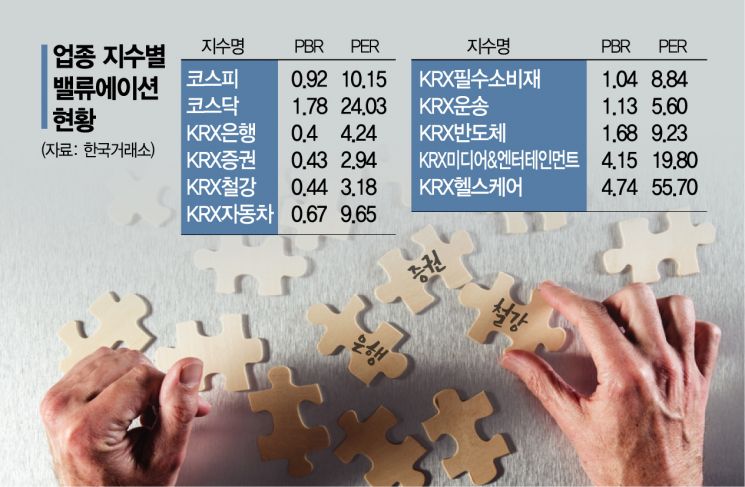
According to the Korea Exchange on the 14th, as of the previous day, the KRX sector PBR (Price-to-Book Ratio) showed the KRX Bank Index at 0.4 times, the lowest among sectors. This was followed by KRX Securities (0.43 times), KRX Steel (0.44 times), KRX Insurance (0.52 times), KRX Utility (0.56 times), and KRX Automobile (0.67 times). PBR is a valuation metric that divides the stock price per share by the net asset value per share. A ratio below 1 means the stock is undervalued compared to its net assets. Simply put, if a company with a PBR below 1 goes bankrupt, investors would theoretically receive more money than their investment amount.
Bank, securities, and steel stocks traded at around 0.4 times, the lowest among all sectors, indicating they are the most undervalued. Their valuations were either below or similar to pre-COVID-19 levels. On January 3, 2020, the PBRs for banks and steel sectors were 0.4 and 0.43, respectively, while securities recorded 0.6. Although these companies' asset values have grown compared to two years ago, their stock prices have not adequately reflected this. Among the stocks included in the index with low PBRs were BNK Financial Group (0.22), DB Financial Investment (0.22), DGB Financial Group (0.23), Hyundai Steel (0.23), Kyobo Securities (0.28), SeAH Besteel Holdings (0.28), Hana Financial Group (0.3), and Woori Financial Group (0.32).
Looking at profitability indicators based on sector PER (Price-to-Earnings Ratio), securities, steel, and bank stocks remained at the lowest levels with PERs of 2.94, 3.18, and 4.24, respectively. This ratio divides the stock price by expected earnings, and a lower value indicates undervaluation, suggesting a higher probability of stock price increases.
However, considering the current stock market sentiment affected by major countries' tightening policies and high inflation burdens, it is predicted to be more prudent to focus on bank stocks, which have relatively low downside pressure and are showing earnings improvements. Securities experts agree that recent public emphasis on loan interest rates has led to overselling of bank stocks, but this has not damaged corporate profits or upward momentum. Ji-young Kim, a researcher at Kyobo Securities, analyzed, "Even amid an economic slowdown, the profits of commercial banks will remain solid. Banks have already preemptively set aside loan loss provisions, enhancing their resilience, so they will maintain earnings stability."
In fact, examining earnings estimates for banks, steel, and securities sectors shows that only the banking sector is maintaining an earnings growth trend. Among steel companies with estimates from three or more securities firms?Daehan Steel, Korea Zinc, Hyundai Steel, Dongkuk Steel, POSCO Holdings, Poongsan, and SeAH Besteel Holdings?the combined operating profit for this year is expected to be 13.2221 trillion KRW, down 7.8% from last year's 14.3391 trillion KRW. The combined operating profit of six major securities firms?Meritz Securities, Korea Financial Group, Mirae Asset Securities, Kiwoom Securities, Samsung Securities, and NH Investment & Securities?is expected to decrease by 25% to 5.8321 trillion KRW from last year's 7.7668 trillion KRW. In contrast, the combined operating profit of eight banks?Woori Financial Group, Shinhan Financial Group, JB Financial Group, BNK Financial Group, Industrial Bank of Korea, KB Financial Group, Hana Financial Group, and DGB Financial Group?is expected to increase by 12% to 29.343 trillion KRW from last year's 26.1208 trillion KRW, with all banks showing earnings growth.
Although the securities sector is unlikely to see a rapid recovery in investor sentiment due to continued poor earnings, the dominant analysis is that conditions will not worsen further. Baeseung Jeon, a researcher at eBest Investment & Securities, explained, "Earnings weakness has already been reflected in stock prices, and considering that the industry is at a historically low point, the possibility of further deterioration is low. Given the low likelihood of additional inflation concerns expanding in the second half, a positive approach should be considered."
The steel sector needs a stimulus momentum from China. The construction industry, a key downstream sector, is sluggish, and high inventory levels combined with price-cutting pressures are weighing on stock prices. Jonghyung Lee, a researcher at Kiwoom Securities, said, "In the second half, steel companies may underperform market expectations due to seasonal off-season effects. However, if the Chinese economy recovers from the second half and Chinese steel prices rebound, the undervaluation appeal of domestic steel companies will become more prominent."
© The Asia Business Daily(www.asiae.co.kr). All rights reserved.

















