Aftermath of Russia-Ukraine War
Livestock Slaughter Prices Highest in 10 Years
Sunflower Oil and Other Oil Prices Soar
Triple Burden of Utility and Labor Cost Increases
[Asia Economy Reporter Moon Hyewon] Mr. A, who runs a franchise chicken restaurant in Eunpyeong-gu, Seoul, is planning to close the business after this summer peak season. With the prices of chicken and oil soaring to unprecedented levels, he has mobilized his entire family to keep the store running in an effort to reduce labor costs, but even this barely covers the living expenses of his family of four. Mr. A said, "I've been in business for over 10 years, but this is the first time I've sold chicken at prices with almost no profit margin," adding, "I feel it would be much better to get a factory job instead."
As the prices of raw materials continue to rise, more franchise owners are voicing difficulties in running their chicken shops. In March, when Yoon Hong-geun, chairman of Genesis BBQ, one of the top three domestic chicken franchises, said on the radio that "chicken should cost 30,000 won," he was criticized, but now many respond that his comment was not just a joke. Chairman Yoon also mentioned that when factoring in not only ingredient costs but also labor and rent, franchise owners have been reduced to earning less than minimum wage.
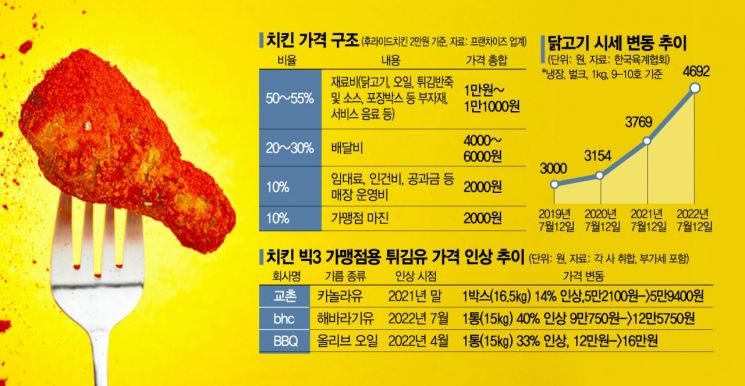
According to the Korea Broiler Association on the 13th, the price of live chicken is trading at 2,790 won per kilogram (medium size) as of the previous day. The slaughter price for processed chicken is 4,692 won per kilogram (based on size 9-10), marking the highest level in 10 years. The surge in international grain prices due to the Russia-Ukraine war has driven up feed costs, which in turn has increased chicken prices. Processed chickens are supplied to franchise companies with a margin of about 1,000 won, priced around 5,600 won, and the franchise headquarters adds another 1,000 won margin to supply to franchisees at about 6,600 won.
The supplied chicken is coated in batter and fried in oil, but the price of this oil has also recently skyrocketed. According to global market research firm Trading Economics, the price of sunflower oil began rising in March 2020. At that time, sunflower oil was priced at $640 per ton, surged to $1,525 per ton in April last year, and nearly quadrupled to $2,376 per ton in May this year before adjusting to around $1,611 per ton this month.
bhc Chicken, which uses sunflower oil as its main ingredient, raised the supply price of sunflower oil to franchisees by about 40%, from 90,750 won (including VAT) per 15kg container to 125,750 won starting from the 7th of this month. bhc Chicken stated that if the international price of sunflower oil stabilizes and purchase prices return to normal, they may lower the supply price to franchisees again, but the outlook is not optimistic. The prolonged Russia-Ukraine war has caused farmers in both countries to miss the sowing season for major crops. More than 75% of the world's sunflower oil exports come from Russia and Ukraine.
With the supply of sunflower oil disrupted by the Ukraine war, prices of substitutes such as palm oil and canola oil are also soaring. Kyochon Chicken, which uses canola oil for frying, raised the price of frying oil supplied to franchisees by 14% to 59,400 won per 16kg box at the end of last year, and BBQ Chicken, which uses olive oil, increased oil prices by 33% in April this year, supplying it to franchisees at 160,000 won per 1kg container. Ultimately, franchise owners are facing a triple burden due to rising raw material costs combined with increases in public utility fees and labor costs. There is a possibility that the consumer price of a chicken, currently around 20,000 won, will be raised further.
An industry insider said, "Since last year, the global logistics crisis has caused instability in the supply of key ingredients, and the rising trend in raw material prices has become too steep for headquarters to bear," adding, "To coexist with franchisees, the company has lowered its operating profit margin, but if this reaches its limit, raising consumer prices will be inevitable."
Professor Lee Eun-hee of Inha University's Department of Consumer Studies said, "If prices rise across the board, even for chicken, which is considered an affordable food, consumers will be driven crazy," and added, "Ultimately, consumption will shrink, which will negatively affect all suppliers." She advised, "Since franchise headquarters have had increased operating profit margins and some leeway, they should take a leading stance to prevent further price hikes for the sake of both consumers and franchisees."
© The Asia Business Daily(www.asiae.co.kr). All rights reserved.
![Clutching a Stolen Dior Bag, Saying "I Hate Being Poor but Real"... The Grotesque Con of a "Human Knockoff" [Slate]](https://cwcontent.asiae.co.kr/asiaresize/183/2026021902243444107_1771435474.jpg)
















