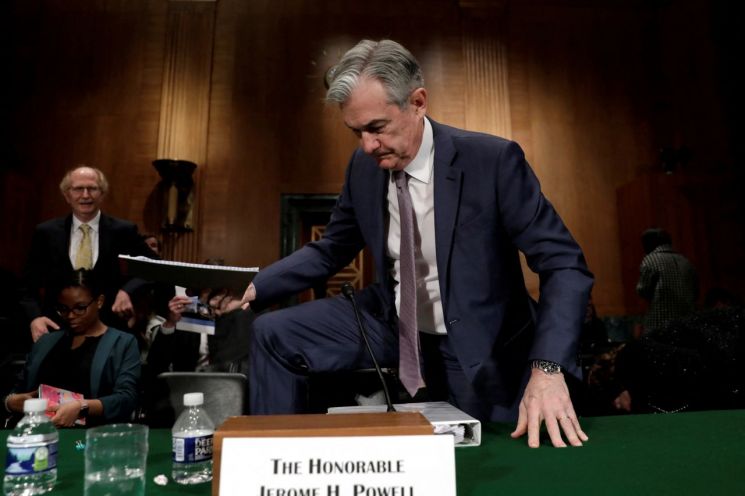
[Asia Economy New York=Special Correspondent Joselgina, Reporter Mun Jewon] Despite the U.S. Federal Reserve's (Fed) consecutive tightening moves, inflation shows little sign of easing, leading the market to increasingly consider the possibility of a so-called ‘jumbo step’?a 1.0 percentage point (100 basis points) hike in the benchmark interest rate at once. Just days before the release of the June Consumer Price Index (CPI), which the Fed closely monitors, U.S. consumers’ expected inflation over the next year also hit an all-time high. Ahead of the U.S. interest rate hike, the won-dollar exchange rate surged to the 1,313 won level during trading, setting a new record high.
On the 11th (local time), the New York Federal Reserve Bank announced through a consumer outlook survey that the expected inflation rate for the next year reached 6.8%. This figure rose by 0.3 percentage points compared to the previous month and is the highest since the survey began in 2013.
Notably, the expected inflation figure released on this day drew more attention as it came just before the CPI announcement scheduled for the 13th. The current market expects the June CPI to rise 8.8% year-on-year, significantly exceeding the 8.6% increase in May. Some even express concerns that it might surpass 9%.
With high inflation expected to persist for the time being, the Fed’s aggressive tightening stance appears to gain more momentum. The market has already taken for granted a ‘giant step’ of a 0.75 percentage point rate hike at the July Federal Open Market Committee (FOMC) regular meeting. Moreover, with last week’s U.S. employment report showing stronger-than-expected solid figures, speculation about an even larger rate hike is spreading.
According to the Chicago Mercantile Exchange (CME) FedWatch, the federal funds (FF) futures market reflected a 93.0% probability of a giant step in July. This is higher than 86.2% a week ago and 92.4% the day before. The possibility of a jumbo step, which was 0% just a week ago, jumped to the 7% range on this day.
Raphael Bostic, President of the Atlanta Federal Reserve Bank, said on the day, "I support a 0.75 percentage point increase," but added that if indicators fall short of expectations, a 1.0 percentage point hike cannot be completely ruled out. On the other hand, Esther George, President of the Kansas City Fed, expressed caution, saying, "Further large rate hikes are possible, but they could burden the economy and financial markets."
Concerns about a recession continue. On the day, Barclays warned that June credit card usage declined, possibly leading to a drop in retail sales, and that this consumption slowdown could exert downward pressure on future growth rates. In the New York bond market, the inversion of the yield curve persisted, with the short-term 2-year Treasury yield exceeding the long-term 10-year yield.
As expectations for the Fed’s aggressive rate hikes strengthen, the dollar index, which measures the value of the dollar against six major currencies, also rose to 108.23 on the day.
The won-dollar exchange rate climbed to the 1,313 won level during trading on the 12th. According to Seoul Foreign Exchange Brokerage, the won-dollar rate started at 1,311.0 won, up 7.10 won from the previous day, and rose to 1,313.2 won around 10:20 a.m. During trading, it reached the level of June 6 (1,311 won), marking the highest since July 13, 2009 (1,315 won).
However, as the sharp rise in the exchange rate increased the likelihood of intervention by foreign exchange authorities, additional gains in the early trading session were limited. The dollar’s strength is interpreted as reflecting market expectations that the Fed will raise the benchmark interest rate significantly this month, coupled with news of China’s intensified COVID-19 lockdowns. Not only the won but also the euro, yen, and yuan showed weakness.
© The Asia Business Daily(www.asiae.co.kr). All rights reserved.
![Clutching a Stolen Dior Bag, Saying "I Hate Being Poor but Real"... The Grotesque Con of a "Human Knockoff" [Slate]](https://cwcontent.asiae.co.kr/asiaresize/183/2026021902243444107_1771435474.jpg)
















