5G Speed 3-4 Times Faster
But Low Concrete Penetration
Investment Burden on Base Stations and Equipment
Focus on Discovering Use Cases for B2B Transactions and Hotspots
[Asia Economy Reporter Cha Min-young] The government and the three major telecom companies, which have shown differing opinions on the utilization plan for the 5G 28 GHz band in its fourth year of allocation, have decided to put their heads together to find a utilization plan. Given the frequency characteristics that reduce usability in urban areas and the heavy burden of base station investment, there is a social consensus that a shift in telecom policy direction is necessary, which is expected to be reflected in the policy.
Establishing a Public-Private Working Group for 28 GHz
Jung Chang-rim, Director of Telecom Policy at the Ministry of Science and ICT, stated on the 11th after a meeting between Minister Lee Jong-ho of the Ministry of Science and ICT and the CEOs of the three telecom companies, "The telecom companies proposed creating a public-private working group to utilize the 5G 28 GHz band," adding, "The public and private sectors will cooperate to explore utilization plans." The group will include government officials, operators, and academic experts, focusing on discovering utilization plans for B2B (business-to-business) and hotspot purposes.
The 28 GHz band, known as the "dream 5G" high-frequency band, features speeds 3 to 4 times faster than the currently used 5G but has the disadvantage of low concrete penetration. Due to its frequency characteristics, it has been evaluated as unsuitable for B2C (business-to-consumer) use. To use it in urban areas with many obstacles, base stations and equipment must be installed more densely, but there is no demand for this. This situation is similar not only in South Korea but also in the United States and Japan. Verizon, a U.S. telecom company that actively invested in the 28 GHz frequency band, ranked first in 5G download speed in 2020 but showed limitations with a connection rate of only 0.5%.
Three Telecom Companies: "20 Times More Investment Than Previous 5G"
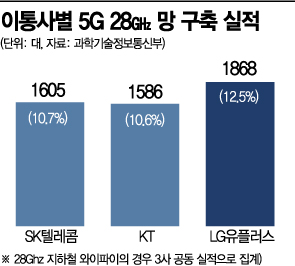
The telecom companies have expressed reluctance to invest in base stations due to cost issues. The industry estimates that for the 28 GHz frequency, about 20 times more equipment is needed compared to the 3.5 GHz band when installing equipment within the same building. The three telecom companies paid about 200 billion KRW each to the Ministry of Science and ICT in exchange for the 28 GHz frequency band for five years starting in 2018, but they impaired the frequency usage rights in their Q4 2020 financial results. Looking at the 28 GHz network construction performance of the three telecom companies disclosed last May, SK Telecom, KT, and LG Uplus recorded implementation rates of 10.7%, 10.6%, and 12.5%, respectively, barely exceeding the government's cancellation threshold of 10%.
The government's shift to a public-private working group after consistently pushing the 5G 28 GHz policy is believed to have been influenced by voices from the National Assembly and civic groups. Min Jae-il, a member of the Democratic Party of Korea, pointed out at the "Desirable 5G Mobile Communication 28 GHz Policy Direction Forum" co-hosted with Kim Young-sik of the People Power Party on the 21st of last month, "We need to seek a feasible policy direction that comprehensively considers the positions of operators, the public, and the government." The increase in the number of operators up to the fourth, led by Naver, for the Ieum 5G (5G specialized network) project utilizing the 5G 28 GHz frequency as spatial networks for companies and factories is also positive.
Separately from concerns about the 5G 28 GHz policy direction, the government and telecom companies plan to accelerate the ongoing subway Wi-Fi infrastructure project and the construction of rural shared networks. Minister Lee Jong-ho of the Ministry of Science and ICT urged the CEOs of the three telecom companies at the meeting, "Please ensure there are no setbacks in building the 5G rural shared network."
© The Asia Business Daily(www.asiae.co.kr). All rights reserved.
![User Who Sold Erroneously Deposited Bitcoins to Repay Debt and Fund Entertainment... What Did the Supreme Court Decide in 2021? [Legal Issue Check]](https://cwcontent.asiae.co.kr/asiaresize/183/2026020910431234020_1770601391.png)















