Animal Abuse Likely to Lead to Violent Crimes Against People
Animal Protection Union Criticizes "Only 0.5% Imprisonment Rate"
"Strong Punishment Needed... Education and Campaigns Also Required"
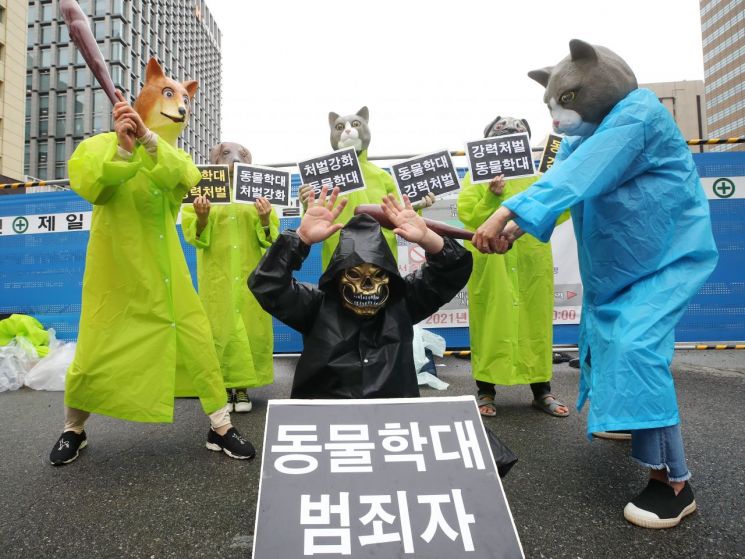 On the afternoon of June 15, in front of the Admiral Yi Sun-sin statue at Gwanghwamun Square in Seoul, participants wore animal masks and performed at a press conference titled "Urging Strong Punishment for Animal Abuse," hosted by civic groups including the Korea Animal Protection Alliance.
 [Image source=Yonhap News]
[Asia Economy Reporter Kang Wooseok] Recently, cruel crimes against animals have been occurring one after another. These include indiscriminate killing of stray cats and horrific abuse. Experts emphasize that strong punishment must underpin efforts to eradicate animal abuse.
According to the Pohang Northern Police Station on the 12th, a man in his 30s identified as A, who was arrested last month on charges of killing a kitten in Pohang, Gyeongbuk, and hanging the corpse on an elementary school commuting route, was revealed to be the same person responsible for the "Stray Cat Serial Abuse Case" that occurred three years ago at Handong University.
At Handong University, from August 2019 to March 2020, seven stray cats were killed, found hanging from trees or with their front paws severed. In police investigations, A admitted that some of these incidents were his doing.
Additionally, A was found to have the same fingerprints as the perpetrator of an animal abuse case that occurred in the central shopping district of Pohang in 2020, which he also confessed to. At that time, cat corpses were found hanging in alleyways.
In March, several severely mutilated cat corpses?around five or six?were discovered at an abandoned fish farm in Pohang. The scene was scattered with a pregnant cat, dismembered bodies, and trapping devices presumed to have been used for abuse. After animal organizations investigated the site and reported it to the police, a man in his 20s identified as B was arrested.
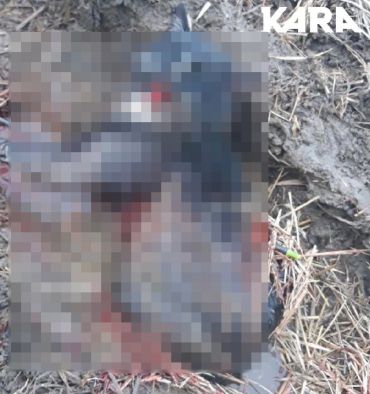 Last March, an incident occurred in Pohang, Gyeongbuk, where stray cats were confined, dismembered, and abused at an abandoned fish farm. Photo by the animal rights organization 'Kara'
Serial killing of animals is serious in itself, but it also has a high correlation with subsequent violent crimes such as murder and rape, causing significant repercussions. According to research from Northeastern University in Boston, USA, 70% of animal abusers have committed at least one other crime. Notably, 46% of murderers and 30% of child molesters had a history of abusing animals. Domestic serial killers such as Kang Ho-soon and Yoo Young-chul also had records of animal abuse.
In fact, a notebook detailing the planned torture and killing of cats was found among the belongings of A, the Pohang kitten killer, and B, the abuser at the abandoned fish farm, reportedly sent threatening messages to informants, including insults and statements like "Should I peel your skin and flesh like a cat?" This has heightened awareness of the brutality of animal crimes and the risk of further offenses.
In the United States, most states classify animal abuse as a felony, and the Federal Bureau of Investigation (FBI) regards it as an antisocial crime, managing data on animal abuse offenders separately by category.
However, in South Korea, despite the increase in animal abuse cases, the arrest rate remains low, leading to criticism that proper responses are not being implemented.
According to data on "Animal Protection Act Violations in the Past 11 Years" received by Justice Party lawmaker Lee Eun-joo from the National Police Agency, a total of 992 violations of the Animal Protection Act occurred in 2020, with 1,014 people arrested. Compared to 78 offenders in 2010, the number of violators increased more than tenfold. However, among 4,358 offenders from 2010 to 2020, only five were detained, resulting in a detention rate of about 0.2%.
In response, the Animal Protection Act was fully revised and promulgated in April for the first time in 31 years, expanding and specifying acts of animal abuse. However, experts point out that this is still insufficient. Lee Won-bok, head of the Animal Protection Union, said, "The revised Animal Protection Act stipulates imprisonment of up to three years or fines up to 30 million won for causing death through animal abuse, but in reality, even the most cruel and horrific animal abuse rarely results in imprisonment. According to our data, the rate of actual prison sentences is only 0.5%."
He added, "Because the judiciary imposes so-called lenient punishments, the mistaken perception that 'animal abuse crimes are not serious crimes' continues to persist in society. People repeatedly abuse animals serially and boast about it on the internet and social networking services (SNS) to show off," criticizing the situation.
Lee emphasized that strong punishment must be the foundation to eradicate animal abuse crimes. He said, "Crimes against socially vulnerable beings such as animals should carry a strong message that once committed, your life can be over. Strict judicial measures are necessary. Socially, related campaigns and education should be conducted to raise awareness that animal abuse is a very serious crime."
© The Asia Business Daily(www.asiae.co.kr). All rights reserved.


















