Excavation of Tomb No. 3 at Wonsangun Burial Mound, National Wanju Cultural Heritage Research Institute
Typical Burial Mound Form... Discovery of Yangiboo Pottery and Short-Necked Pottery
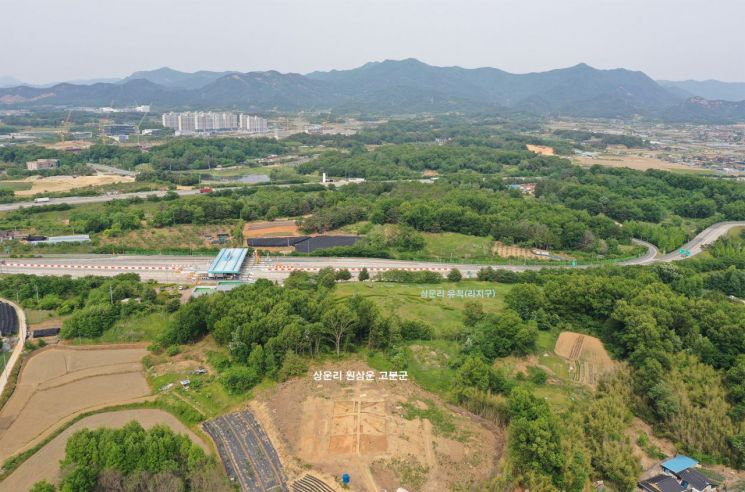
Jeonbuk National University discovered thirty earthen mound tombs and 163 tile burial facilities in Sangun-ri, Wanju, in 2003. The site, estimated to date back to the Proto-Three Kingdoms period, consists of eight tomb mounds in the Wonsangun burial cluster. The National Institute of Cultural Heritage’s Wanju National Research Institute began excavating the central No. 3 tomb mound in March. The mound’s low earthen shape was relatively well preserved. The plan was a square with rounded corners. The mound length measured 15 meters, the surrounding moat (a ditch-like feature around the tomb) was 2 to 4 meters wide, and the maximum height of the mound’s embankment layer was about 80 cm. Evidence was found of a leveled floor surface and clay layers stacked crosswise to prepare the site for the burial facility. It was a typical earthen mound tomb form, created by digging out the space where the burial facility (wooden coffin tomb) would be placed.
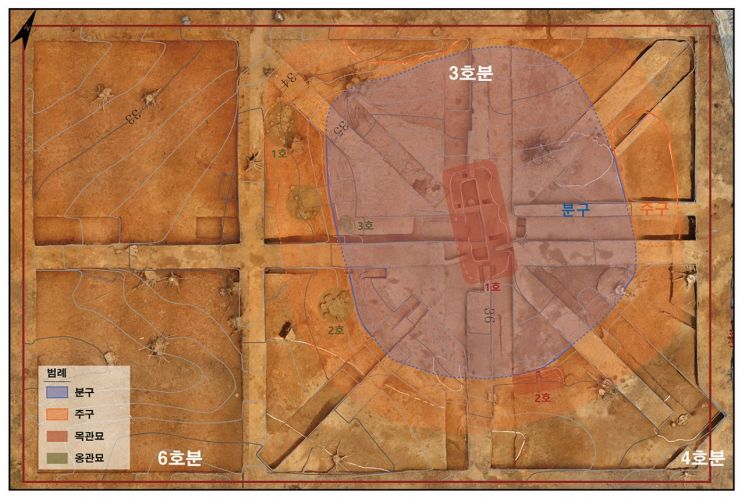
The Wanju National Research Institute will reveal the traces of the No. 3 tomb mound, where the mound was constructed first and the burial facility later, on the 12th. At the center lies a wooden coffin tomb measuring 354 cm in length and 70 cm in width, narrow and elongated in shape. Inside, a two-eared jar (兩耳附壺) and its lid (蓋), as well as a short-necked jar (短頸壺), were excavated. The two-eared jar is a pot with round ring-shaped handles on both sides. The short-necked jar is a pottery vessel with a round body and a short neck. Outside the tomb mound’s moat, one wooden coffin tomb and three jar coffin tombs were found as additional burials. Jar coffin tombs are graves using jar-shaped coarse earthenware as coffins. A research institute official stated, "Among the tombs investigated at the Sangun-ri site so far, this is a relatively early cluster from the Proto-Three Kingdoms period," adding, "It is highly significant that we have secured data that allows a comprehensive interpretation of the Sangun-ri site area." They also said, "We hope that academic research will clarify the nature of the site more precisely and lay the groundwork for its designation as a historic site."
© The Asia Business Daily(www.asiae.co.kr). All rights reserved.
![From Bar Hostess to Organ Seller to High Society... The Grotesque Con of a "Human Counterfeit" [Slate]](https://cwcontent.asiae.co.kr/asiaresize/183/2026021902243444107_1771435474.jpg)

















