Constitutional Amendment Forces Easily Surpass Proposal Quorum, Accelerating Amendment Process
Kishida: "Will Connect to National Referendum as Soon as Possible"
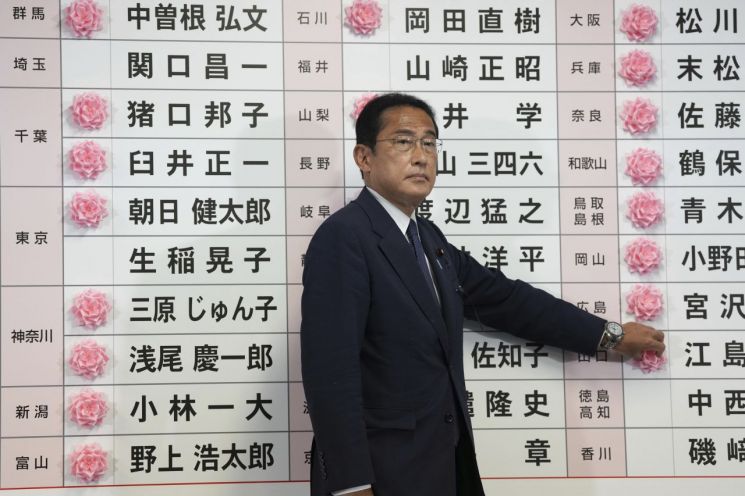
[Asia Economy Reporter Kim Hyunjung] On the 10th, in the Japanese House of Councillors election, the ruling Liberal Democratic Party (LDP) led by Prime Minister Fumio Kishida won a landslide victory by securing a majority of the seats on its own. It is analyzed that the conservative forces rallied around the LDP following the assassination attempt and subsequent death of former Prime Minister Shinzo Abe two days before the election, consolidating votes for the LDP.
According to the local public broadcaster NHK's seat count by party on the 11th, out of the 125 seats newly elected in the previous day's election, the ruling LDP secured 63 seats, achieving a majority on its own. The coalition partner Komeito won 13 seats, bringing the two parties' total to 76 seats. The term for House of Councillors members is six years, with about half of the members elected every three years.
Including the seats not up for election this time (70 seats), the ruling parties hold a comfortable majority with a total of 146 seats out of the entire chamber (majority requires 125 seats or more).
Compared to before, the LDP increased its total seats to 119, gaining 8 seats, while Komeito lost 1 seat, holding 27 seats. The main opposition party, the Constitutional Democratic Party, won only 17 seats, reducing its total seats to 39, which is 6 fewer than before.
The so-called ‘constitutional amendment forces’?the LDP, Komeito, Nippon Ishin no Kai, and the Democratic Party for the People?secured a total of 177 seats, significantly exceeding the two-thirds quorum (166 seats) required in the House of Councillors to propose constitutional amendments.
Prime Minister Kishida appeared on local television that night and expressed his determination for constitutional revision, stating, "We will propose the amendment bill as soon as possible and connect it to a national referendum." The core of the amendment is to explicitly justify the possession of the Self-Defense Forces in Article 9 of Japan’s constitution, also known as the ‘Peace Constitution,’ or to add emergency provisions.
This overwhelming victory in the election strengthens Prime Minister Kishida’s position and lays the groundwork for long-term governance. With no major elections scheduled for the next three years, stable government administration is expected. Additionally, following this election, it is anticipated that the governments of South Korea and Japan will engage in high-level talks, suggesting potential changes in Korea-Japan relations.
© The Asia Business Daily(www.asiae.co.kr). All rights reserved.
![Clutching a Stolen Dior Bag, Saying "I Hate Being Poor but Real"... The Grotesque Con of a "Human Knockoff" [Slate]](https://cwcontent.asiae.co.kr/asiaresize/183/2026021902243444107_1771435474.jpg)











