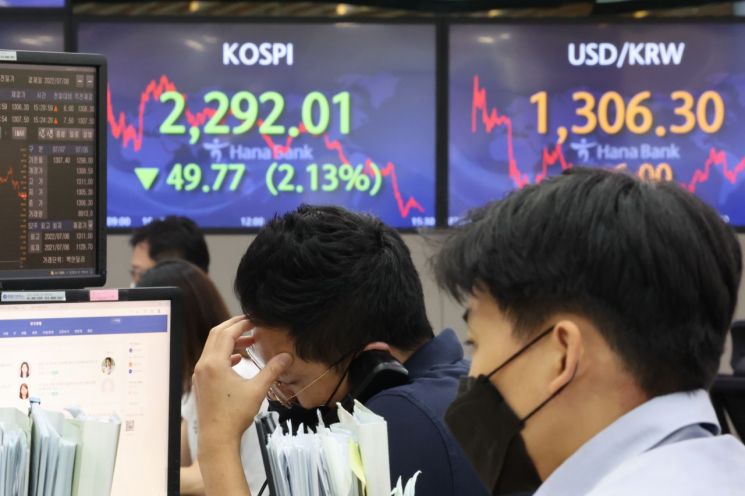
[Asia Economy Reporter Myunghwan Lee] There are forecasts that the securities industry's second-quarter earnings will not be favorable. However, there is also an analysis suggesting a positive approach is possible as the likelihood of further deterioration after the second quarter is low.
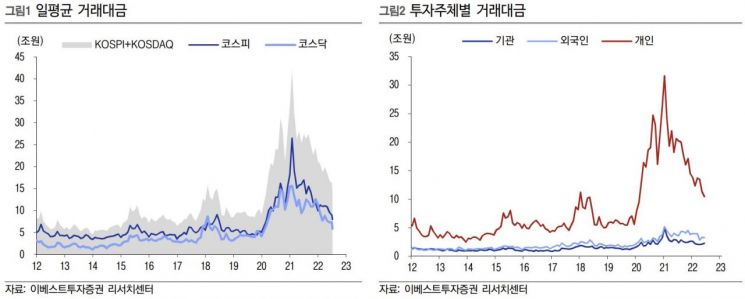
On the 9th, Ebest Investment & Securities analyzed that the business conditions are worsening due to the contraction of individual funds flowing into the stock market. According to Ebest Investment & Securities, the average daily trading volume in June was 16.2 trillion KRW, lower than the average daily trading volume of 17.7 trillion KRW in April and May. This is said to be the lowest level since February 2020. It was pointed out that the business conditions have worsened as the volume dropped to around 14 trillion KRW this month. Looking at it quarterly, the average daily trading volume in the second quarter was 17.2 trillion KRW, down 13% from the first quarter. This marks a continuous decline in brokerage commissions for five consecutive quarters since the second quarter of last year.
The reason for the decrease in trading volume is attributed to the continued contraction of individual funds flowing into the stock market. Since April, the trading volume of institutions and foreigners has slightly increased, but the average daily trading volume of individuals has continued to decline. In June, individual trading volume was 10.5 trillion KRW, down to half compared to last year. The proportion of individual trading also fell below 65%, showing the lowest level since December 2019.
The flow of funds around the stock market is also described as negative. While the deceleration trend of customer deposits continues, credit balances have recently dropped significantly, falling below 18 trillion KRW. Ebest Investment & Securities analyzed that the worsening borrowing conditions due to rising interest rates and negative economic outlook have suppressed risk appetite, thereby restraining the inflow of individual funds into the stock market.
Accordingly, Ebest Investment & Securities expects securities firms' second-quarter earnings to be significantly weak. It explained that a decrease in brokerage revenue and deterioration in trading profits are inevitable due to stock market instability and rapid interest rate hikes, and the IB (Investment Banking) division is also expected to see a reduction in profit scale. It also pointed out that new real estate project financing (PF) deals have contracted, and there is a possibility of recognizing losses related to domestic and foreign investment assets.
However, it was explained that the securities industry's poor earnings have already been reflected in the sector's stock prices. Considering the KOSPI and KOSDAQ market capitalization turnover rates, which have approached historically low levels, the possibility of further business deterioration is low. Given the low likelihood of additional expansion of liquidity contraction and inflation-related concerns in the second half, the second-quarter earnings season is seen as a period for a positive approach to the sector.
Researcher Jaebseung Jeon of Ebest Investment & Securities said, "The recent rise in interest rates has paused, and if major countries' stock markets maintain their current levels, the operating profits related to equity-linked securities (ELS) are expected to enter an early redemption phase in the second half." He analyzed, "Trading profits, which contributed to the deterioration of first-half earnings, are expected to improve in the second half."
© The Asia Business Daily(www.asiae.co.kr). All rights reserved.
![Clutching a Stolen Dior Bag, Saying "I Hate Being Poor but Real"... The Grotesque Con of a "Human Knockoff" [Slate]](https://cwcontent.asiae.co.kr/asiaresize/183/2026021902243444107_1771435474.jpg)

















