Government-Affiliated Committees Number 629... Many Operate as 'Ghosts,' Wasting Budget; Yoon Says "Public Sector Austerity Unavoidable"
[Asia Economy Reporter Baek Kyunghwan] The Yoon Seok-yeol administration is set to embark on a major overhaul of government committees. This decision comes from the judgment that various committees within the government hinder responsible administration and increase administrative inefficiency. As part of tightening the belt in public institutions, the administration plans to boldly reorganize presidential committees first to reduce budgets and enhance administrative efficiency.
Following President Yoon’s directive at the Cabinet meeting held on the 5th at the Yongsan Presidential Office building, the presidential office explained, "President Yoon strongly emphasized that the public sector must take the lead in overcoming the economic crisis, ordering the sale of unnecessary assets, restructuring expenditures, and improving management efficiency. The reorganization of government committees is being pursued from this perspective."
The number of government-affiliated committees increased from 530 under the Lee Myung-bak administration, to 558 under the Park Geun-hye administration, and to 631 under the Moon Jae-in administration, currently standing at 629. Of these, 20 are under the president, 60 under the prime minister, and 549 under various ministries. The presidential office abolished two committees?the Job Committee and the Policy Planning Committee?that were created during the Moon Jae-in administration, which had promoted a job-focused government.
The 20 presidential committees are known to spend about 3.3 billion KRW annually on average. Considering that it is difficult to find meetings directly chaired by the president from 2019 to 2021, and that many committees operate only formally or suffer from high costs and low efficiency, the decision for a major overhaul was made.
Among these, it is reported that plans are being discussed to dissolve 13 out of the 20 presidential committees (65%). Based on last year’s budget, this could save at least 25 billion KRW annually. The committees expected to remain under the president include the Economic, Social and Labor Council, the Regulatory Reform Committee, the 2050 Carbon Neutral Green Growth Committee, the Special Committee on Agriculture, Fisheries and Rural Areas, the Military Death Accident Investigation Committee, and the Low Birthrate and Aging Society Committee?six in total. There is a strong possibility of merging the National Balanced Development Committee and the Local Autonomy Committee, which have overlapping functions, to launch a new Local Era Committee (tentative name). However, since cooperation from opposition parties is essential to reduce various committees, it will not be easy to produce results soon.
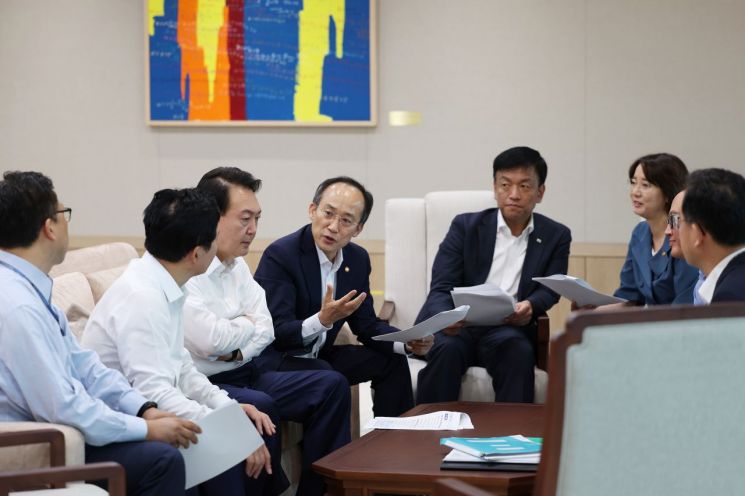
On the 8th, ahead of the first Emergency Economic and Livelihood Meeting, President Yoon reiterated, "Isn’t the whole world facing an economic crisis? The most important thing is that austerity in the public sector is inevitable." This aligns with the plan to use the funds secured through public sector austerity to provide stronger support to those more severely affected by the economic crisis.
President Yoon explained, "No matter how difficult it is, just as families must invest in their children’s education even in hard times, we cannot refrain from boldly investing in the country’s growth engines. That is why yesterday’s fiscal strategy meeting discussed future growth engines such as education, research and development (R&D), and expenditure restructuring."
Meanwhile, starting next week, President Yoon will receive the first work reports from ministers since the government’s launch. Instead of large gatherings with vice ministers and bureau chiefs, ministers will report directly to the president in private meetings. The work reports will cover core ministry tasks such as national agendas and livelihood measures. Discussions will also include public institution innovation, committee reorganization, and regulatory reform.
© The Asia Business Daily(www.asiae.co.kr). All rights reserved.

















