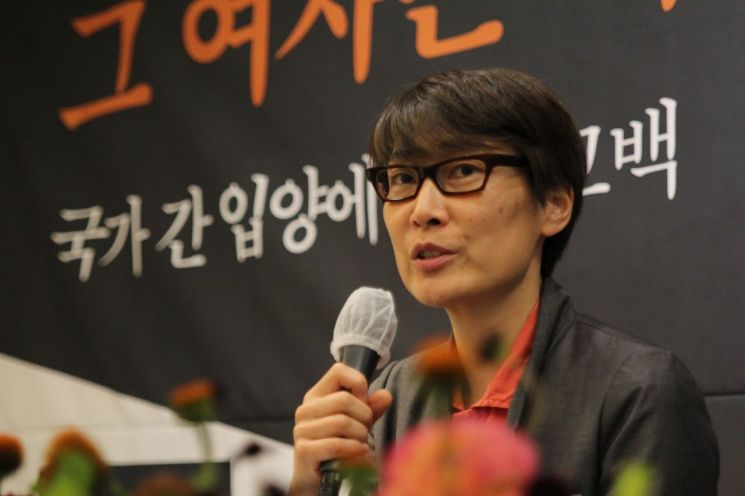
[Asia Economy Reporter Seomideum] “Intercountry adoption is often perceived as a good thing for both adoptive parents and adoptees, but in reality, adoptees face many difficulties due to intercountry adoption. I wanted to express that through a book.”
At a publication press conference held on the 7th at a cafe in Mapo-gu, Seoul, Maya Lee Langvad said this. She was born in Korea in 1980 and was adopted to Denmark. She particularly emphasizes being a woman in the book, and the book’s title is also “That Woman is Angry” (Nanda).
What makes her so angry? She realized early on that she was adopted because she looked different from her white parents. Seeing Korean adoptees in the Danish village, she came to know that she was adopted from Korea. However, she deliberately rejected being grouped with them and took a long time to accept her Korean identity. “I was angry at being forced to be grateful for being adopted into a good environment.” She was also angry at the situation where “finding parents for children is less prioritized than finding children for parents.”
Her visit to Korea in 2007 intensified her anger. Being part of a community that engaged in constructive criticism of adoption for four years and meeting adoptees from around the world, she became aware of the problems of intercountry adoption. She explained, “The more I learned about adoption, the more new points of anger I discovered,” adding, “Active anger has productivity. When seeking a healthy form of anger, the spark of change ignites.”
The book contains stories of adoptees she met in the community. The reason for using “that woman” in the book title was to “distance from the narrator and include testimonies from various people.” Regarding being adopted first because she was a woman, she said, “It is also connected to feminist issues.” She also explained that as a sexual minority, “I often had to observe from the outside.”
After reuniting with her birth parents in 2007, she cut off contact for five years. Language and emotional barriers stood in the way. “I went through five emotionally difficult years.” She lamented, “In Korea, adopted celebrities tend to be portrayed with grand narratives in the media, but there is a severe lack of coverage about the difficulties they face.”
Of course, she does not fail to understand the circumstances that leave no choice but to give up a child for adoption. She understands situations where there is no option. However, she expressed, “The high adoption rate in Korea, which has a low birthrate, raises questions,” and “Intercountry adoption is a business. Social and structural support is necessary.”
The book is composed in the form of a novel-like poem. The author said that this hybrid genre “was not a conscious approach,” but “subversive attempts were important. It was important to go toward a genre that had not been presented before.”
She also emphasized, “I really hope this book will be translated into English as well,” because “the texts in the book are testimonies that we jointly accomplished through various adoptees.”
© The Asia Business Daily(www.asiae.co.kr). All rights reserved.
![Clutching a Stolen Dior Bag, Saying "I Hate Being Poor but Real"... The Grotesque Con of a "Human Knockoff" [Slate]](https://cwcontent.asiae.co.kr/asiaresize/183/2026021902243444107_1771435474.jpg)
















