Ukraine Crisis, Inflation and Other Adverse Factors
Rapid Decline in IT and Device Demand
Concerns Over Boosting DS Performance
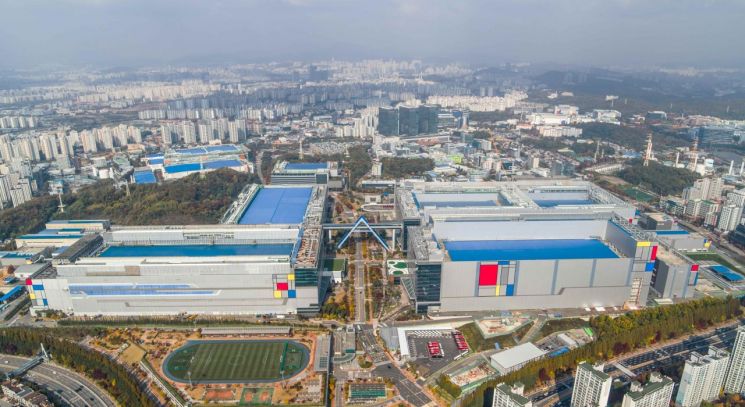
[Asia Economy Reporter Moon Chaeseok] As global demand declines and semiconductor inventories increase, there are forecasts that memory semiconductor prices, including DRAM and NAND flash, will see larger drops in the second half of the year. The DS (semiconductor) division accounts for about one-third of Samsung Electronics' operating profit, and memory semiconductors make up about three-quarters of the DS operating profit. The decline in semiconductor prices inevitably delivers a direct blow to Samsung Electronics' overall performance.
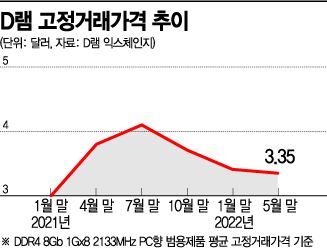
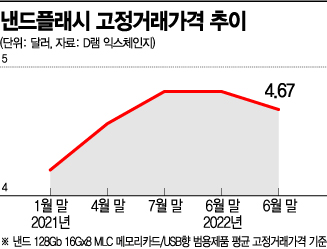
According to market research firm DRAMeXchange on the 7th, the fixed transaction price of DRAM rose from $3.80 in April-June last year and $4.10 in July-September, but reversed to a decline at $3.71 in October-December, $3.41 in January-April this year, and $3.35 in May-June. The fixed transaction price of NAND flash also steadily increased from $4.20 in January-March last year, $4.56 in April-June, and $4.81 from July to last May, but began to fall to $4.67 at the end of last month.
The problem is that the market situation is expected to worsen further in the second half. The prolonged Russia-Ukraine conflict, inflation, and rising interest rates are rapidly shrinking demand for IT devices that use semiconductors. Market research firm Gartner forecasted that global PC and smartphone shipments this year will decrease by 9.5% and 5.8%, respectively, compared to last year.
Park Jaegun, president of the Korea Semiconductor Display Technology Society (professor at Hanyang University), said, "Since more than half of DRAM manufacturers' performance depends on the PC and smartphone sectors, when the economy worsens, memory semiconductor demand sharply decreases, causing prices to fall. Companies will need to accelerate technological development to reduce production costs."
The DRAM market is seeing price drops even in server DRAM, which had previously helped defend prices. Reflecting this, the market expects the average price decline floor for DRAM across all uses?PC, mobile, and server?in the third quarter to be 10% or even more. Initially, the price drop was expected to be 3-8%, but the decline has deepened. Samsung Securities analyst Hwang Minseong said, "The DRAM decrease in the second quarter was mainly due to a slowdown in smartphone sales, and order reductions have been observed since May. The third quarter is expected to see weakness mainly in servers."
For Samsung Electronics, which heavily depends on memory semiconductors, there is no choice but to consider a 'Plan B' to boost DS division performance amid the deteriorating market environment. According to Samsung Electronics' detailed operating profit by division announced in April for the first quarter, the DS division recorded 8.45 trillion won, about twice the 4.56 trillion won of the DX (set) division, which combines video display, home appliances, and mobile. Considering that the DX division's sales of 48.07 trillion won are about twice the DS division's 26.87 trillion won, the DS division's significance is clear. Memory semiconductors accounted for 74.8% of the DS division's operating profit (20.09 trillion won).
Regarding this, President Park said, "Considering major variables such as the Russia-Ukraine war, it is not impossible that semiconductor companies, including Samsung, may adjust the pace of investment." A semiconductor industry insider also lamented, "It is difficult to predict now whether the memory semiconductor market will continue to stagnate, but the increasing uncertainty itself is indeed a burden on management."
© The Asia Business Daily(www.asiae.co.kr). All rights reserved.
![Clutching a Stolen Dior Bag, Saying "I Hate Being Poor but Real"... The Grotesque Con of a "Human Knockoff" [Slate]](https://cwcontent.asiae.co.kr/asiaresize/183/2026021902243444107_1771435474.jpg)












