Majority Opinion "Temporary Restriction on Account Holder's Property Rights... Not Severe Compared to Public Interest"
Opposing Opinion "Payment Suspension Clause Neglects Real Victims... Violates Balance of Legal Interests"
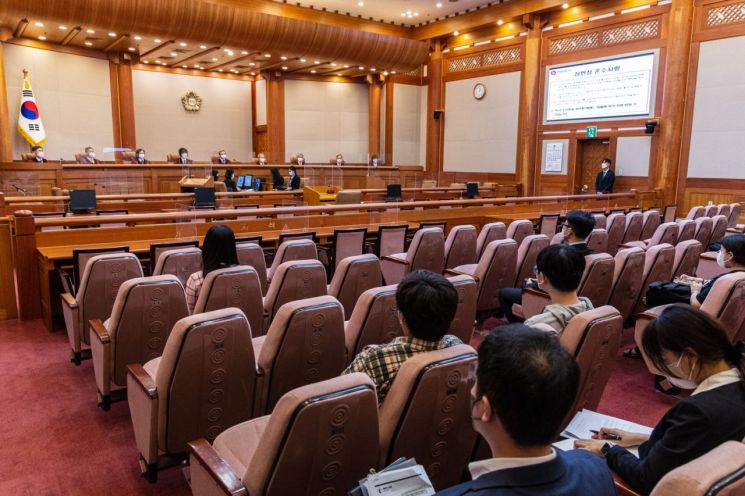
[Asia Economy Reporter Heo Kyung-jun] The Constitutional Court has ruled that a legal provision restricting account transactions, such as suspension of payment, does not violate the Constitution even if the account holder did not actually commit voice phishing crimes but the account was used for criminal activities.
On the 7th, the Constitutional Court announced that it dismissed the constitutional complaint filed by petitioner A against Article 4, Paragraph 1 of the Special Act on the Prevention of Telecommunications Financial Fraud and Refund of Damages, with a 6 to 3 decision by the justices.
The constitutional complaint against the provision restricting electronic financial transactions of account holders whose accounts have been suspended was unanimously dismissed by all justices.
In 2018, A sold cultural gift certificates to a member using an ID under B's name on an internet community and received a deposit of 828,000 won, but was subjected to electronic financial transaction restrictions by the Financial Supervisory Service.
This money was remitted by B, who had been a victim of voice phishing by a fraudster, and B immediately applied for damage relief to the financial institution, resulting in A's account being suspended and other accounts under A's name also being restricted from electronic financial transactions.
Article 4 of the Telecommunications Fraud Damage Refund Act stipulates that if there is suspicion that an account has been used in a telecommunications fraud such as voice phishing, the bank must immediately suspend payment on the account. Once payment is suspended, the Financial Supervisory Service must designate the account holder as a subject of electronic financial transaction restrictions.
A argued that suspending payment and restricting transactions solely because the account holder was used by a fraudster without involvement in the fraud infringes on property rights and filed a constitutional complaint.
However, the Constitutional Court judged that although the property rights of account holders unrelated to the crime may be temporarily restricted by the provision, the extent of the restriction is not considered excessive compared to the public interest of protecting victims, and thus does not violate the principle of proportionality.
On the other hand, Justices Yoo Nam-seok, Lee Eun-ae, and Lee Mi-sun dissented, stating, "The suspension provision prioritizes the property rights protection of potential victims over the property rights protection of the actual victims, the account holders, thus violating the balance of legal interests."
© The Asia Business Daily(www.asiae.co.kr). All rights reserved.
![Clutching a Stolen Dior Bag, Saying "I Hate Being Poor but Real"... The Grotesque Con of a "Human Knockoff" [Slate]](https://cwcontent.asiae.co.kr/asiaresize/183/2026021902243444107_1771435474.jpg)
















