As Part of Women Entrepreneurs Week... 'Women Startup Policy Forum' Held
"Expand Women Enterprise Fund... Opportunities Needed for Underserved Companies"
Experts Emphasize Need for Market Access and Entrepreneurial Spirit Development
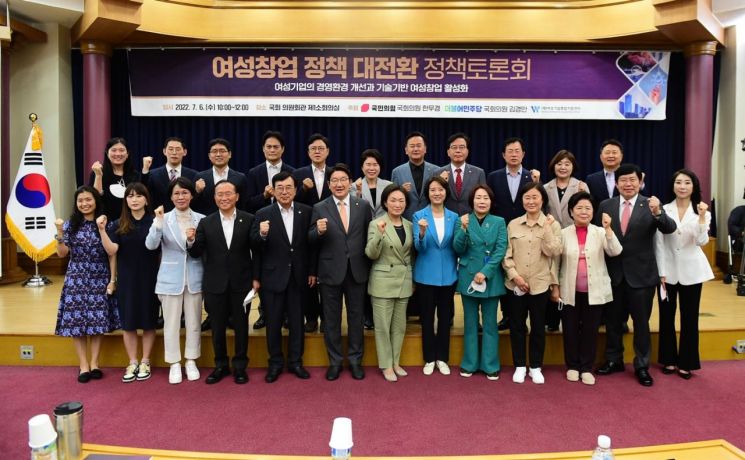 On the 6th, key participants are taking a commemorative photo at the Women's Entrepreneurship Policy Paradigm Shift Policy Forum held at the National Assembly Members' Office Building in Yeouido, Seoul.
[Asia Economy Reporter Kim Bo-kyung] "Almost all visible hurdles have been removed, but I felt a lack of infrastructure like oxygen. I kept stumbling over stones." (Lee Young, Minister of SMEs and Startups)
At the first Women's Entrepreneurship Week policy forum held this year, female entrepreneurs shared the difficulties they have experienced while running their businesses.
On the 6th, a forum titled "A Major Policy Shift for Women's Entrepreneurship" was held at the National Assembly Members' Office Building in Yeouido, Seoul, to examine the current status of women-led tech startups and explore ways to foster the growth of women-owned businesses.
Co-hosted by Han Mu-kyung, a member of the People Power Party, Kim Kyung-man of the Democratic Party of Korea, and the Women’s Enterprise Comprehensive Support Center, the forum was attended by over 100 participants including women entrepreneurs, related organizations, and experts.
Minister Lee Young, who gave the congratulatory remarks, is a former IT venture CEO who founded the security software company "Terten" in 2000. Reflecting on her time running a business, she said, "Whether I went to borrow money, get a loan, or meet clients, it was always men. I thought how great it would have been if I had graduated from an all-boys high school or served in the military."
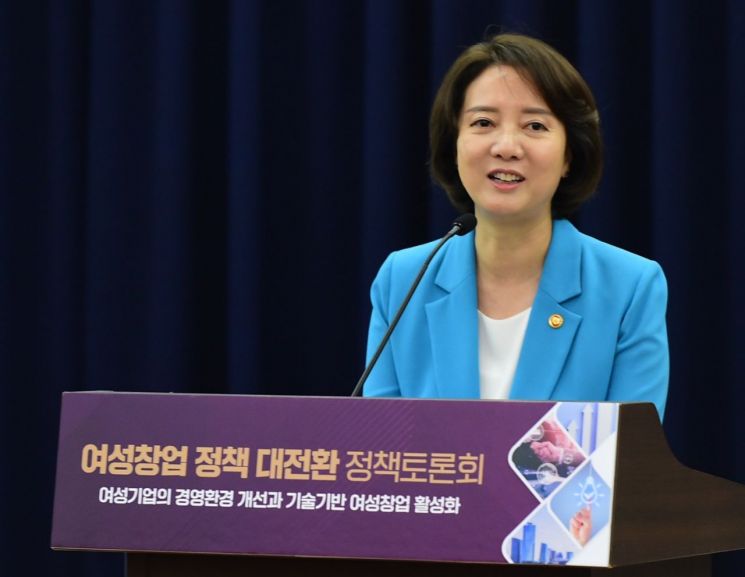 Lee Young, Minister of SMEs and Startups, is delivering a congratulatory speech at the Women's Entrepreneurship Policy Transformation Forum held at the National Assembly Members' Office Building on the 6th.
She recalled, "Many legal hurdles have been removed, but I ran in a situation without infrastructure like oxygen. The men's course, which has produced many players, is smooth to run on, but we kept stumbling over stones and weeds."
She added, "As a former female entrepreneur, I will incorporate voices from the field to improve the system," emphasizing, "Strategic nurturing of women-owned businesses is necessary for national interests as well."
People Power Party floor leader Kwon Seong-dong also said, "Due to low birth rates and aging, the working-age population is decreasing. It is forecasted that the potential growth rate will fall to the 0% range by 2030," adding, "Fostering women-owned businesses and increasing women's economic participation can play a role in solving various issues such as raising birth rates and elderly support."
Kang Ji-young, CEO of RoboArte, who presented at the forum, shared, "Whenever I went to the bank to get a loan, I was always asked, 'Are you the CEO?'" highlighting the need for a social atmosphere and policy support to foster female entrepreneurship.
Lee Jeong-han, director of the Women’s Enterprise Comprehensive Support Center, stated, "Women-owned businesses face difficulties in sales channels, funding, and networking," and emphasized, "To solve these, we need to closely examine the business environment faced by women-owned companies."
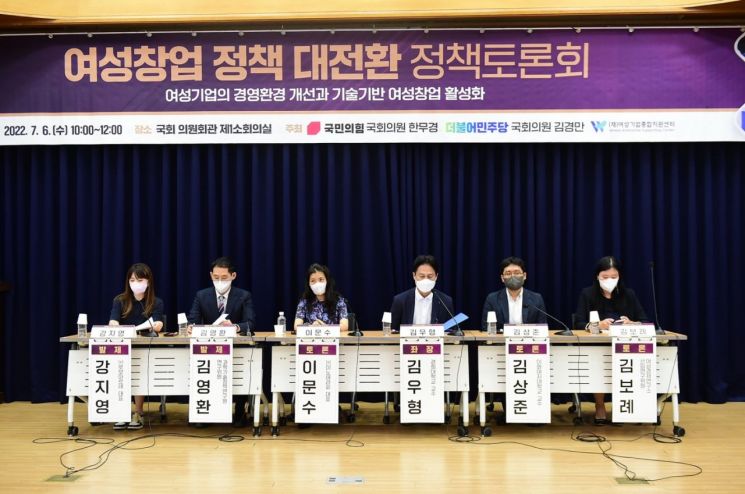 On the 6th, related agency officials, experts, and women entrepreneurs are conducting a comprehensive discussion at the Women's Entrepreneurship Policy Paradigm Shift Policy Forum.
According to Kim Bo-rye, senior research fellow at the Women's Economy Research Institute, last year, 121 technology-based women-led startups attracted 914.7 billion KRW in investment, but this accounted for only 7.6% of the total investment amount.
In this regard, Lee Moon-soo, CEO of InnoTherapy, a KOSDAQ-listed company, said, "There are various funds created for social purposes such as the re-startup fund, but women belong to a small minority among them," and argued, "Opportunities are needed for women-owned businesses in blind spots that do not benefit from women’s business funds."
Looking at last year's second round of the Korea Fund of Funds, the women’s business fund size was 20 billion KRW, which was relatively small compared to other policy funds such as patent technology commercialization (125 billion KRW), film funds (56 billion KRW), early-stage startup funds (146.6 billion KRW), and M&A funds (100 billion KRW).
Kim Young-hwan, a research fellow at the Science and Technology Policy Institute, cited the Ministry of SMEs and Startups’ survey on women-owned businesses, explaining that 35% of women-owned businesses experience difficulties in "securing sales channels."
He also mentioned that the proportion of women entrepreneurs who responded that they face disadvantages in loan conditions during financial transactions increased from 2018 to 2020, and that 61.6% reported feeling discrimination when dealing with other companies, which is relatively high.
It was also revealed that while the overall entrepreneurial spirit of women in their 20s is high, the gap with men widens from their 30s and is largest in their 40s. Researcher Kim analyzed, "During the career interruption period in their 30s and 40s, limitations appear in developing entrepreneurial spirit," adding, "Although the willingness to participate in social activities is strong, the capabilities and mindset to support it decline."
He continued, "The proportion of proactive and opportunity-driven startups, as opposed to passive and livelihood-driven startups, decreased most significantly in the 40s," and suggested, "We need to expand the scope of social contributions by women entrepreneurs while establishing support policies tailored to the women’s startup ecosystem."
© The Asia Business Daily(www.asiae.co.kr). All rights reserved.



















