Dining Out Prices See Highest Increase in 30 Years... Up 8.0% from a Year Ago
Office Workers Seeking Affordable Lunches... Reducing Meeting Appointments
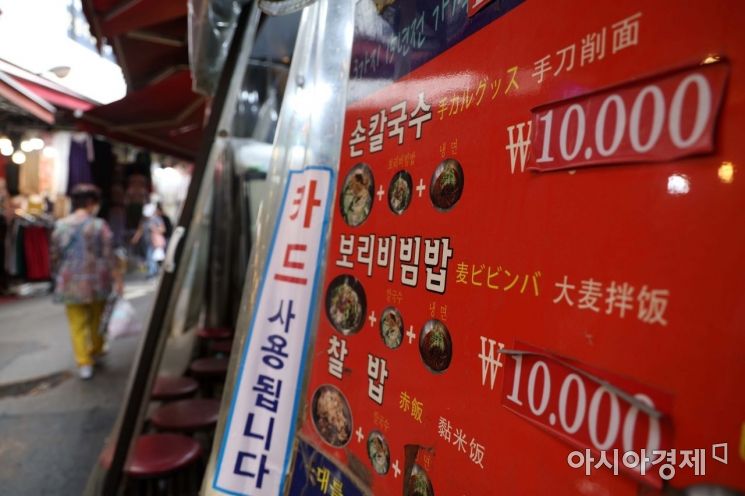 On the 4th, a day before the government's announcement of June consumer price trends, a restaurant in Namdaemun Market, Seoul, is quiet. Photo by Mun Ho-nam munonam@
[Asia Economy Reporter Yoon Seul-gi] As prices soar, the burden on citizens is increasing. In particular, office workers facing higher dining-out costs are roughly managing their meals with 'honbap' (eating alone), and some are cutting back on social appointments to tighten their wallets.
According to the consumer price trend for June announced by Statistics Korea on the 5th, consumer prices rose by 6.0% last month. Among personal services, dining-out prices increased by 8.0% compared to a year ago, marking the highest rise in about 30 years since October 1992 (8.8%).
Looking at detailed items, galbitang (beef rib soup) rose 12.1%, jajangmyeon (black bean noodles) 11.5%, chicken 11.0%, gimbap 10.6%, and raw fish 10.4%, all increasing by more than 10%. With the recovery of daily life after COVID-19, dining-out demand has increased, and rising raw material prices have led to higher production costs, pushing up overall dining-out prices.
The high dining-out prices have significantly increased lunch expenses for office workers. They are coping with 'lunchflation' (lunch + inflation) by bringing packed lunches or eating convenience store food alone.
A 20-something office worker, Mr. Han, said, "The company provides meal allowances, but since lunch expenses are included in the annual salary, it's basically money coming out of my own pocket. The quality of the company cafeteria food is not very good, but because lunch costs are burdensome, I reluctantly eat at the cafeteria."
A 21-year-old university student A, working as a student employee at the department office during vacation, said, "The hourly wage is about 9,000 won, but a decent meal costs around 10,000 won. I work from 9 a.m. to 6 p.m., but there is no separate meal allowance, so the burden is greater. Yesterday, I just had a roll of gimbap," he said.

Moreover, due to soaring dining-out prices, people are postponing or avoiding meetings with friends and acquaintances. The burden of high prices seems to be heavier on the MZ generation (Millennials + Generation Z), who generally have lighter financial situations.
Choi, a 25-year-old office worker who recently visited the cafe street in Seongsu-dong, Seongdong-gu, Seoul, felt the effects of hyperinflation. Choi said, "An Americano costs 7,500 won. Even considering that popular places have high prices, it's too expensive. Usually, I go to such places with friends, but just buying two coffees and one cake costs over 20,000 won." He added, "I used to enjoy cafe tours, but these days I hesitate to go as often as before."
Some have tightened their belts with 'frugal consumption.' Lee, a 20-something job seeker, said, "I stopped ordering delivery a long time ago, and prices quickly reach 50,000 won if I add a few items, so these days I am 'eating out of the fridge' (using ingredients at home to make meals). With my current part-time hourly wage, I have to live frugally and control my spending as much as possible. I hardly meet friends either," he said.
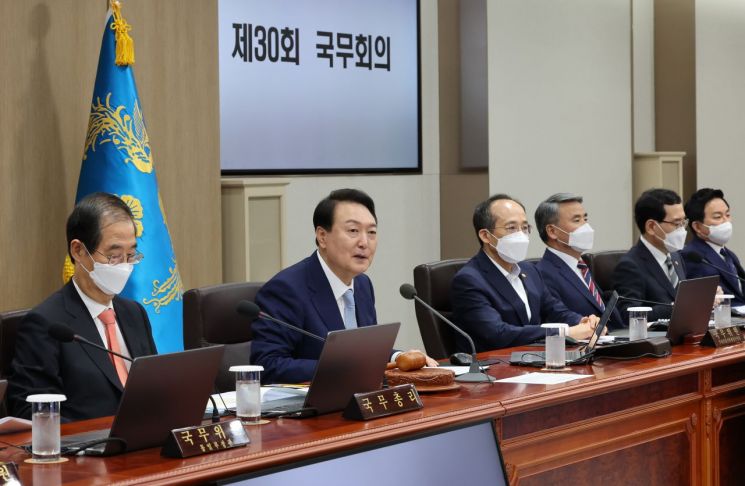 President Yoon Suk-yeol is speaking at the Cabinet meeting held on the morning of the 5th at the Yongsan Presidential Office building in Seoul. [Image source=Yonhap News]
Meanwhile, as price increases continue and warning signs flash for the low-income economy, President Yoon Seok-yeol has stepped forward to personally oversee price issues. Earlier on the 5th, President Yoon stated in his opening remarks at the Cabinet meeting held at the Yongsan Presidential Office building, "I will personally take care of the livelihood issues."
President Yoon said, "The economy is very difficult right now. Consumer prices rose about 6% last month. With supply chain restructuring and the COVID-19 pandemic overlapping, the world is experiencing the most severe price shock since the 1970s oil shock," he said.
He continued, "The public sector will take the lead in alleviating the difficulties of people's livelihoods. Public institutions will sell unnecessary assets, implement bold expenditure restructuring, and improve management efficiency to tighten their belts. The resources thus secured should be provided generously to those who are more vulnerable and struggling," he said.
The political sphere has also taken steps to reduce office workers' lunch expenses. On the 5th, Lee Su-jin, a member of the Democratic Party of Korea, introduced a bill to amend the Income Tax Act to increase the non-taxable limit on office workers' lunch expenses. The amendment raises the non-taxable limit for meal expenses from the current 100,000 won per month to 200,000 won per month.
Lee said, "The 100,000 won monthly limit has been the same standard for 19 years since the 2003 amendment. I have proposed an amendment to the Income Tax Act to set the non-taxable meal allowance to at least 200,000 won per month," she said.
© The Asia Business Daily(www.asiae.co.kr). All rights reserved.



















