Daegu Metropolitan City has recently been removed from the speculative overheating zones and adjustment target areas, leading to increased inquiries about the Daegu real estate market and growing expectations for a rebound.
On June 30, the Ministry of Land, Infrastructure and Transport held the '2022 2nd Residential Policy Deliberation Committee' and decided to lift the regulatory designation for all areas of Daegu. As a result, Suseong-gu was removed from the speculative overheating zone but remained an adjustment target area, while seven districts/counties?Jung-gu, Dong-gu, Seo-gu, Nam-gu, Buk-gu, Dalseo-gu, and Dalseong-gun?were lifted from the adjustment target area after one year and six months.
Except for Suseong-gu, these areas have become non-regulated zones, raising expectations for a real estate market rebound. Starting from the 5th, when the deregulation takes effect, various subscription qualifications will be relaxed in these areas. After only six months of subscription to a housing subscription savings account, applicants will qualify as first priority, and household members and multi-homeowners can also apply as first priority. Additionally, multi-homeowners will not be subject to heavy taxation, and the loan-to-value (LTV) ratio limit for mortgage loans will increase to 70%.
Accordingly, the sales industry predicts that many investors will flock to the Daegu real estate market, as even single-homeowners can obtain loans and various tax burdens are reduced. In particular, since supply is expected to continue steadily and the upward trend is not expected to be steep, experts agree that it is necessary to focus on areas with sufficient growth potential by considering future value and nearby favorable factors.
A real estate expert in Daegu said, "With Daegu being removed from regulated areas, there is already a noticeable buzz around unsold complexes," adding, "However, since unsold inventory is still accumulating and there is a considerable amount of planned supply, it is necessary to distinguish between good and bad properties, focusing on those with high future value rather than making blind contracts."
Among these, Seo-gu is being pointed out as an area with high growth potential. The opening of the high-speed rail Seo Daegu Station in March is expected to alleviate the saturated Dong Daegu Station's functions, and various large-scale favorable developments such as station area urban development projects are underway.
Seo Daegu Station is served by KTX and SRT trains departing from Seoul Station and Suseo Station, stopping 28 and 10 times respectively at Busan Station. The average number of passengers in the first week after opening was 2,473, which increased by about 37% to 3,398 in the seventh week, showing rapid vitality within a month and a half. In particular, in addition to KTX, a total of five railway lines are scheduled to be connected, including the Daegu Metropolitan Railroad (planned for 2023), Daegu Industrial Line (planned for 2028), Integrated New Airport Railroad (planned for 2029), and Dalbit Inland Railroad (planned for 2029), positioning it as a transportation and logistics hub representing the Yeongnam region.
Furthermore, the station area urban development project covering approximately 980,000 square meters around Seo Daegu Station is progressing smoothly. The feasibility study for the Seo Daegu station area urban development project, commissioned by Daegu City to the Ministry of the Interior and Safety, was selected as a non-subject project, exempting it from feasibility studies and central investment reviews. This has accelerated the project with the goal of shortening the project period by more than one year and six months compared to the original plan. A complex transfer center for high-speed and intercity buses is planned to be established at Seo Daegu Station, and additional plans to attract complex shopping malls, hotels, and various facilities for shopping, dining, leisure, and accommodation are also under consideration.
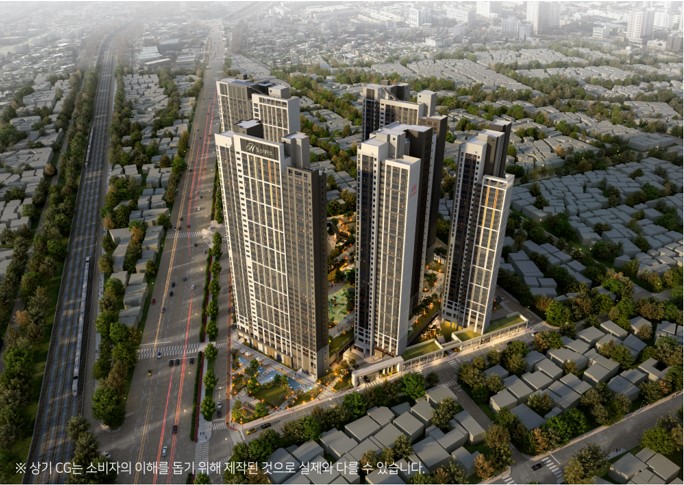
News of new apartment sales benefiting from these favorable factors continues. Hyundai Construction will launch 'Hillstate Seo Daegu Station Central' in July in the Bisan-dong area of Seo-gu, Daegu Metropolitan City. This complex will consist of six buildings with a total of 837 units: five apartment buildings ranging from two basement floors to a maximum of 39 floors, with 762 units of 84㎡ and 102㎡, and one residential officetel building with 75 units of 84㎡.
Hillstate Seo Daegu Station Central is within walking distance of Paldal Market Station on Daegu Subway Line 3, and offers convenient access to various parts of Daegu city via Paldal-daero and Sincheon-daero. Additionally, the relocation of Daegu City Hall, modernization of industrial complexes, and expansion of transportation networks around Seo Daegu Station are planned, which will further improve administrative, business, and transportation infrastructure in the future.
Moreover, Inji Elementary School is within walking distance, and Kyungil Middle School and Daegu Seobu High School are nearby. The densely packed academy district in northern Chimsan-dong is also easily accessible by car. Large shopping malls such as E-Mart Traders, E-Mart Chilseong Branch, and Paldal Market are located nearby, ensuring convenience in daily life. Additionally, Dongari Park, Hajungdo Park, Complex Sports Town, and Daegu Opera House are located nearby, allowing residents to enjoy a pleasant natural environment and cultural facilities close at hand.
Meanwhile, a model house for Hillstate Seo Daegu Station Central will be prepared.
© The Asia Business Daily(www.asiae.co.kr). All rights reserved.
![Clutching a Stolen Dior Bag, Saying "I Hate Being Poor but Real"... The Grotesque Con of a "Human Knockoff" [Slate]](https://cwcontent.asiae.co.kr/asiaresize/183/2026021902243444107_1771435474.jpg)
















