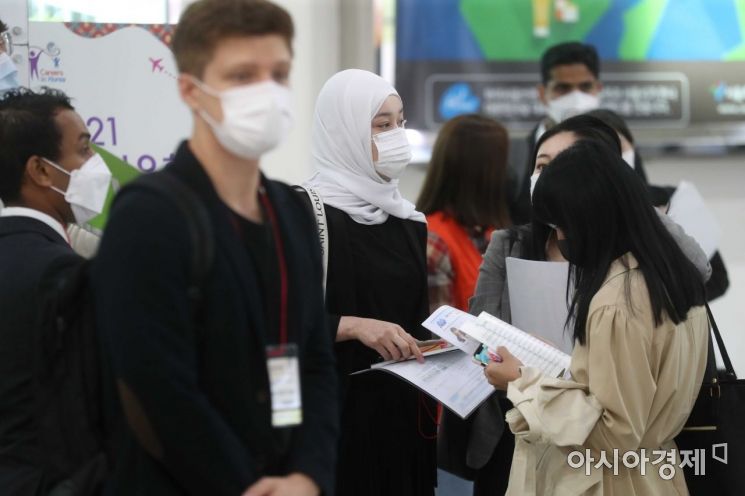
 The '2021 Foreign Student Recruitment Fair' was held on the 12th at SETEC Exhibition Hall 3 in Gangnam-gu, Seoul. Foreign students are waiting to enter. Photo by Mun Ho-nam munonam@
As COVID-19 prolonged, foreign workers who had stayed in their home countries are gradually entering Korea. The Ministry of Employment and Labor expects more than 10,000 foreign workers to enter this month alone, and monthly arrivals in the tens of thousands throughout the second half of the year. When the Employment Permit System for foreigners was implemented in 2004, foreign workers mainly filled positions in so-called 3D industries that domestic workers avoided. Now, they have become indispensable essential personnel, influencing politics, economy, industry, and society as a whole.
Although the population is naturally declining and the birth rate is among the lowest in the world, 7 out of every 100 children are born into multicultural families, and there are 160,058 children from multicultural families attending elementary, middle, and high schools (as of 2021). This is about three times the number from 10 years ago (46,954 in 2012). International marriages have decreased to an annual average of 13,000 to 15,000 cases over the past two years due to COVID-19, but previously exceeded 20,000 cases annually. Minister of Justice Han Dong-hoon raised the establishment of an Immigration Office as a key issue because a control tower is needed to systematically promote foreign immigration to overcome the population cliff. The establishment of an Immigration Office, pursued since the Kim Dae-jung and Roh Moo-hyun administrations, has repeatedly failed due to conflicts between the government and political circles and debates over pros and cons across various sectors of society.
The reality is that public perception and acceptance of so-called ‘Daehan Oegugin’ (foreigners in Korea) have not significantly improved. According to a public perception survey on foreigners and immigration policy by the Korean Society for Survey Research, many citizens believe the number of immigrants should remain at the current level or decrease, and consider important conditions for naturalization to include paying social insurance premiums and having no criminal record. Regarding foreign workers, while there is support for increasing their numbers due to labor shortages, there are also many voices opposing it due to concerns about worsening public safety and reduced job opportunities for domestic workers. Yoon In-jin, president of the Korean Migration Studies Association (professor at Korea University), said, "Immigration policy is a policy for both the public and immigrants," adding, "Since the number of foreign residents in Korea has already exceeded 4% of the total population, we must now carefully plan a ‘prepared future’ to live together with diverse immigrants."
© The Asia Business Daily(www.asiae.co.kr). All rights reserved.

















