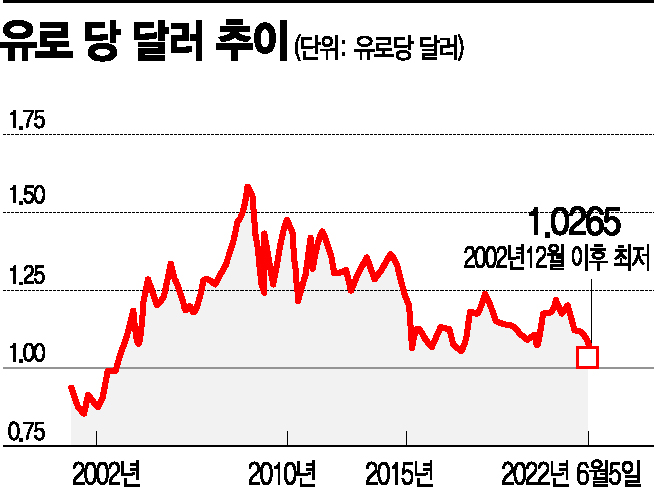
[Asia Economy New York=Special Correspondent Joselgina] As fears of an economic recession surge, the demand for the US dollar has sharply increased, pushing the dollar's value to its highest level in nearly 20 years. In particular, some analysts even say that the '1 dollar = 1 euro' parity is only a matter of time.
On the 5th (local time) in the New York foreign exchange market, the ICE Dollar Index, which measures the value of the dollar against the currencies of six major countries, rose 1.30% from the previous session to 106.51. This is the highest level since November 2002. Compared to a year ago, the increase is nearly 11%.
Especially in the Eurozone, where recession concerns have deepened due to Russia's invasion of Ukraine, the euro fell 1.5% from the previous session to $1.026 per euro, moving closer to euro-dollar parity. The last time the two currencies were at parity was in the second half of 2002. Currently, the euro's value against the dollar is at its lowest level since the end of December 2002.
Nomura Securities predicted, "By August, the era of parity between the dollar and the euro will begin." Neil Jones, head of foreign exchange at HSBC Holdings, also said, "Parity is just a matter of time." There are warnings that if Russia cuts off supplies through the Nord Stream 1 gas pipeline directly connected to Germany, the euro could fall below one dollar.
Currently, the dollar is also showing clear strength against the yen and Swiss franc, which are considered safe-haven currencies in the foreign exchange market. This is interpreted as a result of increased preference for the dollar, a representative safe-haven asset, amid growing fears of a recession. Especially as the Federal Reserve (Fed) has signaled a 0.5 or 0.75 percentage point interest rate hike at the July Federal Open Market Committee (FOMC) meeting, the strong dollar trend is expected to continue for the time being.
However, if euro-dollar parity becomes a reality, there are concerns it could trigger a vicious cycle that further drives up inflation in the Eurozone, which has already soared due to war and supply chain disruptions. Rabobank pointed out, "Currency depreciation will accelerate inflation and cause stock price declines," adding, "The uncertainty brought by the era of euro-dollar parity will inevitably make policy decisions more difficult for authorities."
A strong dollar inevitably deals a direct blow to emerging markets as well. As John Connally, former US Treasury Secretary who attended the Group of Ten (G10) meetings in the 1970s, famously said, "The dollar is our currency, but it is your problem." The Wall Street Journal (WSJ) reported, "The strong dollar is hammering currencies in emerging markets," noting that it lowers currency values and triggers inflation, damaging emerging economies.
Concerns over the strong dollar are also raised within the United States. Morgan Stanley pointed out that the strong dollar could hurt the global earnings translation of US companies. In the first half of this year, the losses US companies suffered due to exchange rate fluctuations amounted to $40 billion, about five times more than a year ago.
© The Asia Business Daily(www.asiae.co.kr). All rights reserved.

















