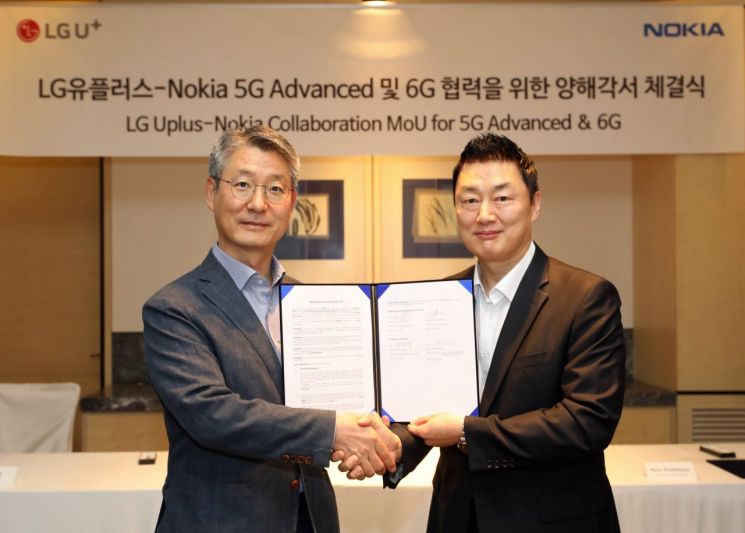
 At the MWC 2022 Revisited event hosted by Nokia at the Four Seasons Hotel in Gwanghwamun, Seoul, Junhyuk Kwon, Head of Network Division at LG Uplus (left), and Taeho Ahn, President of Nokia Korea, are signing a business agreement.
[Asia Economy Reporter Lim Hye-sun] LG Uplus announced on the 6th that it has signed a memorandum of understanding (MOU) to strengthen research and development cooperation in 5th generation (5G) Advanced and 6G fields together with global telecommunications equipment manufacturer Nokia.
Through this agreement, the two companies plan to collaborate on the development of ‘network architecture expansion, frequency expansion, and service space expansion technologies’ that will be fully realized in 5G Advanced, the evolutionary stage of 5G, and 6G. They will also work together to derive requirements for key technologies and discover new technologies.
In 6G networks, standard technologies are needed to separate the hardware and software of wireless communication equipment such as base stations that make up the radio access network (RAN), like Open RAN, and to implement interoperability between equipment from different manufacturers.
To this end, the two companies will jointly conduct research on key Open RAN technologies such as open front haul, Cloud RAN, and Radio Access Network Intelligent Controller (RIC). Once these Open RAN technologies are commercialized in the future, telecommunications companies will secure flexibility in network construction and create opportunities to induce technological innovation from various industries.
‘Energy Harvesting’ technology, which reuses discarded energy, is also a technology that expands 6G networks. The two companies will also jointly research the technical effectiveness and utilization methods of the new technology ‘liquid-cooled base stations.’
To secure 6G frequency expansion technology, they plan to conduct joint research on the next-generation antenna technology called ‘Reconfigurable Intelligent Surface (RIS).’ Reconfigurable Intelligent Surface is one of the 6G element technologies that uses the electromagnetic properties of the antenna surface to adjust the transmission power of radio waves emitted from the base station to the user, and it is likened to an ‘intelligent mirror’ that controls transmission according to the characteristics of the radio waves.
The two companies have conducted field tests for the purpose of verifying 6G advanced technologies and will jointly research terahertz wave RIS technology, which is emerging as a 6G frequency.
In addition, the two companies plan to jointly conduct research on ‘Non-Terrestrial Networks (NTN)’ to secure 6G service space expansion technology. Non-Terrestrial Networks are technologies that provide network quality similar to general cellular networks even in the sea, remote islands, or airspace. LG Uplus has previously conducted research on optimizing low Earth orbit satellite networks through quantum computer D-Wave in collaboration with the Korea Advanced Institute of Science and Technology (KAIST).
© The Asia Business Daily(www.asiae.co.kr). All rights reserved.

















