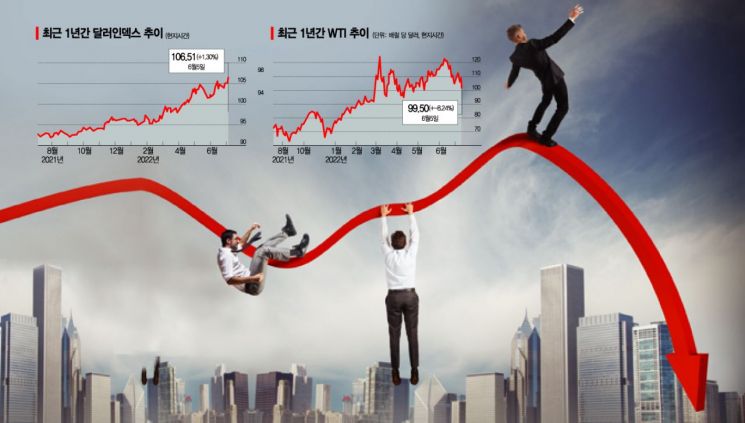
[Asia Economy New York=Special Correspondent Joselgina, Reporter Moon Jewon] The so-called ‘R (Recession) fear’ has engulfed the global financial markets. International oil prices, which had been soaring amid concerns over slowing consumption, plummeted below $100. The inversion phenomenon of the U.S. long- and short-term Treasury yields, considered a signal of recession, reappeared. Amid the dollar’s value soaring to its highest level in nearly 20 years, the intraday value of the Korean won against the dollar touched 1,311 won, marking the lowest in 13 years.
On the 5th (local time) at the New York Mercantile Exchange (NYMEX), August delivery West Texas Intermediate (WTI) crude oil closed at $99.50 per barrel, down 8.2% from the previous trading day. This is the first time since May 11 ($99.76) that WTI prices fell below the $100 per barrel mark. The September Brent crude on the London ICE Futures Exchange also dropped 9.7%, trading around $102 per barrel.
This sharp decline is due to rapidly spreading concerns that energy demand will shrink as the possibility of a recession increases. On the same day, in the New York bond market, the inversion phenomenon was confirmed again as the yield on the U.S. 2-year Treasury briefly surpassed the 10-year Treasury yield (2.792% vs. 2.789%). The inversion, where the short-term 2-year yield exceeds the benchmark long-term 10-year yield, is generally regarded as a precursor to a recession. This is the third time this year that such a phenomenon has occurred.
Recently, indicators suggesting a slowdown in economic growth in the U.S. have been released one after another. The Atlanta Federal Reserve Bank’s GDPNow, which compiles real-time data, estimated on the 1st that the U.S. second-quarter gross domestic product (GDP) growth rate would be -2.1% annualized. This is a warning that a ‘technical recession,’ defined as two consecutive quarters of negative growth, could become a reality.
On the same day, investment bank Nomura warned that major countries worldwide?including the U.S., Eurozone (19 countries using the euro), the U.K., Japan, Korea, Australia, and Canada?could enter a recession within 12 months.
Not only crude oil but also futures prices of major raw materials such as metals and grains mostly declined that day. The U.S. dollar’s value surged to its highest level in 20 years, acting as a headwind in commodity markets traded in dollars. The Dollar Index, which shows the value of the dollar against six major currencies, surpassed 106, reaching its highest level since November 2002.
The won-dollar exchange rate broke through the 1,310 won level, setting a new yearly high. On the 6th, in the Seoul foreign exchange market, the won-dollar exchange rate opened at 1,308.50 won, up 8.20 won from the previous trading day, and surged to 1,311.0 won in early trading. This intraday high is the highest in 13 years since July 13, 2009 (1,315.0 won). The exchange rate also easily surpassed the yearly high of 1,303.7 won recorded on the 30th of last month.
Meanwhile, the New York stock market closed mixed after a rollercoaster session on the first trading day following the Independence Day holiday. Investors are awaiting the Federal Reserve’s June Federal Open Market Committee (FOMC) minutes to be released this week and the June employment report due later in the week.
© The Asia Business Daily(www.asiae.co.kr). All rights reserved.
![From Hostess to Organ Seller to High Society... The Grotesque Scam of a "Human Counterfeit" Shaking the Korean Psyche [Slate]](https://cwcontent.asiae.co.kr/asiaresize/183/2026021902243444107_1771435474.jpg)
















