Biden Administration Strengthens Efforts to Curb China's Semiconductor Rise
ASML, the 'Super Eul' Valued by Samsung's Lee Jae-yong
DUV Equipment Facing US Export Halt Pressure, Domestic Supply Shortage Amid China's Sweep
[Asia Economy Reporter Jeong Hyunjin] The United States, focused on curbing China's semiconductor rise, is once again pressuring ASML, the Dutch semiconductor equipment manufacturer known as the 'super subcontractor' in the semiconductor industry. Following the ban on exporting extreme ultraviolet (EUV) lithography equipment essential for advanced processes, the U.S. is reportedly continuing its pressure by lobbying the Dutch government to prevent the export of older models, such as deep ultraviolet (DUV) lithography equipment, to China.
On the 5th (local time), Bloomberg News, citing multiple sources, reported that the U.S. government is lobbying the Dutch government to block ASML from selling older semiconductor equipment, including DUV, to China. Additionally, at the end of May and early June, Don Graves, U.S. Deputy Secretary of Commerce, visited the Netherlands and Belgium to discuss supply chain issues and mentioned the China export issue. Sources said he also visited ASML headquarters and met with CEO Peter Wennink to discuss related matters.
ASML is the world's only company producing EUV equipment necessary for cutting-edge processes. Global semiconductor companies such as Samsung Electronics, U.S. Intel, and Taiwan's TSMC line up with billions of won to acquire ASML's equipment, making its power so strong that it is called the 'super subcontractor.' Samsung Electronics Vice Chairman Lee Jae-yong recently cited his visit to ASML during a European business trip to see next-generation technology as one of the most important moments.
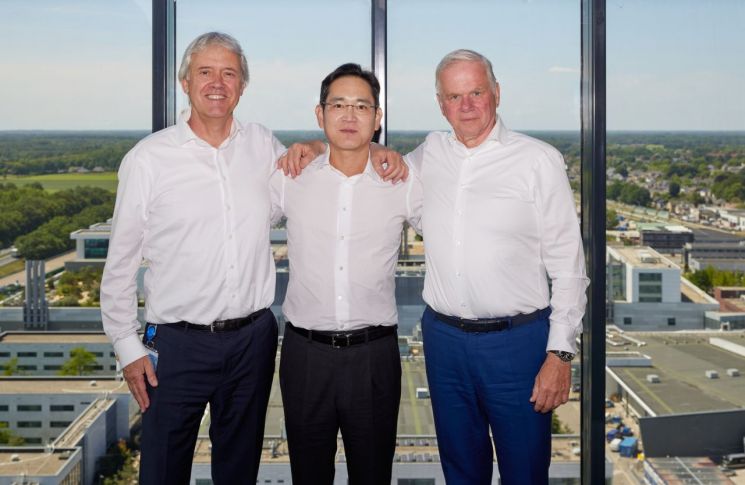 Samsung Electronics Vice Chairman Lee Jae-yong (center) is taking a commemorative photo with ASML CEO Peter Wennink (left) and ASML CTO Martin van den Brink at ASML headquarters in Eindhoven, Netherlands, on the 14th of last month (local time).
 [Photo by Yonhap News]
The DUV equipment that the U.S. is demanding the Netherlands to halt exports of is a device that uses light to engrave electronic circuits on wafers and is an older version of the advanced EUV equipment. This equipment is mainly used in semiconductor processes other than foundry (semiconductor contract manufacturing) processes below 5 nanometers (nm; 1 nanometer is one-billionth of a meter), and in memory semiconductors, more than 90% adopt DUV processes. In recent years, as China has shifted its focus from advanced process competition to developing outdated processes, Chinese companies have actively purchased DUV equipment, causing domestic semiconductor companies to experience shortages in DUV equipment supply.
The Dutch government reportedly has not yet agreed to the U.S. proposal, viewing additional restrictions on ASML's exports to China as potentially damaging to trade relations with China. The Dutch government is already not granting ASML permission to export EUV equipment to China. China is the Netherlands' third-largest trading partner after Germany and Belgium.
Bloomberg analyzed, "This move by the U.S. aims to expand the suspension of advanced system sales to China to curb China's semiconductor rise," adding, "If the Dutch government agrees, it would seriously impact Chinese semiconductor companies from SMIC to Hua Hong Semiconductor." Johnson Wang, an analyst at the Taiwan Institute of Economic Research (TIER), evaluated, "Lithography equipment is the hardest equipment for China to replace," and "Without overseas DUV lithography equipment, the advancement of China's semiconductor industry could be halted."
ASML stated, "These discussions are not new, and no decisions have been made," adding, "We will not specifically respond to rumors." However, CEO Peter Wennink expressed opposition earlier this year to banning DUV equipment sales to China. Following Bloomberg's report, ASML's stock price fell. On that day, ASML closed at $432.40 on the Nasdaq, down 3.87% from the previous day.
Meanwhile, Bloomberg also reported that the U.S. government is applying similar pressure on Japan. Nikon of Japan sells similar technology to Chinese semiconductor companies, and the U.S. is requesting a halt to these sales.
© The Asia Business Daily(www.asiae.co.kr). All rights reserved.
![Clutching a Stolen Dior Bag, Saying "I Hate Being Poor but Real"... The Grotesque Con of a "Human Knockoff" [Slate]](https://cwcontent.asiae.co.kr/asiaresize/183/2026021902243444107_1771435474.jpg)












