Meeting Press Corps After Inauguration, Responds to Tuition and Education Issues
"Never Hired a Lawyer" Regarding DUI Suspended Sentence
On Education Reform: "Will Create a New Framework Starting with Organizational Structure, Many Challenges Ahead"
On Expanding Semiconductor Quotas in the Capital Area: "Seeking Advice to Catch Two Rabbits"
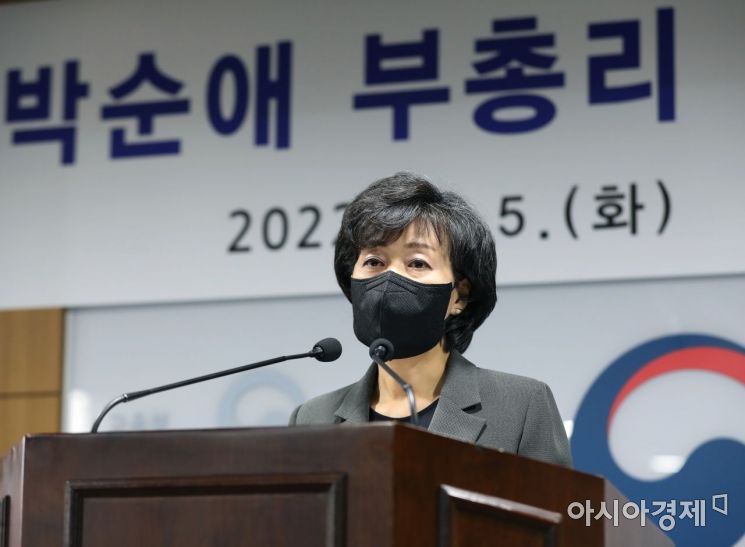 On the 5th, at the inauguration ceremony held at the Government Sejong Complex, Deputy Prime Minister and Minister of Education Park Soon-ae is delivering her inaugural address.
[Asia Economy Reporter Han Jinju] Deputy Prime Minister and Minister of Education Park Soon-ae stated on the 5th that there will be "no immediate measures to raise university tuition fees" regarding the policy to ease regulations on university tuition fees.
On the same day, Park met with the press corps after her inauguration and said, "We need to find a compromise between our intentions and the opinions of universities," adding, "Since inflation is rising too much, even if a pledge was made, there should be some leeway in implementation, and there will be no immediate tuition fee increase."
Park added, "I believe that excessive burdens should not be placed on private universities, and financial support necessary for education can be provided," and "a roadmap will be released soon."
Regarding the issue of receiving a suspended sentence in 2001 after drunk driving while intoxicated, she expressed regret, saying, "I am sorry."
She said, "I have reflected a lot on the mistake I made 20 years ago and am aware that I do not meet the expectations of many people. Among the misunderstandings in society, I have never hired a lawyer," adding, "I think the special pardon for drunk driving before the trial might have influenced the judge. If there are parts that need clarification during the verification process, I will explain."
Regarding the reason for being appointed as the first Minister of Education under the Yoon Suk-yeol administration, she mentioned 'education reform.' Park said, "I think there is a perception that due to various stakeholders in education, the educational services desired by students and the public are not properly delivered," and "I believe I was chosen because I am detached from educational interests and can exert neutral momentum for reform."
On education reform, she mentioned fairness in education and the integration of early childhood, kindergarten, and elementary education, saying, "I want to create a new framework encompassing all aspects, starting from the organizational structure."
Park said, "There is public concern about distrust in public officials and the provision of services based more on suppliers' interests than those of consumers. I wonder whether educational fairness is properly provided within the current system or if accumulated interests have hindered progress," adding, "There will be obstacles to proceeding in my way and the Yoon administration's way, but I intend to systematically change things."
Park emphasized, "The issue of integrating early childhood, kindergarten, and elementary education is an old one that has not been resolved, and university admissions have also failed to produce smooth solutions. The number of instructional hours and subjects are related to teachers rather than guaranteeing students' choices," adding, "Organizational diagnosis or dismantling has been raised as a key topic of education reform. I want to create a new framework encompassing all aspects, starting from the organizational structure. There are many obstacles, so I will continue discussions with the public, the media, and the presidential office to produce results."
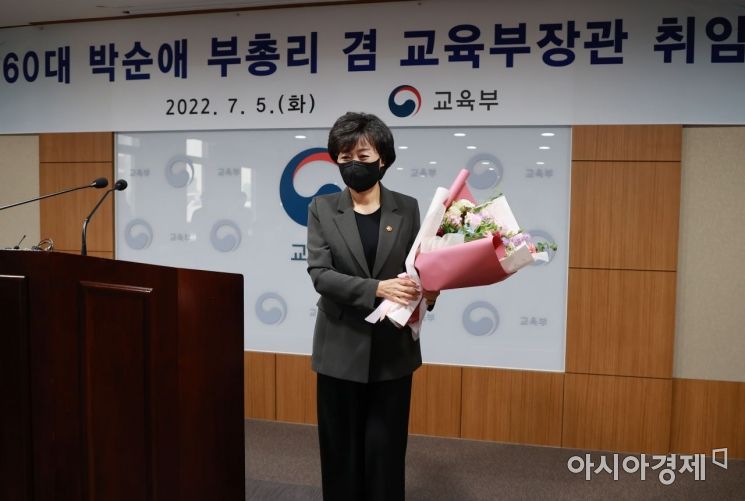
Regarding her mention of a "comprehensive review of higher education regulations" in her inaugural speech, she diagnosed the current situation by saying, "Regulations have piled up layer upon layer, creating a form of deterioration."
Park said, "As regulations have accumulated, they have manifested more as a form of deterioration rather than positive aspects, putting many private universities in various dilemmas," adding, "There are demands from private universities and parts of education that must be conducted within a public framework, so we will start working on which regulations to ease so that they do not hinder the provision of educational services."
Regarding the backlash from regional universities over the expansion of semiconductor department quotas at metropolitan universities, she did not provide a clear solution. Park said, "In the metropolitan area, there have been requests regarding quotas for semiconductor personnel, and regional universities are concerned about regional extinction," adding, "We have received policy advice from experts on ways to catch both rabbits."
She continued, "The Yoon Suk-yeol administration plans to have regions take responsibility from early childhood education to higher education, and even if regulations on metropolitan universities are eased, we want to create conditions so that people want to find their living grounds in the regions. There is no immediate answer, but there will be a day soon to announce policies."
She also said she will continue follow-up work for the formation of the National Education Committee, which will be launched on the 21st. Park said, "Although the committee was established by the previous government, we will coordinate so that the Ministry of Education and the National Education Committee create good governance through collaboration and division of labor," adding, "We are not idle as some worry; preparations are underway this week to receive recommendations."
© The Asia Business Daily(www.asiae.co.kr). All rights reserved.


















