[Asia Economy Honam Reporting Headquarters Reporter Park Jin-hyung] Gwangju Global Motors (GGM) is navigating smoothly despite difficulties such as the shortage of automotive semiconductor parts and the economic downturn.
According to Gwangju Global Motors on the 5th, as of June 30, cumulative production surpassed 35,000 units, with over 22,500 units produced this year alone.
This achievement was made amid unstable surrounding conditions such as semiconductor-related parts shortages in the first half of the year and the Cargo Solidarity strike, leading to a forecast that reaching the annual production goal of 50,000 units will be smooth.
It is analyzed that Gwangju Global Motors' performance in the first half was possible primarily because all executives and employees, including the CEO, united with a spirit of mutual growth.
Also, when difficulties in securing automotive semiconductor parts arose due to lockdowns caused by the COVID-19 situation in China during March and April, swift measures such as emergency procurement of parts from Canada through close cooperation with Hyundai Motor Company helped minimize damage.
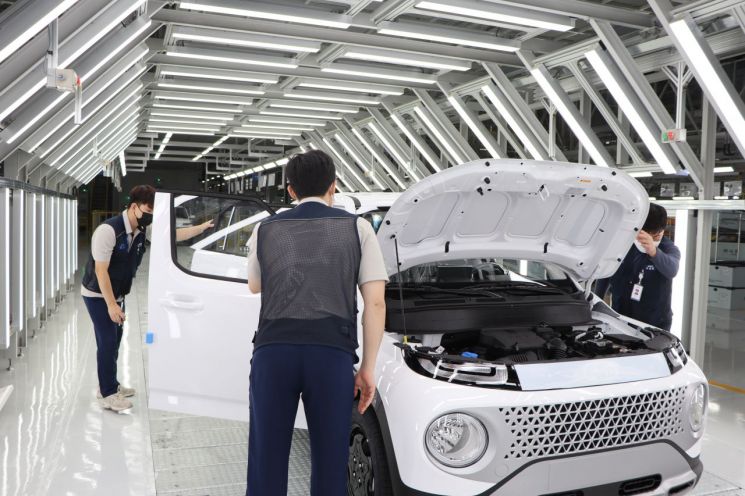
Along with this, producing the ‘Casper Van’ since March, in addition to the Casper which has been wildly popular since its launch, satisfied diverse consumer preferences and positively contributed to the smooth sailing in the first half.
The successful first-half performance of Gwangju Global Motors is particularly meaningful as it completely dispelled recent doubts raised by some quarters regarding sustainability.
In fact, some political circles recently cited a 20 billion won deficit last year and claimed that things would become more difficult, but GGM’s first-half results proved these claims to be unfounded speculation not based on facts.
A Gwangju Global Motors official stated, “The deficit recorded in last year’s accounting was due to labor costs and other expenses incurred during the process of building the factory, installing facilities, and recruiting hundreds of personnel to prepare for mass production. Since the full-scale production of new cars began this year, we have completely turned to profitability.”
As Gwangju Global Motors overcame all difficulties and achieved satisfactory results in the first half, the dominant outlook is that production will gain even more momentum in the second half.
Parts supply issues have been smoothly resolved, and on the 4th, Mayor Kang Ki-jung of Gwangju, who took office as the 8th popularly elected mayor on the 1st, visited Gwangju Global Motors and promised through dialogue with worker representatives that the city would actively and promptly support the social wages demanded by workers. This is expected to greatly help in practicing mutual growth and boosting morale.
Park Kwang-tae, CEO of Gwangju Global Motors, said, “Although we faced external difficulties such as semiconductor parts shortages in the first half, all executives and employees united with a spirit of mutual growth to overcome them, enabling us to approach production in the second half with greater confidence. Continuous profitability has started this year, and with the city of Gwangju promising to promptly promote support such as housing costs, conditions are improving. I am confident that we will not only achieve this year’s goals but also firmly establish and succeed as a mutual growth job creation company.”
© The Asia Business Daily(www.asiae.co.kr). All rights reserved.

















