Heo Jun, Distinguished Professor at Korea Institute for Advanced Study and Princeton University
'Mathematics Nobel Prize' awarded to under 40
International Mathematical Union awards at International Congress of Mathematicians
Recognized for solving challenges like the Riemann Hypothesis and Rota's Conjecture
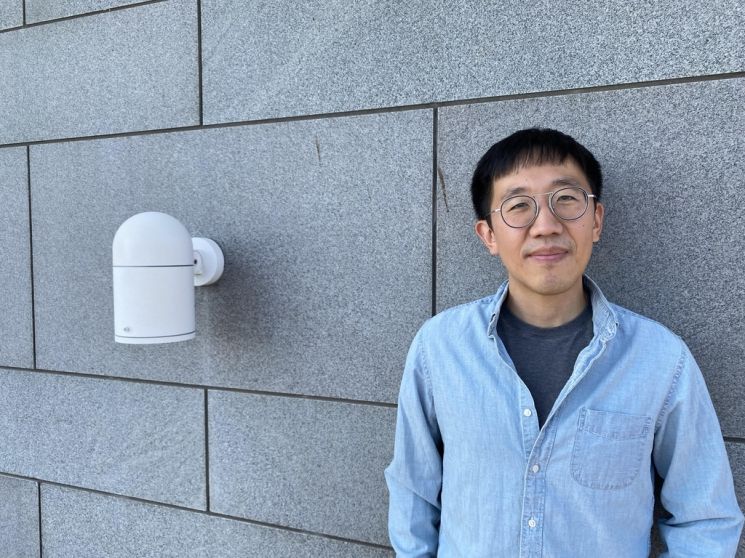
[Asia Economy Reporter Kim Bong-su] A Korean mathematician has become the first ever to receive the Fields Medal, known as the "Nobel Prize of Mathematics."
According to the Korean Mathematical Society on the 5th, at the International Congress of Mathematicians (ICM) held in Helsinki, Finland, Heo Jun, a professor at Princeton University and a distinguished scholar at the Korea Institute for Advanced Study, became the first Korean mathematician to be awarded the Fields Medal, the highest honor in mathematics.
This award is given by the International Mathematical Union (IMU) every four years at the ICM to mathematicians under the age of 40 and is widely regarded as the highest honor in mathematics, often called the Nobel Prize of Mathematics. Unlike the Nobel Prize, which is awarded annually and often shared among multiple recipients, the Fields Medal is awarded every four years to a maximum of four individuals and cannot be shared, making it more difficult to receive. Professor Heo earned the honor as the first Korean mathematician in the 126-year history of the ICM.
Professor Heo is a Korean-American born in the United States. However, he moved to Korea and received all his education from elementary school through to his master's degree in graduate school in Korea. He graduated with a double major in the Department of Mathematical Sciences and the Department of Physics and Astronomy at Seoul National University and completed a master's degree in mathematics. After earning his Ph.D. in mathematics from the University of Michigan in the United States, he is currently a professor at Princeton University and a distinguished scholar at the Korea Institute for Advanced Study.
Professor Heo was awarded the Fields Medal in recognition of his pioneering work in solving numerous difficult problems in combinatorics using algebraic geometry. His research achievements have contributed to the development of various applied fields such as information and communication, semiconductor design, transportation, logistics, machine learning, and statistical physics. He notably solved the Reed conjecture, a representative open problem in combinatorial algebraic geometry.
Professor Heo's father is Heo Myung-hoe, an emeritus professor in the Department of Statistics at Korea University, and his mother is Lee In-young, an emeritus professor in the Department of Russian Language and Literature at Seoul National University College of Humanities. He attended Bangil Elementary School, Isu Middle School, and Sangmun High School (which he dropped out of) in Seoul. It is well known that he dropped out of high school to pursue becoming a poet and passed the qualification exam. He then earned a bachelor's degree in Physics and Astronomy from Seoul National University in 2007 and a master's degree in Mathematics from the same university in 2009.
After moving to the United States, during his doctoral studies in 2012, Professor Heo gained fame by solving the Reed conjecture, a mathematical problem that had remained unsolved for nearly 50 years. The Reed conjecture was proposed in 1968 by British mathematician Ronald Reed and is a problem in combinatorics. He also solved another difficult problem, the Rota conjecture, sweeping prestigious international scientific awards such as the Blavatnik Awards for Young Scientists (2017) and the New Horizons Prize (2019). The Rota conjecture was proposed in 1971 by American mathematician Gian-Carlo Rota. Last year, he also received the Ho-Am Prize, Korea's highest academic award.
Geum Jong-hae, president of the Korean Mathematical Society, said, "Professor Heo's receipt of the Fields Medal, the highest honor for mathematicians, is a great achievement following the International Mathematical Union's upgrade of Korea's national mathematics rating to the highest level, Group 5, on February 1 this year," adding, "With Korea's basic science winning the Fields Medal, we expect Nobel Prize awards to follow soon."
Meanwhile, Professor Heo is scheduled to return to Korea on the 8th.
© The Asia Business Daily(www.asiae.co.kr). All rights reserved.

















