In the Past Year, a Total of 5,434 Listings for 9 Prohibited Items
Consumers Urged to Exercise Caution
[Asia Economy Reporter Yoon Seul-gi] It has been confirmed that 'items prohibited from online transactions' are being circulated on domestic secondhand trading platforms. Many consumers are unaware of the prohibited items, leading to ongoing illegal transactions.
According to the Korea Consumer Agency on the 5th, a usage survey was conducted on major secondhand trading platforms such as Junggonara, Danggeun Market, Bungaejangter, and Hello Market from May last year to April this year. The total number of sales posts for nine types of personal items prohibited from trading on these platforms was 5,434.
Among them, sales posts for health functional foods, which require prior business registration before sale, were the most numerous at 5,029.
Cosmetic samples or subdivided products, which are prohibited from online and offline transactions (134 posts), and volume-based waste bags that require store permission (62 posts) were also found to be traded on secondhand trading platforms.
Additionally, sales posts for vision correction products prohibited from online sales (45 posts), pharmaceuticals including iron supplements (76 posts), luxury food items such as tobacco and alcohol (5 posts), and veterinary medicines (4 posts) were confirmed. Other items traded secondhand included handmade foods requiring business permits (16 posts) and medical devices requiring sales business registration (63 posts).
The Consumer Agency pointed out that although all secondhand trading platforms provided notices about prohibited items in their announcements, Danggeun Market and Hello Market did not have such notices during the sales post creation stage, making it difficult for users to be aware of these restrictions.
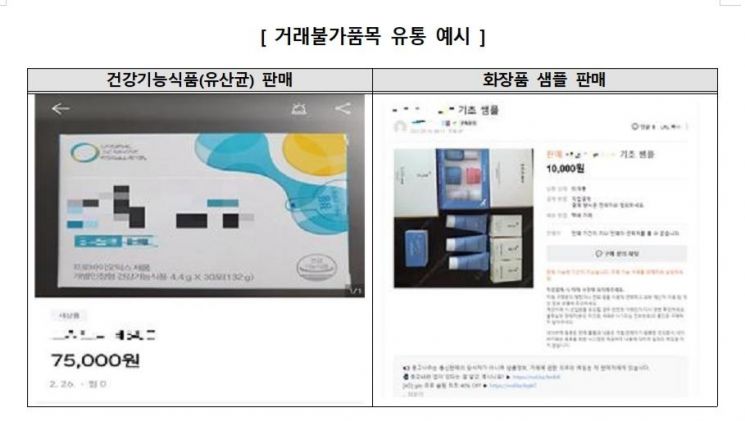 Examples of distribution of prohibited items traded on secondhand transaction platforms. Photo by Korea Consumer Agency
While the platforms operate keyword blocking functions for prohibited items, abbreviations or slang terms can be used in searches, resulting in ineffective blocking.
In fact, a survey conducted by the Consumer Agency in April targeting 1,150 users of four secondhand trading platforms showed that 45.9% of respondents were unaware that prohibited items existed.
Meanwhile, among consultations related to secondhand trading platforms received by the 1372 Consumer Counseling Center over the past three years, complaints about "product information differing from what was disclosed" accounted for the largest portion at 32.4%.
The Consumer Agency stated, "Based on this investigation, we plan to recommend secondhand trading platform operators to block the distribution of prohibited items and strengthen management of professional sellers," adding, "Consumers can exercise the right of withdrawal and other rights if the seller is a business entity, even when purchasing through secondhand trading platforms."
© The Asia Business Daily(www.asiae.co.kr). All rights reserved.


















