Highest Incidence Rate and Proportion in 20s
Risk Level Maintains 'Low' for 7 Consecutive Weeks
276 Additional Omicron Subvariant Cases in One Week
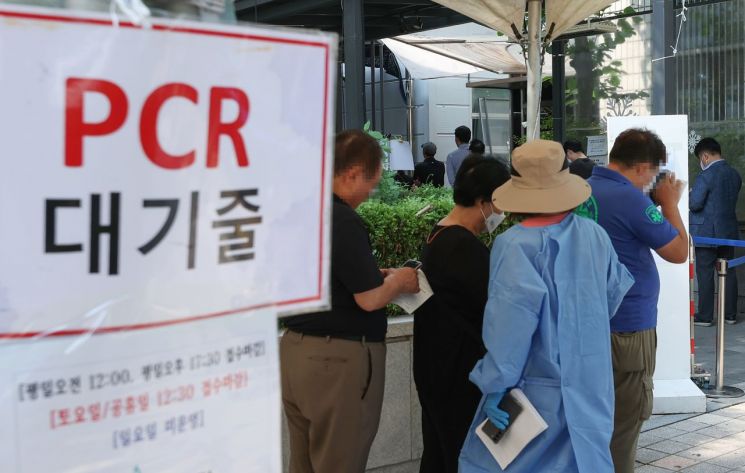
[Asia Economy Reporter Jo In-kyung] As the COVID-19 outbreak has turned to an increasing trend again, the number of new weekly confirmed cases has increased by more than 20% compared to the previous week. Additionally, 276 cases of Omicron subvariant, which has higher transmissibility than the existing Omicron variant, were newly detected within a week.
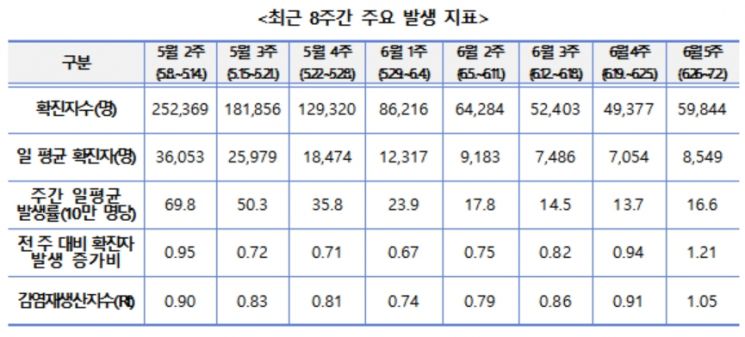
According to the Central Disease Control Headquarters on the 5th, the number of weekly confirmed cases in the 5th week of June (June 26 to July 2) was 59,844, with a daily average of 8,549 cases, an increase of 21.2% compared to the previous week (49,377 cases). The weekly confirmed cases had been continuously decreasing since the 3rd week of March (2,822,000 cases) but increased again after 15 weeks.
The effective reproduction number (Rt) also recorded 1.05, exceeding 1 for the first time in 14 weeks since the 4th week of March (1.01). The effective reproduction number quantifies how many people one infected person infects; a value above 1 indicates the outbreak is spreading, while below 1 means it is being suppressed.
COVID-19 confirmed cases increased in daily average incidence rates compared to the previous week across all age groups except those aged 80 and above. The highest incidence rate was observed in people in their 20s (daily average 28.6 cases), and the 20s age group accounted for the largest proportion of total cases at 22.2% (13,307 cases).
The number of confirmed cases aged 60 and above, who are at higher risk of severe illness, increased from 7,657 in the 4th week of June to 8,206 in the 5th week, but their proportion decreased from 15.5% to 13.7%.
The number of new severe and critically ill patients in the 5th week of June was 50, a 19.0% increase from 42 cases the previous week. The weekly number of deaths was 46, a 48.3% decrease from 89 the previous week.
Although the number of secured intensive care and semi-intensive care beds nationwide continues to decrease, the bed occupancy rate remains low at less than 10%. The intensive care bed occupancy rate is 5.2% nationwide, and the semi-intensive care bed occupancy rate is 8.1%.
The COVID-19 risk level is assessed as 'low' nationwide, in the metropolitan area, and in non-metropolitan areas, maintaining the same level for seven consecutive weeks since the 3rd week of May (May 15?21).
Meanwhile, in the 5th week of June alone, 55 cases of the Omicron subvariant BA.2.12.1, 36 cases of BA.4, and 185 cases of BA.5 were confirmed, and epidemiological investigations are underway. Among the additionally confirmed subvariant cases, 209 were domestic infections, and 67 were imported cases.
Notably, the detection rate of BA.5 among subvariants increased to 28.2% (24.1% domestic, 49.2% imported), which is 2.7 times higher than one week ago (10.4%). BA.5 is known to have higher transmissibility than the previously dominant BA.2 (Stealth Omicron) and possesses characteristics that evade protection from existing vaccines and immunity from prior infections.
Im Suk-young, head of the Central Disease Control Headquarters Situation Management Team, explained, "BA.5 has already become the dominant strain among imported cases and its detection rate is significantly increasing in domestic cases as well." She added, "Due to increased activity, the rise in detection rate of the immune-evasive variant BA.5, and waning immunity, there is a high possibility of a resurgence exceeding predictions. We ask everyone to adhere to basic prevention measures such as hand washing, wearing masks, and regular ventilation, especially in summer vacation spots and crowded, enclosed environments."
© The Asia Business Daily(www.asiae.co.kr). All rights reserved.
!["The Woman Who Threw Herself into the Water Clutching a Stolen Dior Bag"...A Grotesque Success Story That Shakes the Korean Psyche [Slate]](https://cwcontent.asiae.co.kr/asiaresize/183/2026021902243444107_1771435474.jpg)

















