KB Management Research Institute 'Trends in the Jeonse and Monthly Rent Market Based on Actual Transaction Prices' Report
Significant Increase in Monthly Rent Proportion for Single-Family, Multi-Family, and Low-Cost Rental Housing Over the Past Two Years
Deposit Reduced and Monthly Rent Increased Due to Financial Difficulties Following COVID-19
 A survey conducted among those engaged in rental businesses such as multi-family houses revealed that few are willing to pay professional companies a commission to handle monthly rent collection and housing maintenance. They said they would rather manage it themselves as a side job since the income is not substantial. It is expected that the housing rental management industry will find it difficult to secure many jobs in the near future. The photo shows a residential area in Seoul (not related to the specific content of the article).
[Asia Economy Reporter Shim Nayoung] Kim Jungwon (46, pseudonym), a day laborer living in Dobong-gu, Seoul, was notified by his landlord earlier this year to increase the deposit on his multi-family rental lease by 50 million won. Living day-to-day and facing reduced work opportunities, he had no immediate way to raise the money. When he visited a local bank to inquire about a personal loan, the interest rate exceeded 4% annually.
Unable to find a proper job and short on living expenses since the COVID-19 outbreak, Kim eventually gave up on a 150 million won lease and switched to a monthly rent of 500,000 won with a 20 million won deposit. The refunded deposit was temporarily used for living expenses. Ban Sungjin (52, pseudonym), who runs a real estate agency in the neighborhood, said, "Since interest rates have risen significantly this year, many people prefer monthly rent over taking out risky lease deposit loans. Landlords also prefer monthly or semi-monthly rents that bring cash in hand rather than lump sums, as there are fewer investment opportunities."
Monthly Rent Increases and Lease Deposits Decrease More Among Low-Income Groups
According to the report "Trends in the Jeonse and Monthly Rent Market Based on Actual Transaction Prices" by KB Financial Group Management Research Institute on the 5th, the share of monthly rent for detached and multi-family houses increased by 20.4 percentage points (from 25.6% in 2019 to 46.0% in Q1 2022). During the same period, the share of lease deposits decreased by 15.7 percentage points (from 51.4% to 35.7%). Among apartments, detached/multi-family houses, row houses/multi-unit buildings, and officetels, detached and multi-family houses showed the largest increase in monthly rent share and the largest decrease in lease deposit share.
The report explained, "For example, tenants of detached and multi-family houses might prefer paying an additional 20,000 won in monthly rent (based on a 4.8% interest rate) rather than increasing the deposit by 5 million won. Households with relatively small deposits have faced financial difficulties since COVID-19, leading them to withdraw deposits for living expenses and increase their monthly rent share, or they judged that switching to monthly rent was better than bearing interest costs during the period of rising interest rates."
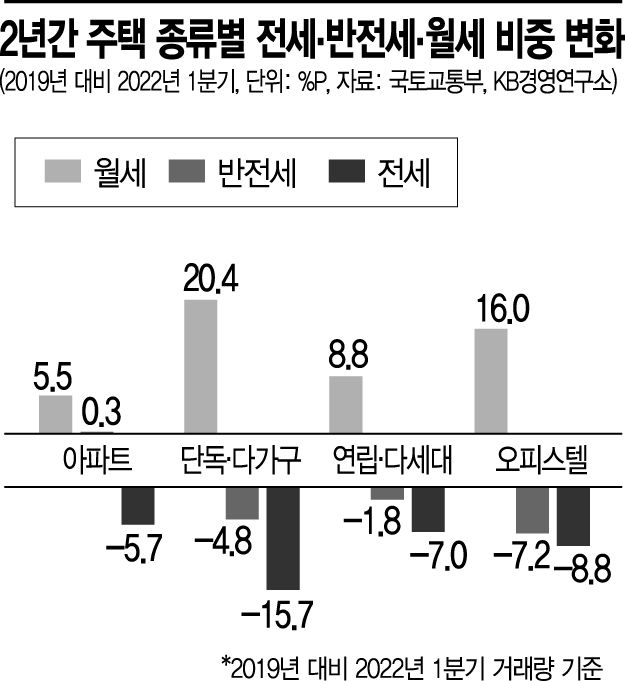
Officetels showed the next largest increase in monthly rent share (16 percentage points, from 25.7% to 41.7%) and decrease in lease deposit share (8.8 percentage points, from 52.7% to 43.9%). The report analyzed that since officetels have a high proportion of single-person households with relatively low income and assets, tenants likely chose monthly rent increases over additional deposits. For reference, the monthly rent share for apartments changed from 6.6% to 12.1%, and the lease deposit share changed from 66.7% to 61.0%.
Increase in Semi-Jeonse Share in Rental Housing
In rental housing, the share of semi-jeonse (a mixed lease with deposit and monthly rent) also increased. The report explained, "For high-priced rental housing, as jeonse prices rose sharply, households unable to raise the difference in deposit amounts increasingly switched to semi-jeonse." Compared to 2019, the top 10% jeonse prices rose by 100 million won (from 350 million won to 450 million won), while the top 10% deposits for semi-jeonse increased by only 70 million won (from 330 million won to 400 million won). The gap between jeonse prices and deposits widened from 20 million won in 2019 to 50 million won in 2021, leading households unable to cover this difference to switch to semi-jeonse.
The situation is similar for low-priced rental housing. For the bottom 25% in jeonse prices, deposits remained at 30 million won until 2018?2020 but dropped to 25 million won in 2021 and further halved to 16 million won in Q1 this year. For the bottom 10%, deposits held at 10 million won from 2016 to 2020 but fell to 5 million won in 2021?Q1 2022. This suggests that deposits failed to keep pace with jeonse prices, leading to increases in semi-jeonse and monthly rent.
Kim Jinseong, a research fellow at KB Management Research Institute's Real Estate Research Team, explained, "During the two years of the COVID-19 pandemic, deposits for low-priced rental housing actually decreased, leading to a shift to monthly rent and increased housing costs for tenants." He added, "From August this year, as interest rate hikes and the right to request contract renewal are reflected in the market, the expansion of jeonse loans for low-asset and low-income groups could become a financial burden, so it is necessary to explore various housing cost support measures."
© The Asia Business Daily(www.asiae.co.kr). All rights reserved.

















