Korea University Guro Hospital Thoracic Surgery Team Led by Professor Kim Hyun-gu
Reduced Chest Tube Insertion and Hospital Stay Compared to Conventional Robotic Surgery
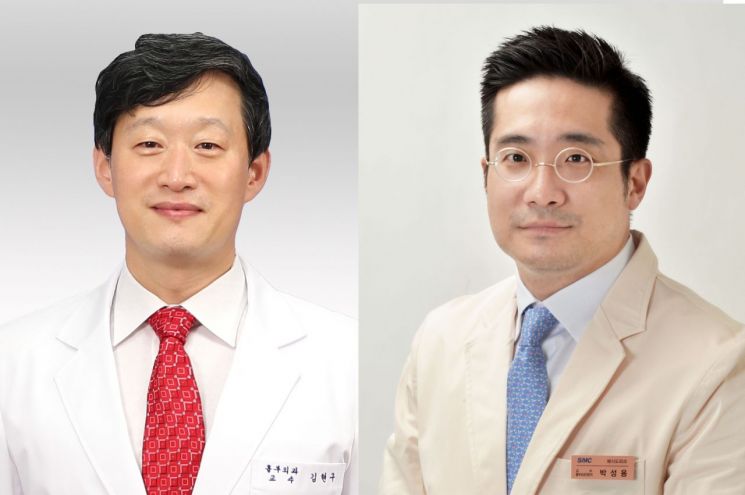 Professor Kim Hyungoo, Department of Thoracic Surgery, Korea University Guro Hospital (left), and Professor Park Sungyong, Department of Pulmonary and Esophageal Surgery, Samsung Seoul Hospital (right).
[Asia Economy Reporter Kim Young-won] Professor Kim Hyun-gu's team from the Department of Thoracic Surgery at Korea University Guro Hospital (Professor Kim Hyun-gu, Professor Park Sung-yong from Samsung Seoul Hospital's Department of Pulmonary and Esophageal Surgery) announced on the 5th that they have reported the world's first case of thoracic tumor surgery using a single-port system robot surgical device exclusively designed for single-port surgery.
The single-port system robot surgical device, introduced in 2018, has already been applied to various surgeries; however, due to low accessibility caused by the ribs and limitations in the movement of the robotic arms, it had not been applied to thoracic surgery. Previously, Professor Kim's team was the first in the world to publish initial clinical results using the single-port system robot surgical device in the field of thoracic surgery in 2020. This study takes a step further by reporting for the first time worldwide that the single-port system robot surgical device can be applied to thoracic surgery.
Corresponding author Professor Kim and first author Professor Park published a paper on 17 successful thoracic tumor surgeries performed exclusively using the single-port system robot surgical device since August 2020. The paper was published in the June issue of the international academic journal, Journal of Thoracic Disease.
The 17 thoracic tumor surgery cases analyzed in the paper were mainly patients with thymoma. The surgical approach was selectively applied considering the lesion's location, size, and accessibility among the lower sternum, lower ribs, and intercostal spaces.
All surgeries were performed exclusively using the single-port system robot surgical device from start to finish. The research team analyzed the effectiveness compared to thoracic tumor surgeries using older robot surgery models. The results showed an average surgery time of 120 minutes, chest tubes were removed on average after 1 day post-surgery, and the average hospital stay was 3 days. No unpredictable or special complications were observed in any patient.
Professor Kim stated, "The single-port system robot surgical device allows freer joint movement compared to previous models and has one endoscope and three arms, enabling more precise surgery. This likely contributed to faster patient recovery and shorter durations of chest tube insertion and hospitalization." He added, "Through this case analysis, we were able to confirm the potential success of thoracic surgery using the single-port system robot surgical device."
Professor Park said, "Although this paper analyzed the application of the single-port system robot surgical device in relatively less complex surgeries, we expect even greater benefits when applied to high-difficulty surgeries. We plan to expand its application range in the future by addressing several limitations identified through this analysis."
© The Asia Business Daily(www.asiae.co.kr). All rights reserved.

















