Price Increase Signs for Samgyetang Ahead of Sambok
May Seoul Samgyetang Price 14,577 Won
Average 15,000 to 18,000 Won
Famous Restaurants Also Raising Prices One After Another
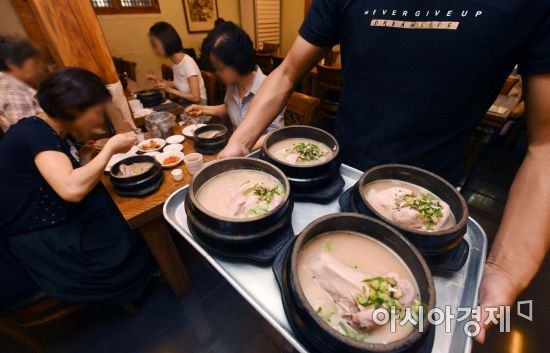
[Asia Economy Reporter Song Seung-yoon] "Samgyetang is perfect for summer, but now it's burdensome."
Kim Ju-young (34), an office worker living in Guro-gu, Seoul, was recently surprised when he visited a samgyetang restaurant with colleagues for lunch. The price of samgyetang, which was 15,000 won earlier this year, had increased by 2,000 won. Samgyetang with other ingredients such as abalone or wild ginseng easily exceeded 20,000 to 30,000 won. Kim said, "Four of us had lunch and it cost over 100,000 won," adding, "It used to be a dish we often enjoyed every summer, but now it's difficult to do so."
The price of samgyetang, a representative summer dish, is also expected to rise. Chicken prices are gradually increasing ahead of the Sambok (the three hottest days of summer), and the cost of raw materials used in samgyetang dishes is also soaring. The first of the Sambok days, Chobok, starts on the 16th of this month, and many places are expected to raise prices around this time.
According to the Korea Rural Economic Institute (KREI) on the 5th, the number of chickens slaughtered in July is expected to increase by 1.5% year-on-year to 7,686 due to increased chick production. However, according to the Livestock Products Quality Evaluation Institute's chicken distribution price trends, the live broiler chicken distribution price is 2,095 won, up 23% from 1,694 won on the 10th of last month, about a month ago. Although prices fluctuate during this period, the overall trend is upward. Typically, chicken prices rise during the year-end and New Year holidays when demand is high, fall in spring, and then steadily increase from late May through the Sambok period.
This time, in addition to this, the prices of most ingredients and labor costs have risen, leading to an increase in samgyetang prices. According to the Korea Consumer Agency's integrated price information portal, Chamgagaek, the average price of samgyetang in Seoul remained steady at 14,500 won from February through April but began to move slightly to 14,577 won in May. On average, samgyetang sold in restaurants ranges from 15,000 to 18,000 won. A famous samgyetang restaurant in Seoul, Restaurant A, had a basic samgyetang priced at 16,500 won until early this year, but recently raised it by 2,000 won to 18,500 won. Restaurant B, which has been in business for decades, also raised its price to 17,000 won and recently increased it by another 1,000 won. At this place, samgyetang with wild ginseng and abalone has already surpassed the 30,000 won mark. Samgyetang restaurants and other places handling chicken say they cannot absorb the rising raw material costs without raising prices.
An official from the broiler industry said, "Production costs such as feed prices are steadily rising, so even if the farm gate price increases, margins are shrinking for farmers," adding, "The number of chickens slaughtered during the peak season is decreasing every year, and the demand for samgyetang on the Boknal days has also significantly declined compared to before, so business owners are likely struggling even after raising prices."
© The Asia Business Daily(www.asiae.co.kr). All rights reserved.
![Clutching a Stolen Dior Bag, Saying "I Hate Being Poor but Real"... The Grotesque Con of a "Human Knockoff" [Slate]](https://cwcontent.asiae.co.kr/asiaresize/183/2026021902243444107_1771435474.jpg)















