Departure for Incheon Airport at 10 AM on the 5th, Arrival at US Launch Site on the 7th
Launch on the 3rd of Next Month, Lunar Orbit Insertion by Late December
Conducting Six Scientific Experiments Over One Year Mission
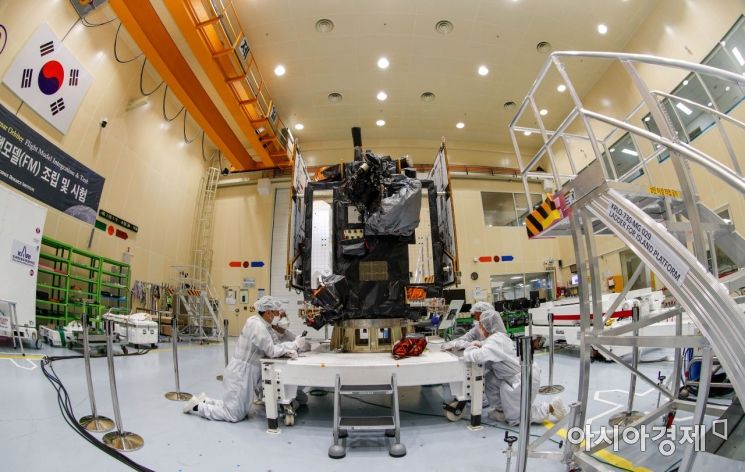 Researchers at the Korea Aerospace Research Institute in Yuseong-gu, Daejeon, are inspecting South Korea's lunar orbiter, Danuri. Danuri will be loaded into a specially made container and transported to the U.S. Space Force Base at Cape Canaveral, Florida, on July 5, and is scheduled to be launched into space at 8:20 a.m. on August 3.
 /Daejeon=Photo by Kang Jin-hyung aymsdream@
[Asia Economy Reporter Kim Bong-su] South Korea's first lunar exploration orbiter, 'Danuri,' is embarking on a 380,000 km journey to the Moon.
The Ministry of Science and ICT announced on the 5th at 10 a.m. that 'Danuri' has departed from the Korea Aerospace Research Institute (KARI) in Daejeon and begun transportation to an overseas launch site. Danuri is loaded in a special container and transported to Incheon Airport, then flown to Orlando Airport in the United States. It is scheduled to arrive at the U.S. Space Force base at Cape Canaveral, Florida, on the 7th. The special container carrying Danuri is a custom-made product capable of maintaining temperature, humidity, positive pressure, and shock absorption.
At the launch site, Danuri will undergo about a month of status checks, fueling, and integration with the launch vehicle as part of the launch preparation process. It is scheduled to be launched on August 3rd at 8:24 a.m. Korean time (August 2nd, 7:24 p.m. local time) aboard SpaceX's Falcon 9 launch vehicle. After launch, it will navigate for about four and a half months and enter lunar orbit by the end of December. It will then perform scientific missions while orbiting 100 km above the Moon for one year.
Danuri carries the ShadowCam, a permanently shadowed region imaging camera developed by NASA, to explore humanity's second candidate site for lunar landing. Additionally, it will conduct the world's first full-Moon imaging using a polarization camera, as well as experiments measuring the Moon's magnetic field and gamma rays, and verifying space internet technology.
Kwon Hyun-joon, Director of the Large Public Research Policy Division at the Ministry of Science and ICT, stated, “The production and domestic inspection of the lunar orbiter Danuri have been completed. We will do our best to ensure that this becomes South Korea’s successful first step toward the Moon.”
© The Asia Business Daily(www.asiae.co.kr). All rights reserved.

















