Jinpyo Kim "Urges Swift Agreement on the Reorganization of the National Assembly"
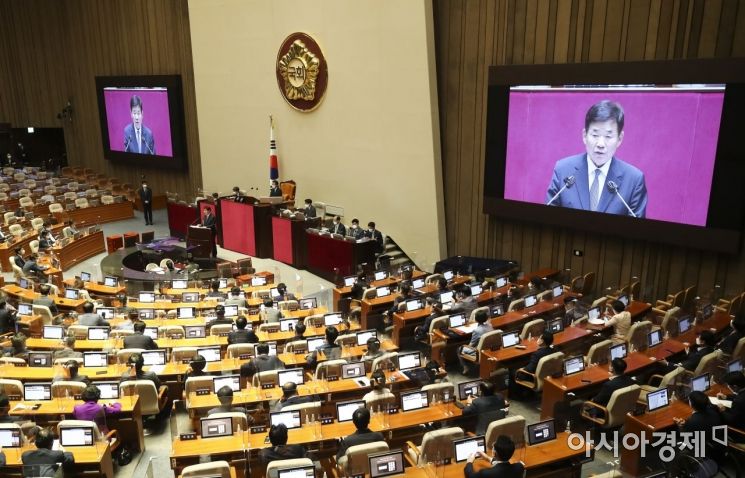 Kim Jin-pyo, elected as the Speaker of the National Assembly for the second half of the year, is giving his acceptance speech at the plenary session held at the National Assembly on the 4th. Photo by Yoon Dong-joo doso7@
[Asia Economy Reporters Bomryeong Geum, Juni Park, Hyunji Kwon] Kim Jin-pyo, a five-term lawmaker from the Democratic Party of Korea, was officially elected as the Speaker of the 21st National Assembly's second half. As Deputy Speakers, Jeong Jin-seok from the People Power Party and Kim Young-joo from the Democratic Party were elected. With this, the previously 'inactive' second half of the National Assembly is set to return to normal operations.
On the afternoon of the 4th, during the plenary session of the National Assembly, 275 lawmakers from both ruling and opposition parties gathered to vote, resulting in Kim Jin-pyo receiving a total of 255 votes and being elected as Speaker.
According to the National Assembly Act, Kim Jin-pyo resigned from the Democratic Party and became an independent. The Speaker cannot hold party affiliation during their term.
Kim Jin-pyo will serve as Speaker until May 2024, when the 21st National Assembly ends.
Immediately after his election, Kim Jin-pyo said, "It is truly fortunate that both ruling and opposition parties agreed on the election of the Speaker," and added, "I urge a swift agreement on the organization of the National Assembly."
Jeong Jin-seok, elected as Deputy Speaker from the ruling party, received 223 out of 235 votes, while Kim Young-joo, elected as Deputy Speaker from the opposition party, received 243 out of 258 votes.
Kim Young-joo became the second female Deputy Speaker in the history of the National Assembly, following her predecessor Kim Sang-hee.
Jeong Jin-seok emphasized, "I will do my best to restore dialogue and compromise, which are the essence of the legislature, and to help the party become a true representative of the people's will." Kim Young-joo stated, "We must strengthen legislative policy activities to respond to the people's demands," and added, "To this end, I will do my utmost to expand policy development to enhance lawmakers' policy expertise."
The People Power Party and the Democratic Party had a tense standoff over the organization of the second half of the National Assembly after the first half Speaker's term ended on May 29. Although the floor leaders of both parties negotiated the day before, no agreement was reached.
Initially, the Democratic Party announced it would elect the Speaker and Deputy Speakers unilaterally during the plenary session that afternoon. However, the People Power Party set a 'condition' that they would cooperate with the election of the Speaker and Deputy Speakers if the standing committee chairs were elected by mutual agreement after their morning party meeting. The Democratic Party accepted this condition, and the vote proceeded.
© The Asia Business Daily(www.asiae.co.kr). All rights reserved.

















