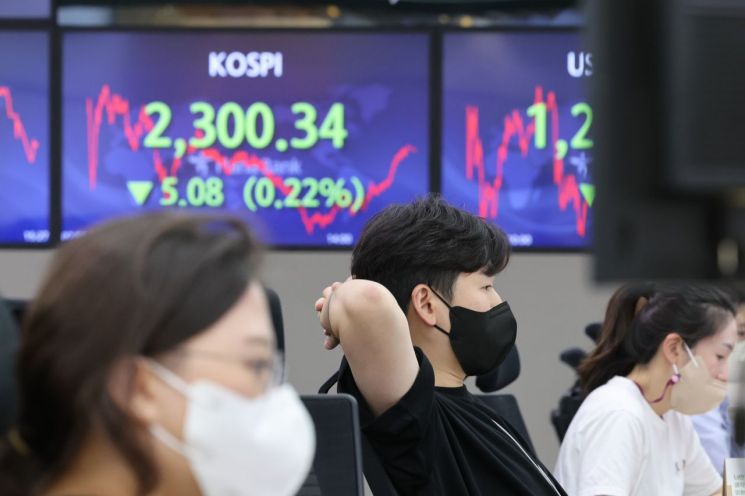
[Asia Economy Reporter Lee Jung-yoon] The KOSPI index, which started higher, ultimately closed lower as individuals and foreigners simultaneously sold off amid concerns of an economic recession. The KOSDAQ index also showed an early upward trend but declined due to selling pressure from foreigners and institutions.
The KOSPI closed at 2300.34, down 5.08 points (0.22%) from the previous trading day. The index opened at 2310.73, up 5.31 points (0.23%) from the previous day, fluctuated around the 2300 level, and set new yearly lows twice. It first hit a yearly low at 2288.92 in the morning and then dropped further to 2276.63. Although it rebounded to close above the 2300 level, the KOSPI ended lower for the fourth consecutive trading day. Additionally, it recorded a closing price yearly low for two consecutive days following the previous trading day, marking the lowest level in about 1 year and 8 months since November 2, 2020. Individuals and foreigners led the decline by net selling approximately 184.4 billion KRW and 138.5 billion KRW respectively, while institutions bought about 312.1 billion KRW.
Among the top market capitalization stocks, SK Hynix rose the most by 1.83%. It was followed by Samsung Electronics (1.60%), Samsung Biologics (1.28%), Kakao (1.19%), and Kia (0.64%). On the other hand, LG Chem (-1.77%), Samsung SDI (-1.17%), Hyundai Motor (-1.11%), NAVER (-0.84%), and LG Energy Solution (-0.14%) showed weakness. During the session, Samsung Electronics fell to 55,700 KRW and SK Hynix to 86,300 KRW, hitting 52-week lows, but later showed an upward trend.
By sector, medical precision rose 2.78%, followed by telecommunications (1.22%), pharmaceuticals (0.91%), food and beverages (0.85%), electrical and electronics (0.83%), textiles and apparel (0.29%), services (0.24%), and securities (0.17%). Most other sectors declined, with construction falling over 4%, marking the largest drop. Machinery (-3.37%), transportation equipment (-1.82%), and chemicals (-1.51%) also declined.
Researcher Heo Jae-hwan of Eugene Investment & Securities explained, "Concerns about an economic recession continued to be reflected in stock prices. Despite some rebounds in stocks like Samsung Electronics as sectors such as construction and machinery fell, the overall trend was downward." He added, "The continued strength of the dollar also sustained foreign selling pressure." In the Seoul foreign exchange market, the USD/KRW exchange rate rose to 1,299.9 KRW during the session and closed at 1,297.1 KRW, down 0.2 KRW from the previous trading day.
Researcher Kim Seok-hwan of Mirae Asset Securities said, "The recession issue continues to suppress the market. Before the Federal Reserve's 0.75 percentage point rate hike, the market was at a crossroads between economic slowdown and recession, but now it seems that a recessionary situation is fundamentally in place."
The KOSDAQ index, which started higher, rose to 736.71 early in the session but ultimately closed at 722.73, down 6.75 points (0.93%) from the previous day. Individuals bought about 57.7 billion KRW to defend against the decline, but foreigners and institutions net sold approximately 38 billion KRW and 15.5 billion KRW respectively.
Among the top market capitalization stocks, HLB rose the most by 3.00%, followed by EcoPro BM (2.95%), Pearl Abyss (2.54%), Alteogen (1.56%), L&F (1.16%), and Studio Dragon (0.14%). Conversely, Kakao Games fell 3.42%, and Celltrion Pharm (-1.40%), Cheonbo (-0.63%), and Celltrion Healthcare (-0.58%) also declined.
© The Asia Business Daily(www.asiae.co.kr). All rights reserved.

















