Joint Declaration Adopted Highlighting the Need to Revive the Visa Waiver Program
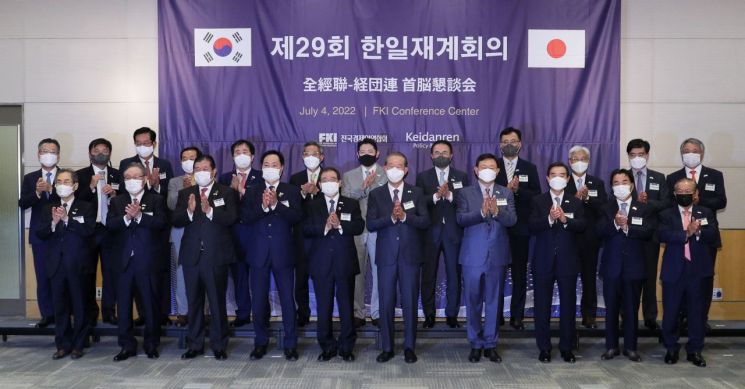
[Asia Economy Reporters Park Sun-mi and Moon Chae-seok] "It's been three years since 2019, right?" "Nice to meet you. It's an honor to see you like this." "Ohio (Gozaimasu)." (VIP reception at the Korea-Japan Business Meeting on the 4th)
The Korea-Japan Business Meeting, which had not been held due to the impact of COVID-19, was held for the first time in three years. Notably, this meeting saw an unprecedented full attendance of the four major groups: Samsung, SK, Hyundai Motor, and LG. This is interpreted as a reflection of the Korean business community's determination to take the lead in improving the strained Korea-Japan relations since the launch of the Yoon Suk-yeol administration.
Four Major Groups’ ‘First’ Full Attendance at Korea-Japan Business Meeting
On the 4th, the Federation of Korean Industries (FKI) held the 29th Korea-Japan Business Meeting at the FKI building in Yeouido, Seoul, together with the Japanese business organization Keidanren. It was the first time in three years that the two organizations met face-to-face.
In particular, many CEOs from large corporations, including the four major groups that withdrew from the FKI following the 2016 political scandal, attended the meeting. Although the four major group chairpersons had gathered once before at the 2009 Korea-Japan summit-linked New Year business meeting, this was the first time all these groups attended the Korea-Japan Business Meeting, a high-level private economic cooperation channel between the two countries.
From the four major groups, Samsung Electronics President Lee In-yong, Hyundai Motor President Gong Young-woon, LG Electronics President Cho Joo-wan, and SK Materials President Lee Yong-wook appeared at the meeting. Also attending were major corporate owners and CEOs such as Lotte Group Chairman Shin Dong-bin, Hyosung Chairman Cho Hyun-joon, KB Financial Group Chairman Yoon Jong-kyu, Shinhan Financial Group Chairman Cho Yong-byoung, and POSCO Holdings President Jeon Joong-seon.
Before the meeting began, key Korea-Japan business figures exchanged brief conversations, creating a warm and friendly atmosphere. Sensitive words such as ‘materials, parts, and equipment’ and ‘white list’ were avoided, with handshakes, greetings, and hopeful talks about cooperation dominating. The heads of the economic organizations urged the restoration of dialogue not only between business communities but also between the two countries’ leaders and governments in their opening remarks.
FKI Chairman Huh Chang-soo said, "I hope a Korea-Japan summit will be held soon to resolve issues such as mutual export regulation removal, resumption of Korea-Japan currency swaps, and Korea’s accession to the CPTPP (Comprehensive and Progressive Agreement for Trans-Pacific Partnership) all at once." Keidanren Chairman Tokura Masakazu also said, "The more difficult Korea-Japan relations become, the more important it is to respect the spirit of the 1998 ‘Korea-Japan Partnership Declaration’ and for both countries to move forward together with a future-oriented mindset." He added, "The Japanese business community also hopes that dialogue between the two countries’ leaders and ministers will resume early."
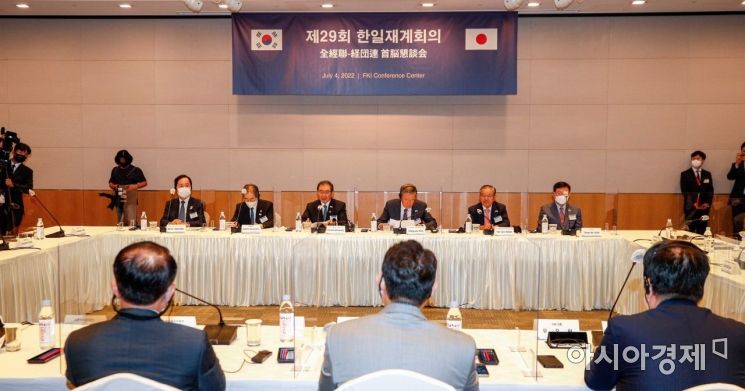 Masakazu Tokura, Chairman of the Japan Business Federation, is delivering a welcoming speech at the "29th Korea-Japan Business Meeting" held on the 4th at the Federation of Korean Industries building in Yeouido, Seoul. Photo by Jinhyung Kang aymsdream@
Korea and Japan Business Leaders Meet Face-to-Face After 3 Years... What Are the Issues?
The FKI and Keidanren established the Korea-Japan Business Meeting in 1982 to promote mutual understanding and friendship between the business communities of the two countries, and have held it regularly since 1983. However, relations deteriorated after the 2019 Supreme Court ruling on forced labor compensation during Japanese colonial rule, and the meeting was not held in 2020 and last year due to the spread of COVID-19. The meeting, usually held between September and November, was specially moved forward to July this year, reflecting a shared recognition that, after a long hiatus, they must meet promptly to open a new chapter of relationship improvement following the launch of the Yoon Suk-yeol administration.
The main agenda items at the meeting were ▲economic trends and outlooks of both countries ▲Korea-Japan cooperation for realizing a sustainable society ▲new world order and international relations. Specifically, discussions and proposals covered ▲removal of mutual export regulations ▲revival of mutual visa-free entry systems to expand human exchanges ▲necessity of Korea’s accession to the CPTPP ▲Korea-Japan joint cooperation for the development of the IPEF (Indo-Pacific Economic Framework) ▲formation of a Korea-US-Japan business summit, among other topics of mutual interest.
Particularly regarding the removal of mutual export regulations, voices grew louder emphasizing the need to maintain stable supply chain connections in strategically important semiconductor and display industries. Japan had imposed economic retaliation by tightening export regulations on three key semiconductor and display materials to Korea in July 2019, but the prevailing assessment is that this has brought no real benefit to either country.
There was also consensus among participants on both sides about reviving the mutual visa-free entry system, which was suspended after the spread of COVID-19, to expand human exchanges. The revival of the visa exemption program is essential for normalizing private exchanges. Since the suspension of the mutual visa-free entry system between Korea and Japan in March 2020, the number of mutual visitors, which was about 10.5 million in 2018, plummeted to 34,000 last year.
Korean participants emphasized the necessity of Korea’s accession to the CPTPP and requested Japan’s support, while also exchanging views on the need for Korea-Japan cooperation within the IPEF, launched in May under the Biden administration. The need for trilateral cooperation with the United States, the biggest ally of both Korea and Japan, was raised, along with proposals for forming a Korea-US-Japan business summit and holding regular meetings to strengthen practical trilateral cooperation in the economic sector.
Meanwhile, the FKI and Keidanren adopted a joint declaration consisting of eight articles, including respecting the spirit of the 1998 ‘Korea-Japan Joint Declaration ? A New Partnership Toward the 21st Century’ (also known as the Kim Dae-jung-Obuchi Declaration), building a future-oriented relationship, and confirming the necessity of reviving the visa exemption program to normalize private exchanges. The joint declaration also stated that maintaining and developing good Korea-Japan relations, which share values of democracy and market economy amid unstable international circumstances, is very important and contributes not only to the development of both countries but also to peace and stability in Northeast Asia. The two organizations agreed to hold the 30th Korea-Japan Business Meeting in Tokyo at an appropriate time in 2023.
© The Asia Business Daily(www.asiae.co.kr). All rights reserved.
![Clutching a Stolen Dior Bag, Saying "I Hate Being Poor but Real"... The Grotesque Con of a "Human Knockoff" [Slate]](https://cwcontent.asiae.co.kr/asiaresize/183/2026021902243444107_1771435474.jpg)

















