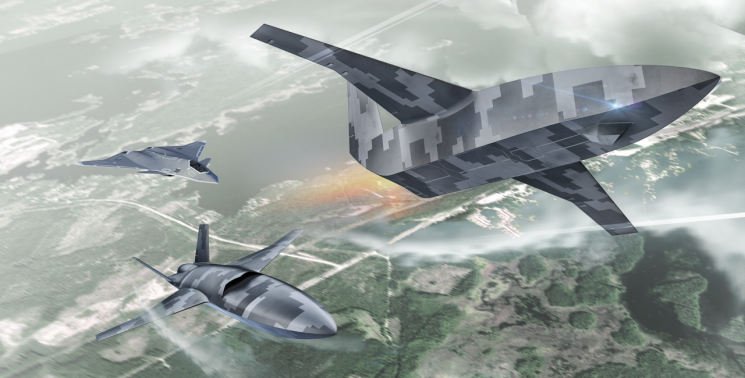
[Asia Economy Military Specialist Yang Nak-gyu] In September last year, the Agency for Defense Development (ADD) developed a design technology for aircraft shapes that are difficult for enemy radars to detect. This is called a 'stealth' low-observable shape. To create stealth aircraft, they incorporated all the core technologies, including removing the tail wings of the aircraft and applying radar-absorbing materials on the surface of the aircraft. We visited the Korea Aerospace Research Institute of Korean Air, a leading figure in stealth unmanned aerial vehicles (UAVs), to take a closer look at stealth technology.
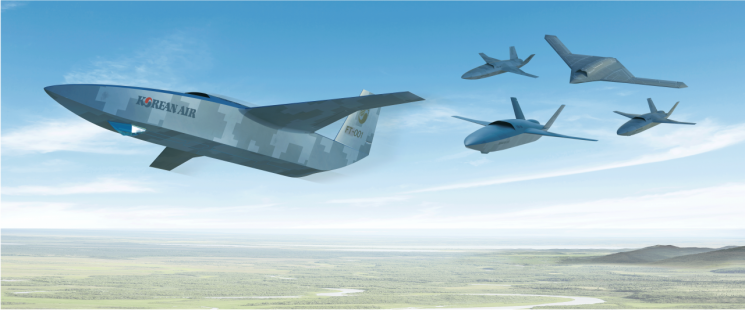
Korean Air developed the unmanned aircraft Gauri-X1 in 2014. The Gauri-X1 is a scaled-down version of a large unmanned combat aircraft, reduced to 46% of the size, with a length of 10.4 meters, a wingspan of 14.8 meters, and a weight of 10 tons. The Gauri-X1 flew 50 km in 1 hour and 30 minutes, opening up the possibility of developing unmanned combat aircraft. Following this, from this year, they plan to develop the attack-type unmanned combat aircraft Gauri-X2. It can be equipped with Korean-style medium-range guided bombs and is called a 'mini B-2 bomber.' To mount weapons, it is expected to be equipped with a 5,500-pound class turbofan engine currently under development for stealth UAVs. The engines for stealth unmanned combat aircraft being developed by the U.S. and others are equipped with 10,000-pound class engines.
Korean Air plans to further develop 'unmanned wingmen' and 'stealth unmanned reconnaissance aircraft' using the Gauri UAV. The unmanned wingmen have a manned-unmanned cooperative function called 'Mumti.' Before a manned fighter jet infiltrates enemy territory, the stealth unmanned wingmen take the lead. They can engage in combat or perform reconnaissance missions ahead of the manned aircraft. Protecting the lives of fighter pilots is a given. Since unmanned aircraft are deployed simultaneously with manned aircraft, they can respond to sudden situations. The unmanned wingmen are scheduled for their first flight in 2025, and in 2027, joint manned-unmanned operations will be tested alongside government-owned manned aircraft.
Countries around the world, including the United States, are competing to develop unmanned wingmen. In December 2020, the U.S. Air Force flew the low-cost unmanned combat aircraft XQ-58A 'Valkyrie' together with stealth fighters F-22 'Raptor' and F-35 'Lightning II' at the Yuma Test Range in Arizona. The test was to verify whether the XQ-58 could properly communicate with the F-22 and F-35. In the future, the Valkyrie will take the lead ahead of the F-22 and F-35 to enter enemy territory for reconnaissance or attack missions.
Korean Air also plans to develop a 'stealth unmanned reconnaissance aircraft' based on the Gauri UAV technology. This means creating Korean versions of the U.S.-operated stealth unmanned combat aircraft X-47B and the RQ-180 stealth reconnaissance aircraft. The stealth unmanned reconnaissance aircraft will be equipped with electro-optical infrared detection equipment and synthetic aperture radar, enabling deep penetration into North Korean airspace to conduct reconnaissance missions at any time.
To this end, Korean Air plans to develop high-heat-resistant and radar-absorbing materials for hypersonic vehicles. Hypersonic vehicles fly at speeds exceeding Mach 9 (approximately 11,000 km/h). At this speed, temperatures exceeding 2,000 degrees Celsius occur at the front of the vehicle. If the vehicle cannot withstand this heat, it will melt before reaching its destination. Therefore, high-heat-resistant and radar-absorbing materials are essential for hypersonic vehicles.
Kim Kyung-nam, head of development at Korean Air, said, "To achieve stealth performance in UAVs, it is essential to develop composite materials for the airframe that can withstand engine heat while absorbing external radar waves." He added, "If this technology is developed, it will enable not only stealth UAVs but also hypersonic missiles."
Hypersonic missiles are called 'game changers' because they are harder to detect and intercept than conventional ballistic missiles, potentially changing the course of warfare. Only three countries?the U.S., China, and Russia?have successfully launched them.
Our military has already requested the Joint Chiefs of Staff to develop hypersonic missiles to be mounted on the Korean fighter KF-21 Boramae, with development expected to begin as early as this year. The request to the Joint Chiefs is the official first step in weapon development.
According to the Agency for Defense Development's (ADD) preliminary concept study last year, considering domestic technological levels and the KF-21's weapon payload capacity, it is possible to develop hypersonic missiles with a range of over 500 km and speeds exceeding Mach 5. Based on this vehicle, if a hypersonic missile is launched from above Seoul, it can reach Pyongyang, 250 km away, in 1 minute and 15 seconds.
The military plans to equip the KF-21 with two types of air-to-air missiles, nine types of air-to-ground bombs, and one type of air-to-ground missile. Adding hypersonic and supersonic missiles will enable 'precision strikes.'
© The Asia Business Daily(www.asiae.co.kr). All rights reserved.
![Clutching a Stolen Dior Bag, Saying "I Hate Being Poor but Real"... The Grotesque Con of a "Human Knockoff" [Slate]](https://cwcontent.asiae.co.kr/asiaresize/183/2026021902243444107_1771435474.jpg)

















