Environmental Value of -2.434 Trillion KRW
Improvement Plan Through Reduced Power Consumption Including Shortened Main Equipment Test Time
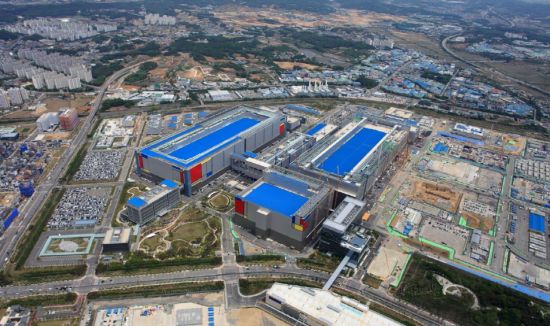
[Asia Economy Reporter Moon Chaeseok] Samsung Electronics was found to have created sustainable management value worth over 49 trillion won last year. This figure combines financial value, socio-economic value, and environmental value. The company also faces the challenge of achieving noticeable greenhouse gas reductions in manufacturing processes in the DS (semiconductor) division by promoting joining RE100, which aims to cover 100% of electricity consumption with renewable energy such as solar power.
According to Samsung Electronics' recently released '2022 Sustainable Management Report' on the 4th, the sustainable management value created last year was 49.13 trillion won. This includes financial value of 39.91 trillion won, socio-economic value of 11.65 trillion won, and environmental value of -2.434 trillion won. The financial value was derived from net profit over the past year. Socio-economic value was calculated from dividends and interest payments to investors and creditors, support funds for partner companies' win-win funds, community donations, returns on investments in educational projects and hygiene facility development projects, among others. Environmental value was estimated by calculating social costs such as greenhouse gas emissions and air pollutants (NOx, SOx, PM) emitted from business sites.
Samsung Electronics stated in the report that the DS and DX (Integrated Set) divisions combined reduced 6.41 million tons of greenhouse gases last year. The use of renewable energy increased by 31% compared to the previous year, reaching 5,278 GWh. The company decided to make reducing greenhouse gas emissions and expanding renewable energy use across the entire value chain?from product development, procurement, manufacturing, distribution, usage, to recycling?a core principle. The disclosure of specific data related to carbon neutrality, recently emphasized by key executives, is also regarded as a noteworthy non-financial achievement.
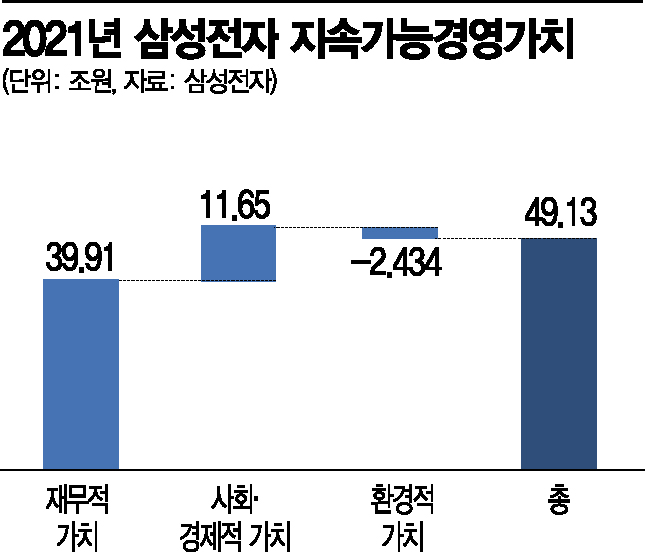
However, the fact that over 2 trillion won was spent on environmental value remains a challenge to be addressed. This is due to an increase in greenhouse gas emissions, converted to carbon dioxide equivalent, to 17.4 million tons last year?a 17.5% rise compared to the previous year?caused by the construction and operation of new semiconductor lines. This is a painful result for Samsung Electronics, which has stated the principle of "minimizing the purchase of carbon emission rights." From a corporate perspective, even if the company emits more carbon than the quota set by authorities and has to buy emission rights, it could engage in 'emission rights trading' if the market price is low, but Samsung Electronics is committed to thorough 'carbon reduction.' According to the Korea Exchange, the price of carbon emission rights (KAU21) was 20,800 won as of the previous trading day on the 1st, a sharp drop of 41.2% from 35,400 won at the beginning of the year. Since prices fluctuate, emission volumes could be adjusted depending on the situation, but Samsung Electronics' principle differs from this.
Samsung Electronics' solution is 'reducing electricity consumption.' It calculates that carbon emissions can be reduced by shortening main equipment test times, improving operating temperature conditions of auxiliary equipment, and neutralizing high-efficiency equipment and wet scrubbers (harmful gas purification devices). Process innovations such as the newly announced 'Foundry 3nm GAA (Gate-All-Around)' technology on the 30th of last month are key. This technology can reduce power consumption by about 50% compared to the existing 5nm process.
Expanding renewable energy use is also emerging as a solution. According to Samsung Electronics, expanding renewable energy use accounted for 44% of last year's greenhouse gas reduction ratio. This is a larger share than process gas treatment (43%), manufacturing process efficiency improvement (12%), and equipment operation efficiency improvement (1%). The company is also considering joining RE100, certified by The Climate Group, a non-profit organization based in London, UK. Samsung Electronics stated, "Following 100% renewable energy use in the US, Europe, and China, we are expanding renewable energy use in Brazil, Mexico, and other countries."
© The Asia Business Daily(www.asiae.co.kr). All rights reserved.
!["The Woman Who Threw Herself into the Water Clutching a Stolen Dior Bag"...A Grotesque Success Story That Shakes the Korean Psyche [Slate]](https://cwcontent.asiae.co.kr/asiaresize/183/2026021902243444107_1771435474.jpg)

















