Hundreds of Vehicles Flooded Due to Heavy Rain in Central Region
"What If They Sell It as a Used Car?" Consumers Worried
Essential to Check Insurance History with 'CarHistory'
Thoroughly Inspect Seat Odor and Engine Room Visually
Avoiding Circulation Period of Flooded Cars Is Also a Strategy
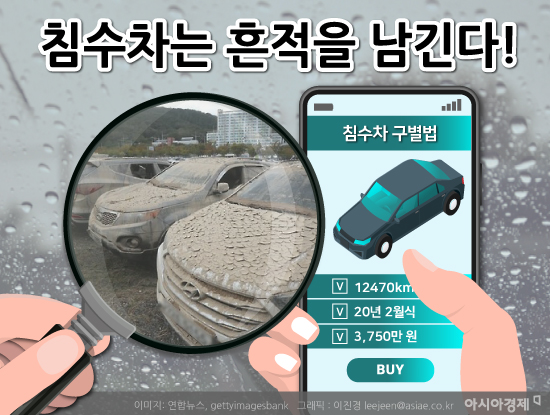 During the rainy season, when vehicle flood damage increases, it is important to carefully inspect used cars before purchasing. / Photo by Jin-Kyung Lee, Asia Economy Reporter
[Asia Economy Reporter Lim Juhyung] A 'Flooded Car Warning' has been issued in the used car market following the recent heavy rains that struck the central region. There are claims that hundreds of vehicles damaged by flooding may have been disguised as undamaged cars and entered the used car market. Although the principle is to scrap flooded vehicles after damage inspection, it is difficult to rule out the possibility that some unscrupulous dealers might hide the history and sell them to consumers. This is why it is important to carefully scrutinize suspected flooded vehicles, especially during the rainy season when flood damage is frequent.
◆Flooded vehicles surge after 170mm downpour... Consumers anxious, saying "I shouldn't buy a used car"
According to the General Insurance Association on the 4th, an average of 170mm of heavy rain fell in Gyeonggi Province from midnight to 5 p.m. on the 30th of last month, resulting in 326 reported cases of vehicle flooding and debris damage.
At that time, photos showing rainwater flooding a parking lot in a used car trading complex in Suwon, Gyeonggi Province, were shared on some online communities, raising consumer concerns. The number of flooded vehicles reached about 100, and it was reported that some of these vehicles were also advertised on popular used car trading websites.
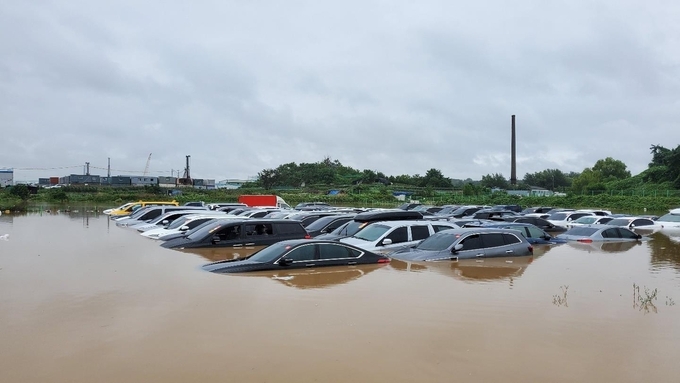
In response, the site stated on the 1st, "Upon confirming the flooding, we immediately informed the affected dealerships to terminate diagnostic advertisements for flooded vehicles," adding, "We are currently identifying flooded vehicles at the dealerships and deleting the advertisements after verification."
However, some netizens remain uneasy. Comments such as "What if I get tricked into buying a flooded car?" and "I shouldn't buy a used car for the next one or two months" have been circulating.
◆If you mistakenly buy a flooded car, you may have to scrap it... Thoroughly check insurance history
Consumers are sensitive to flooded cars because it is difficult to determine whether a vehicle has been flooded just by looking at it. Newer vehicles are equipped with various electronic devices inside, and even a single flooding incident can severely impair their performance.
The most reliable way to check for a flooded car is to directly look up repair and total loss information through the Korea Insurance Development Institute's car insurance history inquiry service called 'Car History.' By entering the vehicle identification number or license plate number on the website, you can instantly verify the information. While there is a small fee for insurance history inquiries, flood history checks are provided free of charge.
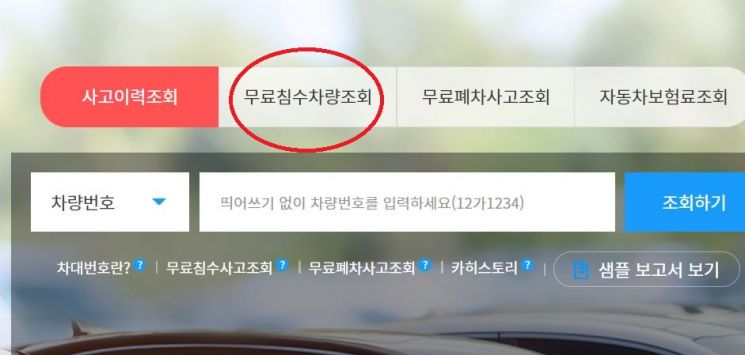 You can check the flood history of a vehicle through the car insurance history inquiry service 'Car History'. / Photo by Car History homepage capture
However, this method has limitations. If the vehicle owner personally bore the flood damage costs despite having comprehensive insurance, no record will remain. Also, if the damage was never reported to the insurance company, the history cannot be confirmed.
◆Thorough visual checks such as air conditioner odor and metal corrosion
When electronic records are unreliable, inspecting the vehicle directly can be a solution. Even after drying and deodorizing, a car that was once submerged in water often retains an unpleasant odor inside. It is advisable to close all windows and turn on the air conditioner to check for any smells.
Inspect the seat belts, driver's seat, and rear seats carefully for any corroded parts. You can also check for flooding by examining the metal parts under the floor mats, trunk floor, and beneath the seats. These areas are difficult to replace, making it hard to conceal mud, water stains, or corrosion.
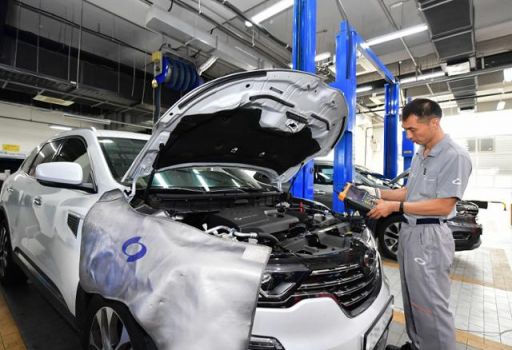 The condition of the engine room can be used to determine whether a vehicle has been flooded. The photo shows an employee at a completed vehicle service center inspecting a flooded vehicle. / Photo by Yonhap News
It is also important to check the engine compartment for signs of replacement of the Electronic Control Unit (ECU). Since the ECU is vulnerable to moisture, it is almost always replaced in flooded vehicles.
◆"Flooded cars circulate after summer"
Avoiding the period when flooded cars are actively circulated in the used car market can be a strategy for safe used car transactions. The used car trading site explained, "Generally, flooded cars are not circulated during the rainy season or typhoon periods when flooding damage is widely reported in the media," adding, "This is because insurance companies and vehicle owners are busy handling the vehicles, and some flooded car dealers are occupied with acquiring vehicles from flooded areas at that time."
Furthermore, repairing a flooded car and putting it on the used car market requires disassembling and reassembling the entire or parts of the vehicle, which takes a long time. Therefore, the likelihood of flooded cars being actively circulated is relatively higher in the fall or early winter after summer has passed.
© The Asia Business Daily(www.asiae.co.kr). All rights reserved.
![Clutching a Stolen Dior Bag, Saying "I Hate Being Poor but Real"... The Grotesque Con of a "Human Knockoff" [Slate]](https://cwcontent.asiae.co.kr/asiaresize/183/2026021902243444107_1771435474.jpg)


















