Choo Kyung-ho and Lee Chang-yong Meet After 18 Days to Discuss Economic Situation
Inflation Soars Amid Growing Concerns Over Economic Slowdown
Bank of Korea May Implement 'Big Step' This Month... Interest Burden Expected to Increase
No Suitable Countermeasures... Silence Follows Meeting Between Choo Kyung-ho and Lee Chang-yong
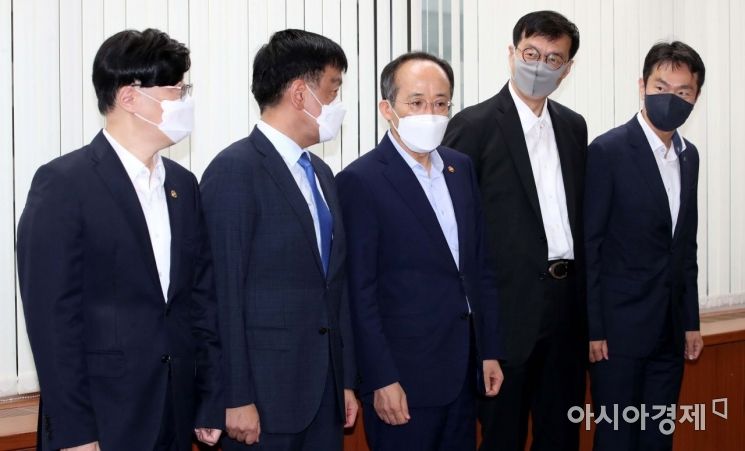 Deputy Prime Minister and Minister of Economy and Finance Choo Kyung-ho is taking a commemorative photo at the Financial Authorities Breakfast Meeting chaired by the Deputy Prime Minister held on the 4th at the Bankers Hall in Jung-gu, Seoul. From the left: Kim So-young, Vice Chairman of the Financial Services Commission; Choi Sang-mok, Senior Secretary for Economic Affairs to the President; Deputy Prime Minister Choo; Lee Chang-yong, Governor of the Bank of Korea; Lee Bok-hyun, Governor of the Financial Supervisory Service. Photo by Moon Ho-nam munonam@
Amid soaring prices and growing concerns over economic slowdown, Deputy Prime Minister and Minister of Economy and Finance Choo Kyung-ho and Bank of Korea Governor Lee Chang-yong met again after about two weeks to discuss countermeasures. With the consumer price inflation rate approaching 6%, and a complex crisis involving global supply chain instability, expanding trade deficits, and rising exchange rates, the related ministries agreed to actively respond jointly, but analyses suggest that there are no clear solutions.
On the morning of the 4th, Deputy Prime Minister Choo, Governor Lee, Chief Presidential Secretary for Economic Affairs Choi Sang-mok, Vice Chairman of the Financial Services Commission Kim So-young, and Governor of the Financial Supervisory Service Lee Bok-hyun held a breakfast meeting at the Bankers’ Hall in Jung-gu, Seoul, to discuss the recent economic and financial situation. This was the first time in 18 days since the Emergency Macroeconomic and Financial Meeting on the 16th of last month that Deputy Prime Minister Choo and Governor Lee met to discuss cooperation measures.
The reason for their meeting again on this day is that the domestic economic situation is not favorable. The consumer price inflation rate for June is expected to exceed 6% for the first time in 23 years and 7 months since November 1998 (6.8%), and it is anticipated that even higher inflation rates will continue in July and August. The ongoing Ukraine crisis has kept international energy and raw material prices on the rise, and with increases in electricity and gas rates as well as the summer vacation season, there are concerns about rapid price hikes.
During the approximately one-hour meeting, Deputy Prime Minister Choo, Governor Lee, and others agreed that the current complex economic crisis is likely to persist for a considerable period, and recognized the need to closely monitor key issues and respond jointly. In particular, they decided to establish a joint response system among related ministries to proactively address macroeconomic risk factors during the period of rising domestic and international interest rates.
The Bank of Korea’s Monetary Policy Committee is highly likely to implement a 'big step' by raising the base interest rate by 0.5 percentage points at once this month to curb inflation. According to the June Consumer Sentiment Survey released by the Bank of Korea on the 29th of last month, the expected inflation rate reached 3.9%, the highest in 10 years and 2 months. Since high expected inflation increases the likelihood of steeper future price rises, it is necessary to suppress it through interest rate hikes.
In particular, as the U.S. Federal Reserve (Fed) is expected to take a 'giant step' by raising the base interest rate by 0.75 percentage points at the upcoming Federal Open Market Committee (FOMC) regular meeting, if the Bank of Korea does not at least implement a big step, domestic capital outflows due to interest rate inversion could accelerate.
However, if interest rates are raised sharply, the interest burden could become excessively heavy, especially for vulnerable groups. As of the first quarter, domestic household debt amounts to 1,859 trillion won. It is reported that Deputy Prime Minister Choo, Governor Lee Bok-hyun, and other financial authorities also discussed policies to prevent the shock of defaults among vulnerable borrowers during the meeting. The Ministry of Economy and Finance and the Bank of Korea explained that they plan to closely monitor and respond to the debts of vulnerable borrowers such as small business owners and youth, the soundness of financial institutions, and corporate funding situations.
Deputy Prime Minister Choo and Governor Lee agreed to continue meeting frequently to do their best to overcome the complex economic crisis, but there are also criticisms that there are no suitable solutions. This is because, amid the U.S. sharply raising interest rates to the highest level in 40 years due to inflation, South Korea has limited policy options available. After the meeting, Deputy Prime Minister Choo and Governor Lee left the venue without making any further remarks.
© The Asia Business Daily(www.asiae.co.kr). All rights reserved.

















